A detailed, action-oriented explanation of strategic planning process from mission, vision and values to strategic priorities, goals, KPIs, and initiatives.
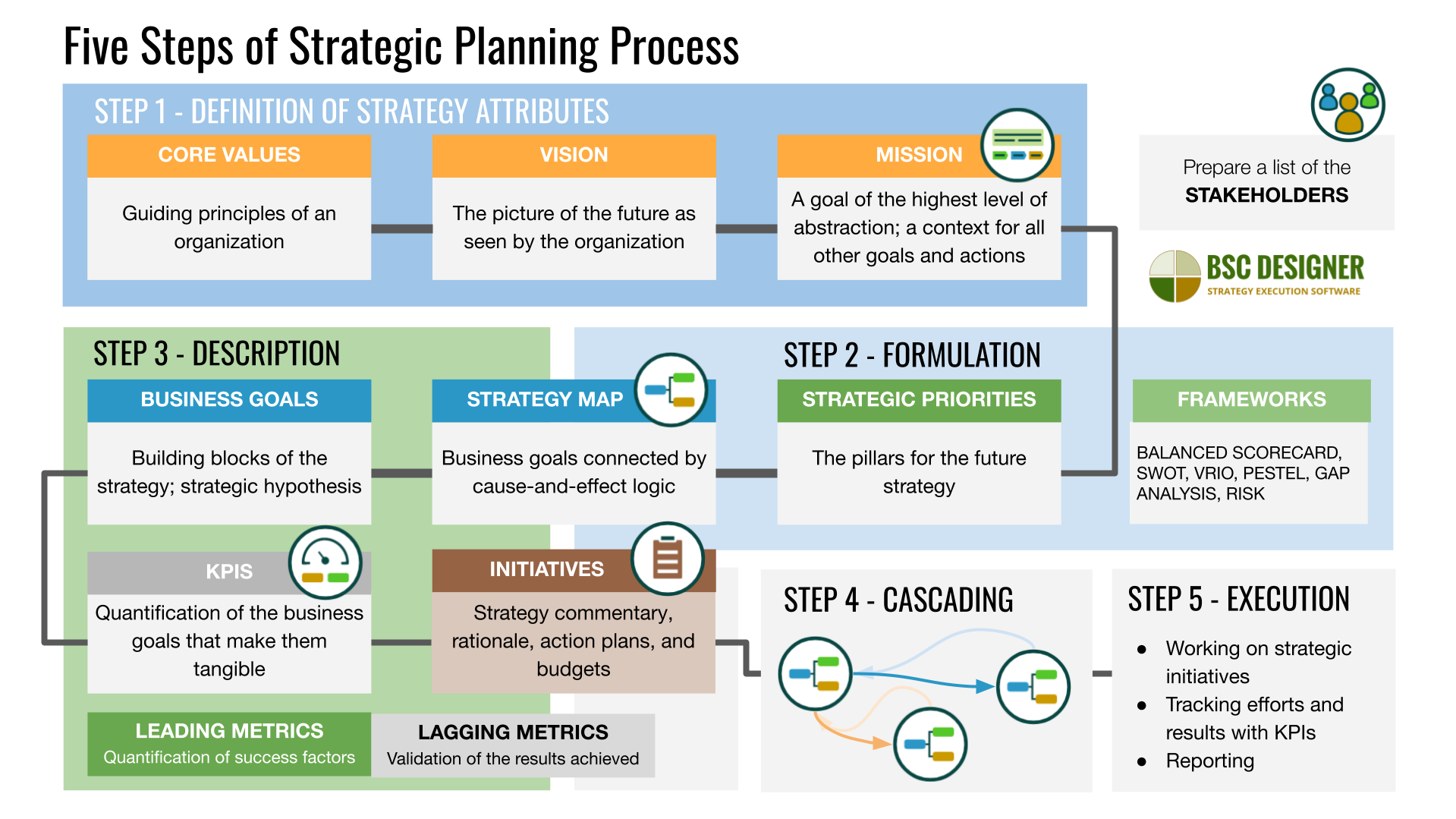
There are 5 steps in the strategic planning process (five levels of abstraction for strategic planning):
- Preparation. Stakeholders
- Step 1. Definition of strategy attributes: Mission, Vision, Values
- Step 2. Strategy formulation: Frameworks, Strategy Commentary, Strategic Themes, Prioritization
- Step 3. Strategy description: Objectives, Strategy Maps, KPIs, Initiatives, Budgeting, Risk
- Step 4. Cascading
- Step 5. Execution
 BSC Designer for immediate access to 31 scorecard and KPIs templates.
 Prepare a List of the Stakeholders
The stakeholders are the persons or systems that have an interest in the organization. A stakeholder can affect or can be affected by the organization.
Analysis of the stakeholders is common for any management domain. In the ecosystem of strategic planning, we will use the list of the stakeholders to understand the challenges of the organization better and make strategy more focused.
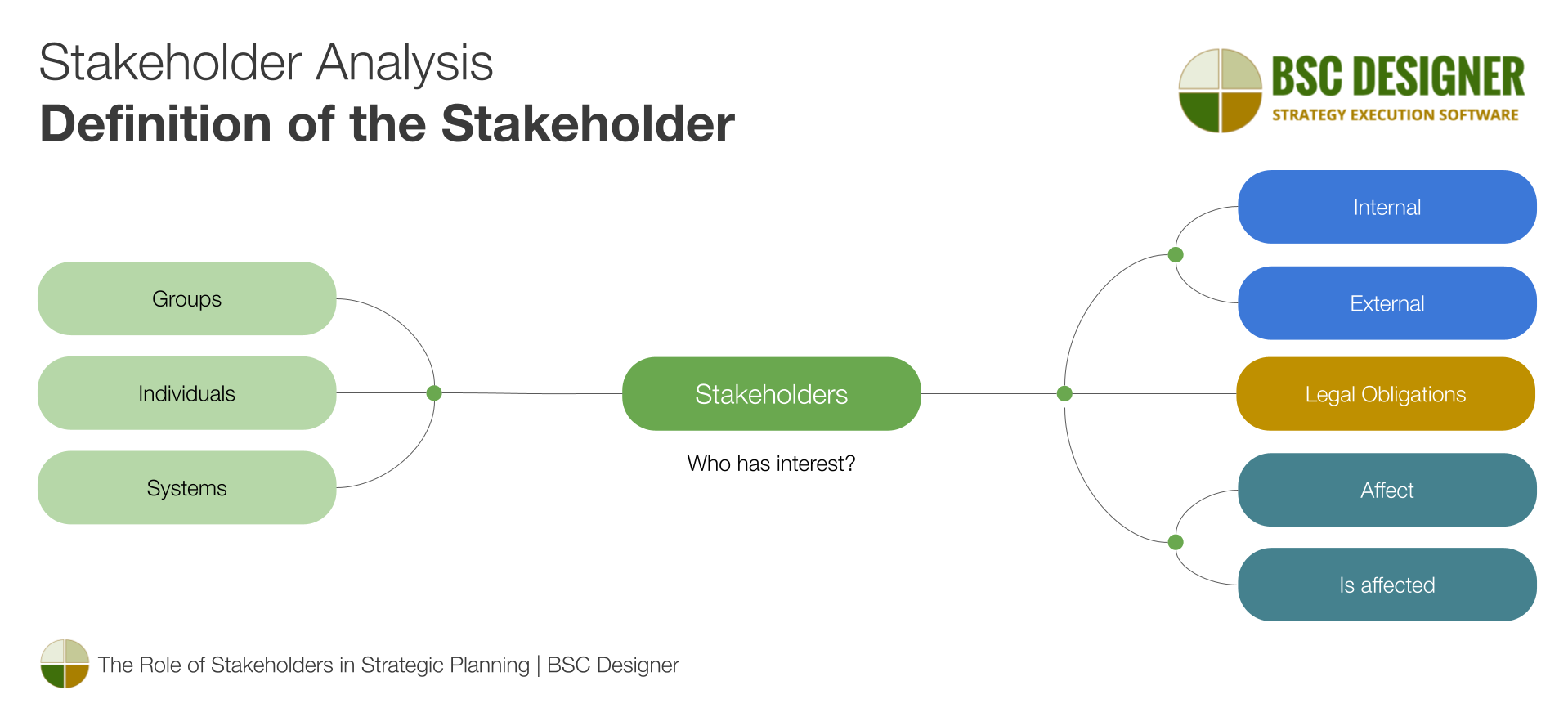
Business Roundtable has defined the five basic types of stakeholders:
- Customers
- Employees
- Suppliers
- Communities
- Investors
To reflect different interests of the stakeholders from the same group, we can define subgroups of the stakeholders. For a more technical explanation, check out Gilb’s glossary.
Stakeholders of BSC Designer
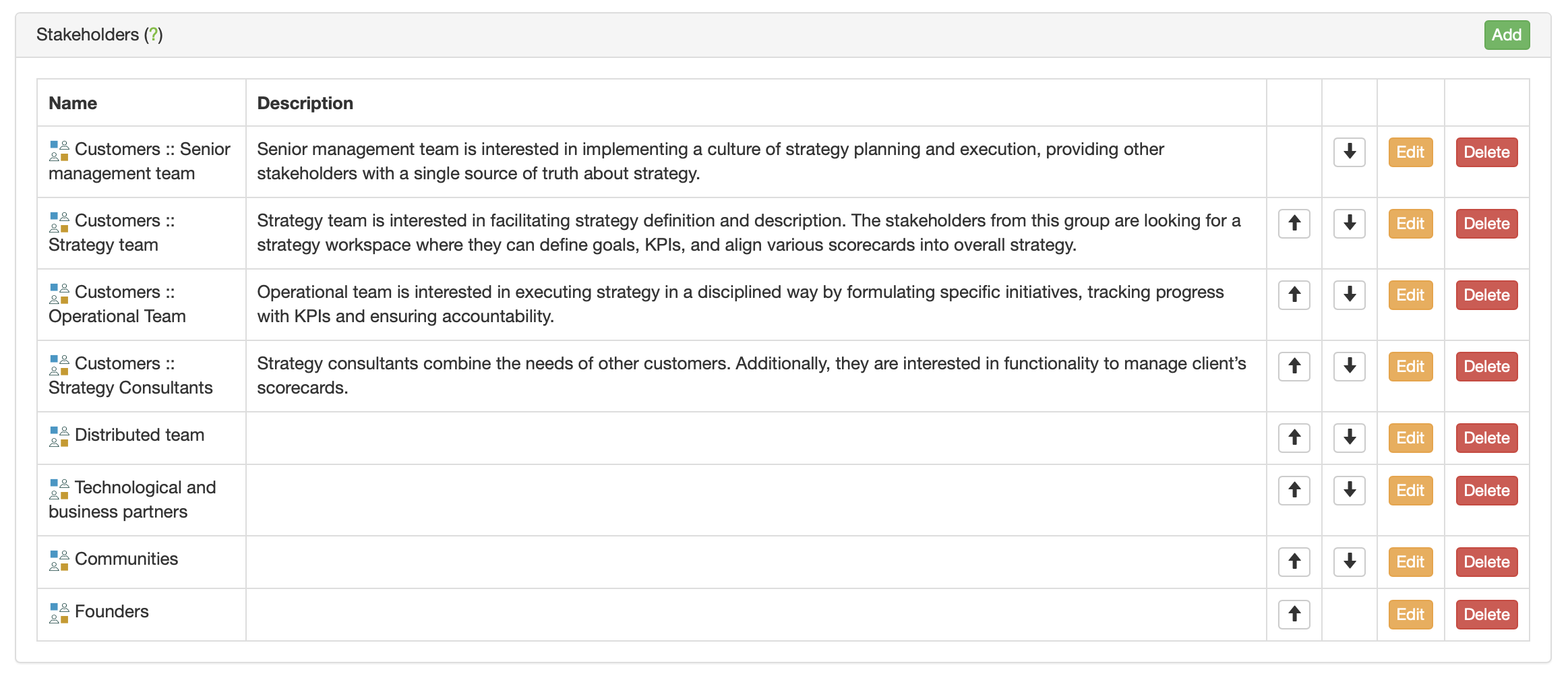
In case of BSC Designer, the five classical stakeholders look like this:
- Customers (see the subgroups below)
- Distributed team (instead of Employees)
- Technological and business partners (instead of Suppliers)
- Communities
- Founders (instead of Investors)
For the Customers group we define subgroups and their interests:
- Senior management team is interested in implementing a culture of strategy planning and execution, providing other stakeholders with a single source of truth about strategy.
- Strategy team is interested in facilitating strategy definition and description. The stakeholders from this group are looking for a strategy workspace where they can define goals, KPIs, and align various scorecards into overall strategy.
- Operational team is interested in executing strategy in a disciplined way by formulating specific initiatives, tracking progress with KPIs and ensuring accountability.
- Strategy consultants combine the needs of other customers. Additionally, they are interested in functionality to manage client’s scorecards.
Step 1. Definition of Strategy Attributes
In strategic planning, the level of highest abstraction is one where we discuss the mission, vision, and values.
Organizations create mission/vision statements (see below for some thoughts about the difference between the terms) for two main reasons:
- A formal one: follow the common trend and have something to show to investors;
- A practical one: use them as building blocks of corporate culture and focus the team’s efforts.
1.1. Mission/Purpose: The Most Important Goal of the Organization
On the strategy map, we have some strategic goals.
Mission is a goal of the highest level of abstraction, a context for all today’s goals and actions.
BSC Designer Mission
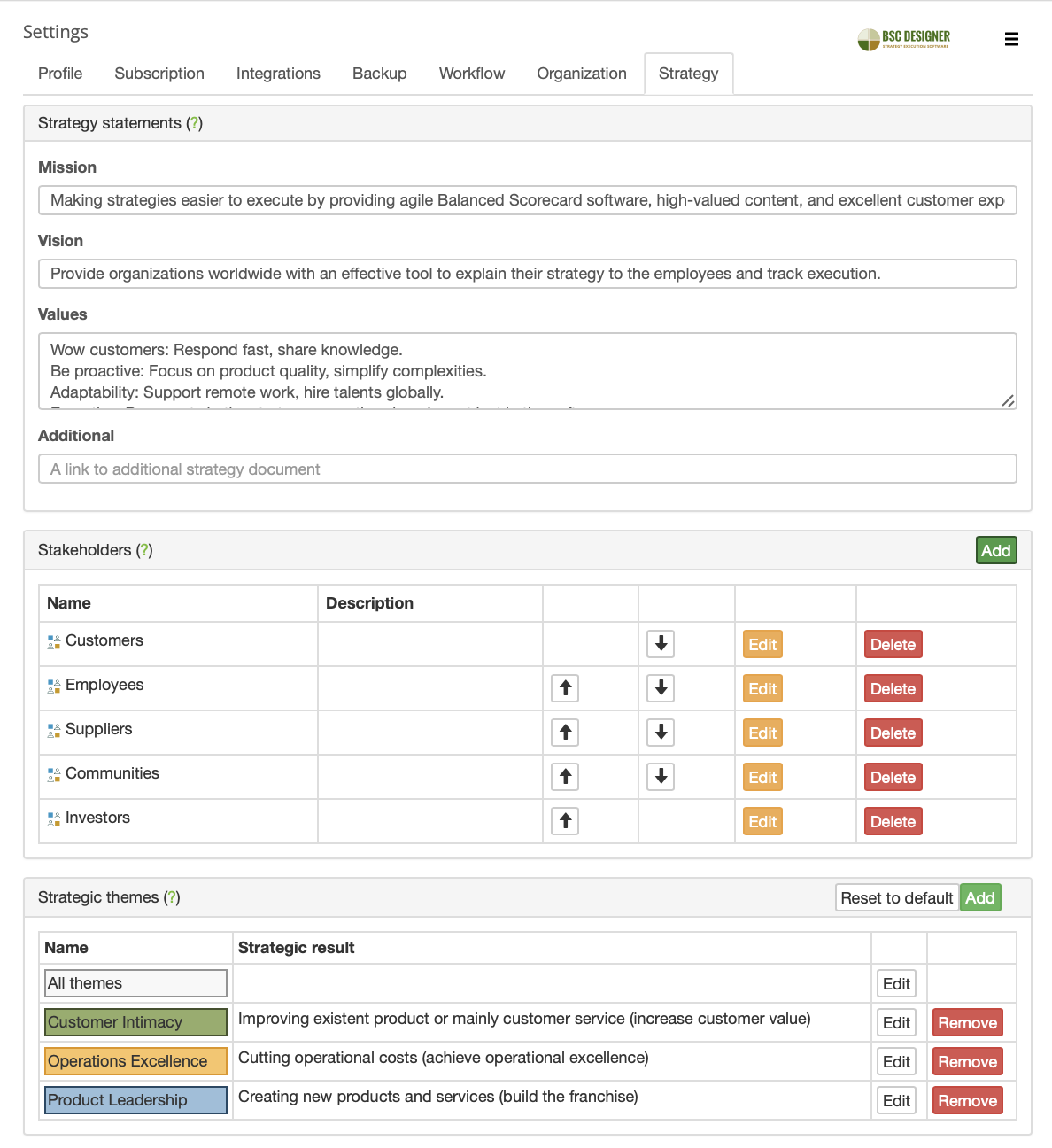
Making strategies easier to execute by providing agile Balanced Scorecard software, high-valued content, and excellent customer experience.
Example of Good/Bad Mission
An excellent example of a good/bad mission statement might be the Apple company.
- Back in 1980, Apple’s mission was based on the inspirational rhetoric of Steve Jobs. He used such phrases as “digital media revolution” and “a contribution to the world.”
- Now, Apple’s mission statement does not seem to be formulated at all. You can follow the story in the article1 by Henry Blodget published on Business Insider.
A good mission statement inspires your team. Bad mission statements are generic, boring and don’t provide any guidance. Find more thoughts on the topic in the LinkedIn post by Bernard Marr.
1.2. Vision: The Way An Organization Sees the Future
With mission, we have the highest level of abstraction of the company’s goals. Now we are changing the planning horizon from today to the future.
Vision describes the future as seen by the organization.
BSC Designer Vision
Provide organizations worldwide with an effective tool to explain their strategy to the employees and track execution.
1.3. Core Values: Guiding Principles of the Organization
Core values are the backbone of any organization.
Core values are the principles by which an organization works.
Whatever an organization does, it is supposed to be aligned with its values. Let’s talk about what these values are and how to implement them properly.
Examples of Core Values
Similar to the typical business goals, core values also follow certain patterns:
- Customer-related values
- Team-related values
- Product-related values
- Leadership values
- Sustainability and growth values
- Personal values and qualities
Let’s look at some examples grouped into these categories.
Customer Values
- Exceed expectations
- Wow customers
- Friendly service
- Care for others
- Client Satisfaction
- Be the customer of your product
Team Values
- Collaborating
- Sharing (skills, experience, knowledge)
- Diversity, Inclusion, Equity
- Learning from mistakes
- Celebrating success, Having fun
Product Values
- Quality (see the quality scorecard)
- Excellence in Design
- Simplify
Leadership and Management Values
- Lead by example
- Empowerment
- Entrepreneurial spirit
- Accountability
- Transparency
- Safety (see the safety KPIs)
Sustainability Values (based on 3 pillars of sustainability)
- Social responsibility
- Economic sustainability
- Environmental sustainability
- Curiosity, Creativity
- Self-Improvement
- Self-Discipline
- Continuous Improvement
- Open Mindedness, Questioning Old, Risk-Taking
- Innovations (see the innovations scorecard)
Personal Values
- Integrity
- Trust
- Respect
Declared Values vs. Followed Values
How often we see companies that declared they are:
- Innovative, sustainable, accountable, and transparent,
but
- They show exactly the opposite behavior.
In this case, an organization basically tells its employees that “values are just a formality!”
To improve the company’s performance, it’s not enough to compile a list of values. The values should be followed.
Companies where employees perceive that top managers follow the declared values show stronger performance.2
What does it mean to follow values?
- You should hire by values
- Plan and execute with your values in mind
- Reward following your values
BSC Designer Values
Here are the values that we follow in BSC Designer:
- Wow customers. Respond fast, share knowledge.
- Be proactive. Focus on product quality, simplify complexities.
- Adaptability. Support remote work, hire talents globally.
- Expertise. Be experts in the strategy execution domain, not just in the software.
1.4. Test Your Mission, Vision, and Values in Challenging Situations
Have you ever seen a company that has “being customer-centric” among their values but actually don’t respond to client’s emails within one week?
- Values that are not aligned with actions do more harm than good.
If you found a significant difference between your values and your actions, you can either update your values to more realistic ones or adjust your behaviour patterns according to the values.
In calm waters, most corporate values seem to work. Test your values in crisis time!
1.5. Setting Strategy Attributes in BSC Designer Software
Users of BSC Designer can specify their mission/vision/values directly in the software (see the  > Settings > Strategy tab). The strategy statements can be global for the whole company as well as customized for a scorecard.
BSC Designer for immediate access to 31 scorecard and KPIs templates. Step 2. Strategy Formulation
As demonstrated by the authors of “Strategy Safari,”3 there are at least 10 schools of strategy that explain different approaches to the strategy and the ways to formulate it. You can be a follower of a certain strategy school, but there are some key components that exist in any good strategy.
According to Richard Rumelt (“Good Strategy. Bad Strategy”4), a good strategy includes three components (called “kernel” by the author):
- A diagnosis – a hypothesis about the reason of the challenge that the company face,
- A guiding policy – a hypothesis about the solution to the challenge, and
- Coherent action – a hypothesis about what might help, e.g., a company’s response to the challenge.
2.1. Frameworks That Help to Generate Strategic Hypotheses
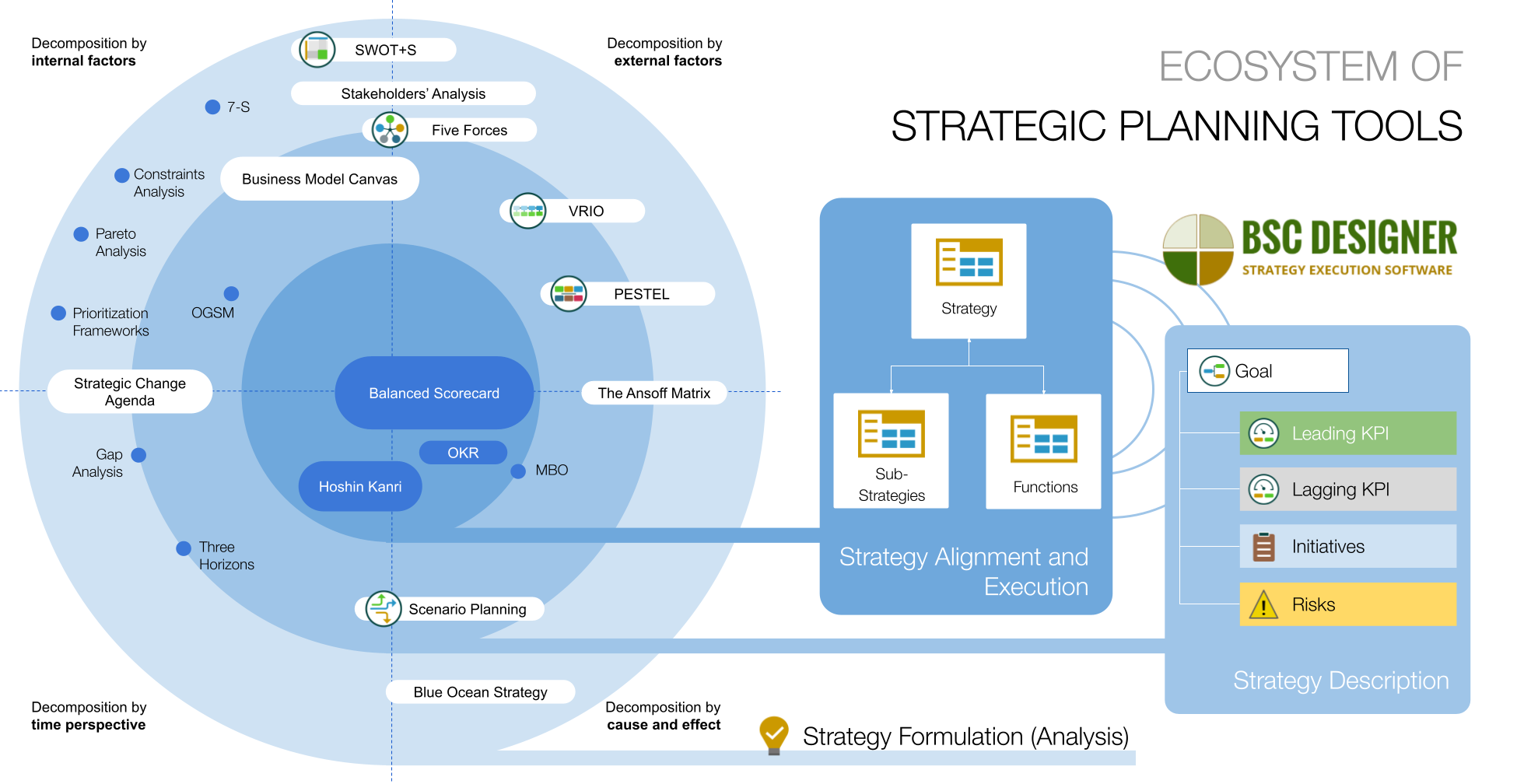 Under the umbrella of “strategy planning,” we can group various business tools that play some role in formulating a hypothesis about what might work:
- SWOT analysis – for reviewing a company’s options from the positions of strength, weakness, opportunities, and threats. Or its improved version – SWOT+S.
- PESTEL analysis – for an analysis of the external environment.
- VRIO analysis for resources and capabilities.
- Risk Management – for formulating risk assessment and risk control plans.
- Strategy gap analysis – to compare current performance against expected results.
- TOC analysis – to understand where the limiting performance bottlenecks are.
- Prioritization frameworks – that help to prioritize operational goals.
It is also useful to define:
- Constraints – limits applied by resources, technology, skills, etc.
- Customer needs to define later Customer Value Proposition.
Is this the full list? For sure, no. An executive’s toolkit includes some more popular tools.
2.2. Strategy Commentary Document
In the next step, we will need to convert strategic hypotheses generated with some of the frameworks into the form of the strategy map with specific objectives that will be linked with each other by cause-and-effect connections.
A strategy map cannot include all of the supporting ideas and your reasoning (strategic rationale), include these ideas into supporting documentation, Strategy Commentary.
Strategy commentary might be a 2-3 page document that explains the logic that was followed to formulate the current strategy.
Strategy Commentary in BSC Designer
Create a new initiative and describe the supporting ideas and rationale there:
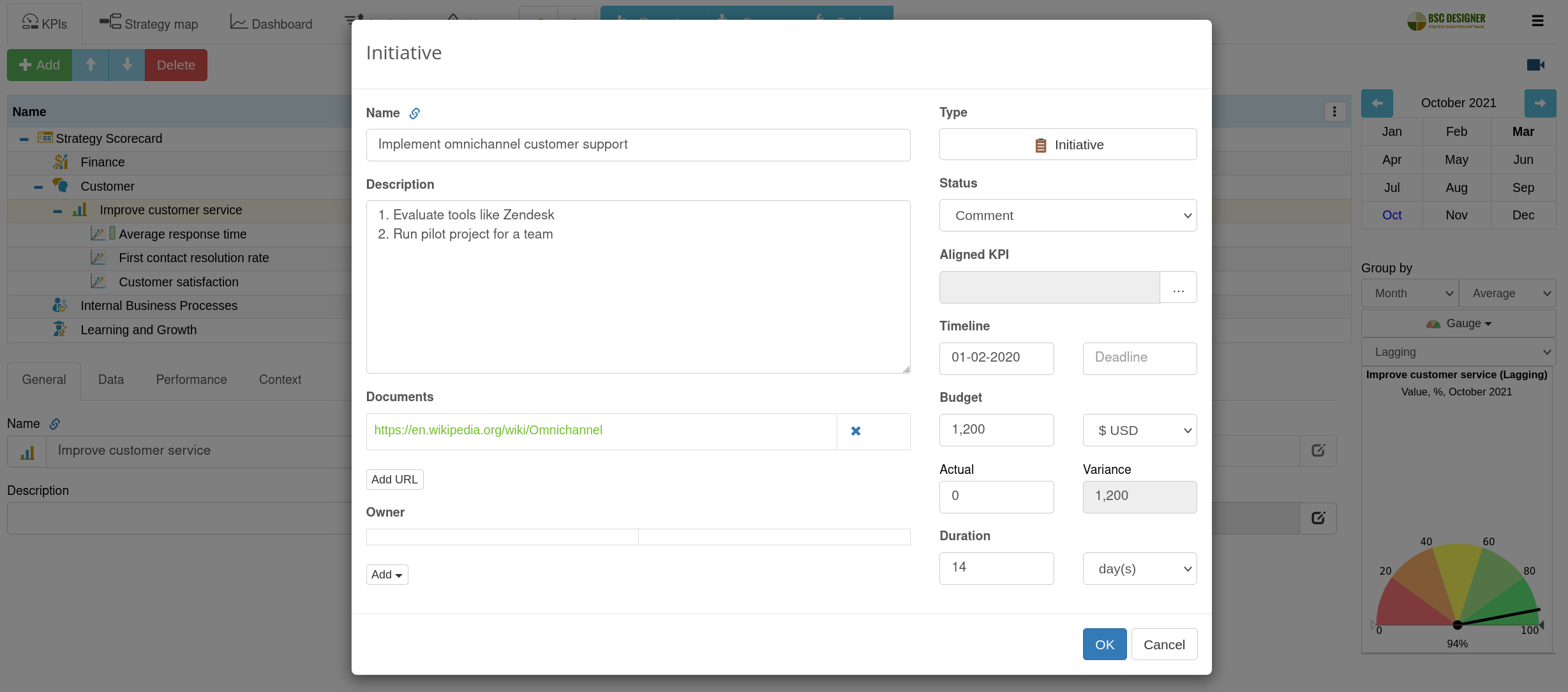
BSC Designer for immediate access to 31 scorecard and KPIs templates. - Use the description field for the goals and KPIs to explain their meaning
- Link additional documents to the initiative if needed
- Specify budget and time information
2.3. Strategic Themes
Among all possible factors of successful mission achievement, we need to pick a few that will be our priorities.
The two popular terms to describe this choice are:
- Strategic priorities, or
- Strategic themes
What are these themes?
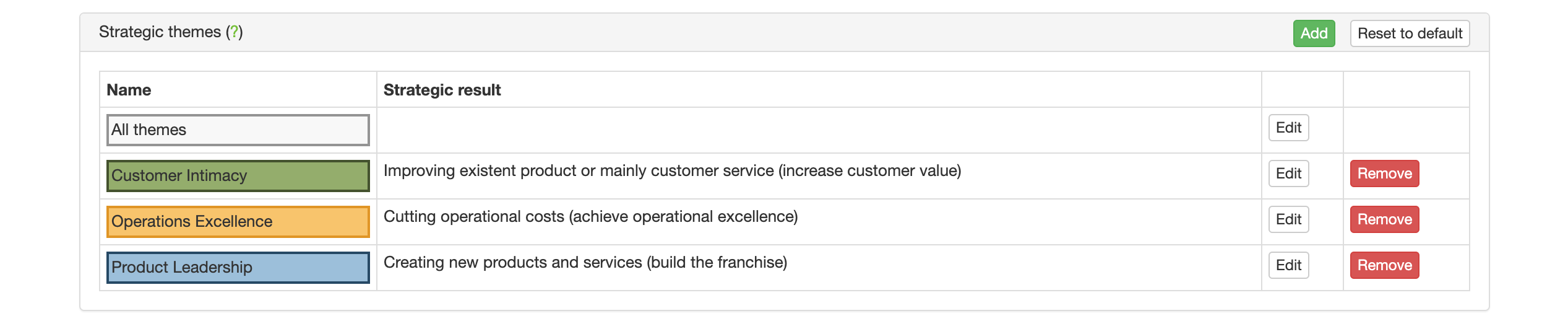
BSC Designer for immediate access to 31 scorecard and KPIs templates. It depends on the context. If we are defining an overall strategy of the organization, then they can be:
- Product excellence
- Customer service
- Excellence in operations
If, for example, we are in the product team and focusing our development efforts, then these themes might change to more specific ones:
- Perceived product quality
- Customer onboarding experience
- Easiness to maintain
These themes will be the pillars of the strategy.
Different authors approach strategic themes in their own way. For example, in the Balanced Scorecard by Kaplan and Norton,5 these themes are:
- Product Leadership Strategy (building the franchise)
- Customer Intimacy Strategy (increasing customer value)
- Operational Excellence Strategy (achieving operational excellence)
Another approach, Porter’s generic strategies6 sound similar:
- Differentiation (creating unique product and service)
- Focus (specialized service in a certain niche)
- Cost leadership (achieving lower costs, for example, by focusing on operational excellence)
Another popular framework, McKinsey’s Three Horizons, approaches the challenge of sorting out thoughts about business growth. It suggests focusing on three time horizons and distribute efforts accordingly.
Focus on One of the Strategic Themes
While we have several top priorities, the idea is to achieve excellence in one of these themes to make it a core competence. The other themes should be executed on a good level.
- McDonald’s company is good in customer service, but their focus is on effective operations
- Alcoa is good in operations, but their focus is on workers’ safety
- Zappos sells good products, but their main focus is on customer experience
The Problem of an Excessive Focus
The idea of focus has its disadvantages. Companies stop seeing new opportunities, and they might think that focus is everything. It is not. As Richard Rumelt in “Good Strategy. Bad Strategy” said: “It would be nice if focus always meant more profits. But it just isn’t so.”
A solution?
Look at the “Growth Values” category discussed above. Make sure that your company has an appropriate environment for innovations. Before, we discussed the way organizations can build a scorecard for innovation process.
Strategic Priorities of BSC Designer
- Product leadership. Deliver professional Balanced Scorecard software that is easy to get started, fairly priced, and make the life of the strategist easier.
- Relationship with customers. Quick and effective communication with customers via customer service, expert articles, and educational videos.
- Operational excellence. Optimize business processes with three pillars of sustainability in mind.
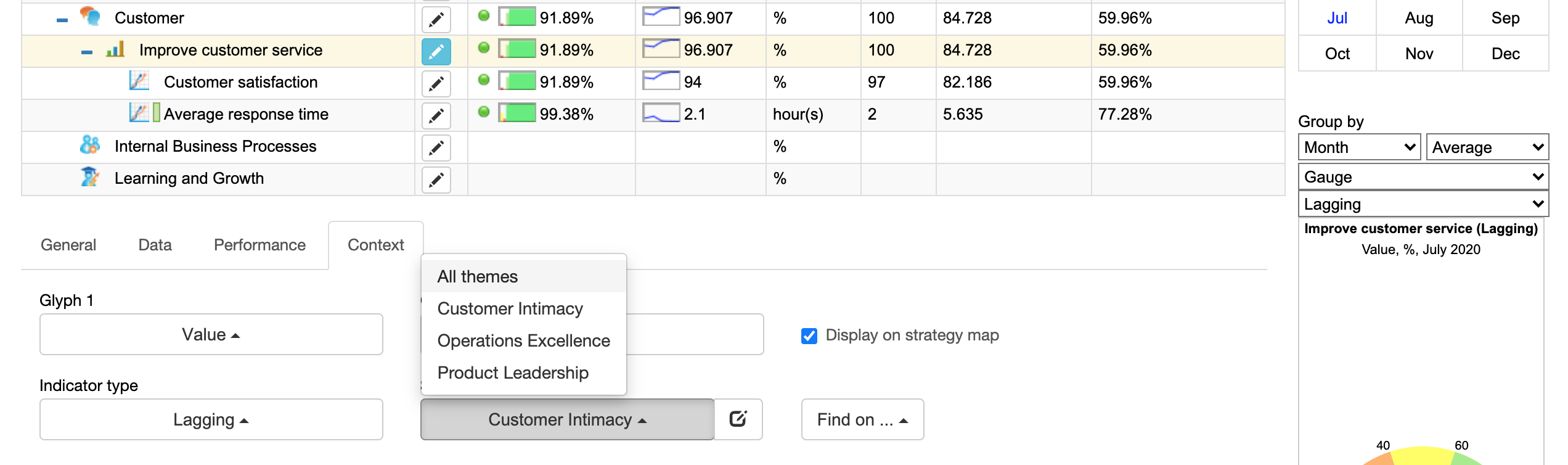
Strategic Themes in BSC Designer Software
Switch to the Context tab for a goal or KPI to change a strategic theme:
BSC Designer for immediate access to 31 scorecard and KPIs templates. 2.4. Strategy Prioritization for Operational Goals
Strategic themes or strategic priorities help to organize top-level choices of the organization. What about choices on the operational level? How can we decide about priorities for specific goals?
In this case, strategic themes will be a starting point for prioritization. For example, we can filter some ideas that don’t fit any strategic themes. Still, we would have a long list of goals. How to prioritize those goals?
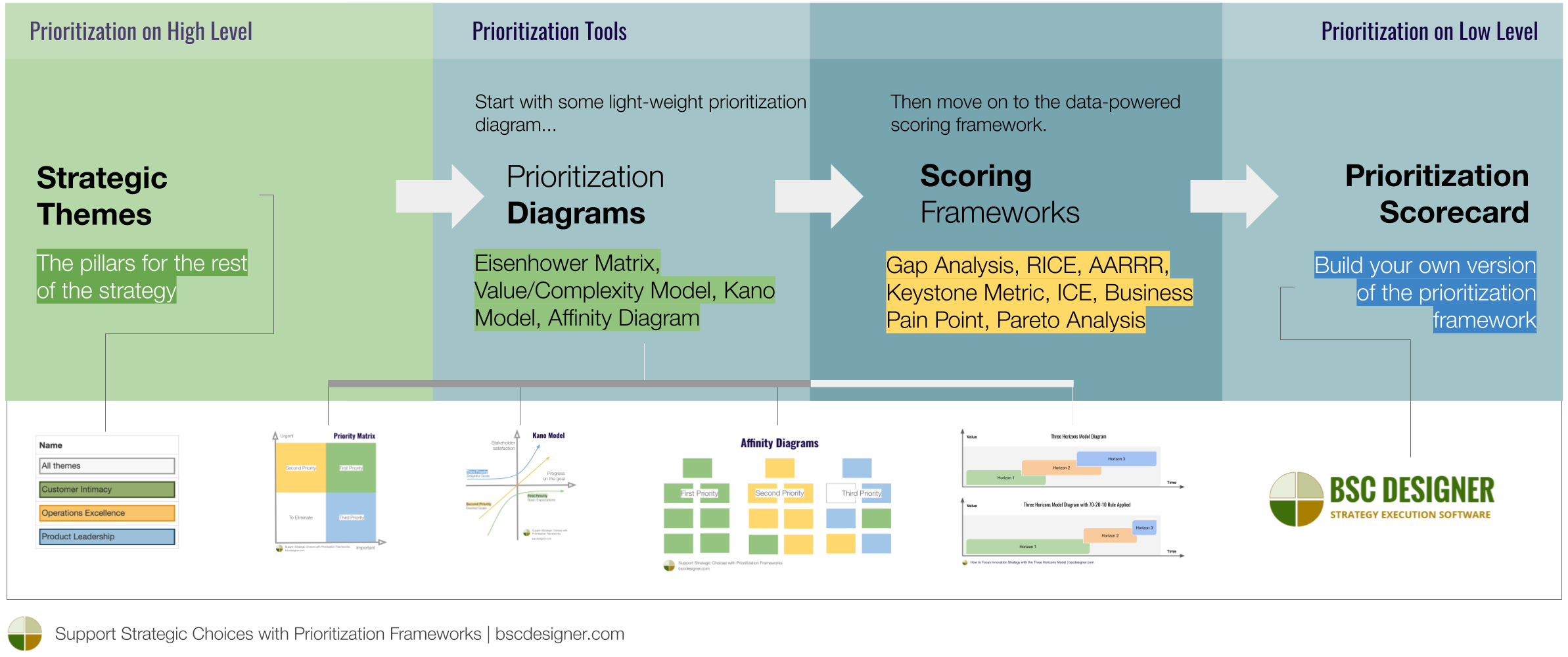
There are many frameworks that address this challenge:
In essence, all of them are about defining certain parameters (more specific priorities derived from strategic themes) and evaluating goals against those parameters.
The evaluation process might be as simple as placing goals into the four-sector Prioritizes Matrix or multi-factor prioritization according to several parameters and their weight (importance). In this article, we have discussed some prioritization frameworks, as well as a specific approach to calculating priority scores.
Step 3: Strategy Description
We started with the mission that defined a goal of the highest level of abstraction. Then we discussed the strategic priorities that are on the lower level. What’s next? Business goals!
3.1. Business Goals and Objectives
Business goals are more specific parts of a company’s strategy.
- They formulate a hypothesis about how an organization can achieve desired results
- There is a cause-and-effect logic that can connect them and form a strategy map
In the previous article, we discussed two typical questions about business goals:
- What’s the difference between an operational goal and a strategic one?
- How can the separate goals be converted into the strategy?
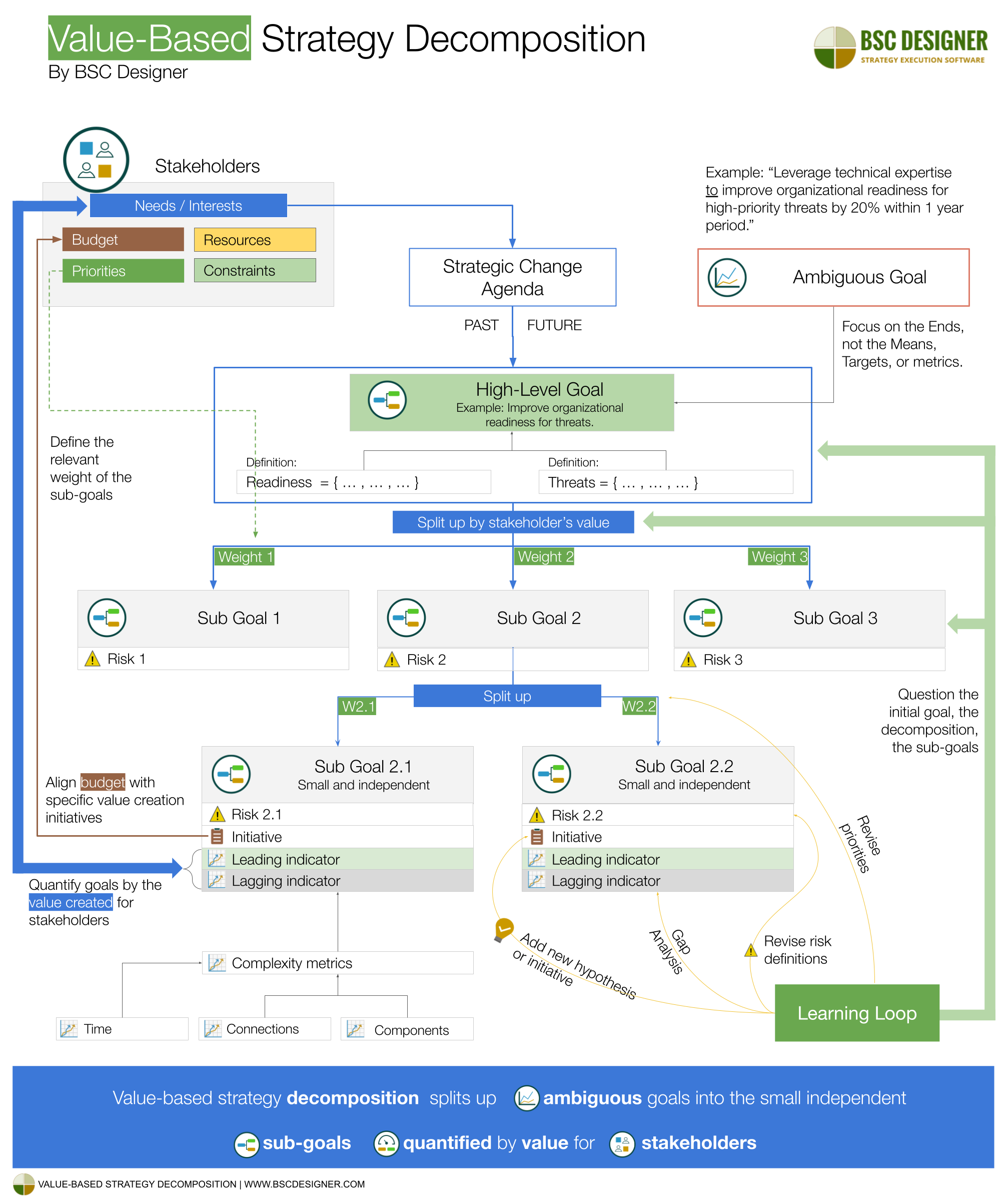
The initial goals are typically vague and ambiguous. We need to define them better and split them up into more specific, tangible parts. The process is called goal decomposition.
- In a typical process-based decomposition, the sub-goals are formulated according to their functional context. While this approach is easier to follow, it doesn’t ensure alignment with the interests of stakeholders.
- With value-based decomposition, we are looking at the initial goal through the prism of stakeholders’ value and break it down until the level of sub-goals and initiatives, where a sub-goal can be quantified with the value created for stakeholders.
3.2. Strategy Map
In this step, we need to place business objectives on the strategy map. It’s important to catch the cause-and-effect connections between them. As discussed before in Strategy Maps: A Guide for Getting Started,7 the cause-and-effect logic is not always shown as an arrow; sometimes, it is just mentioned in the strategy commentary document.
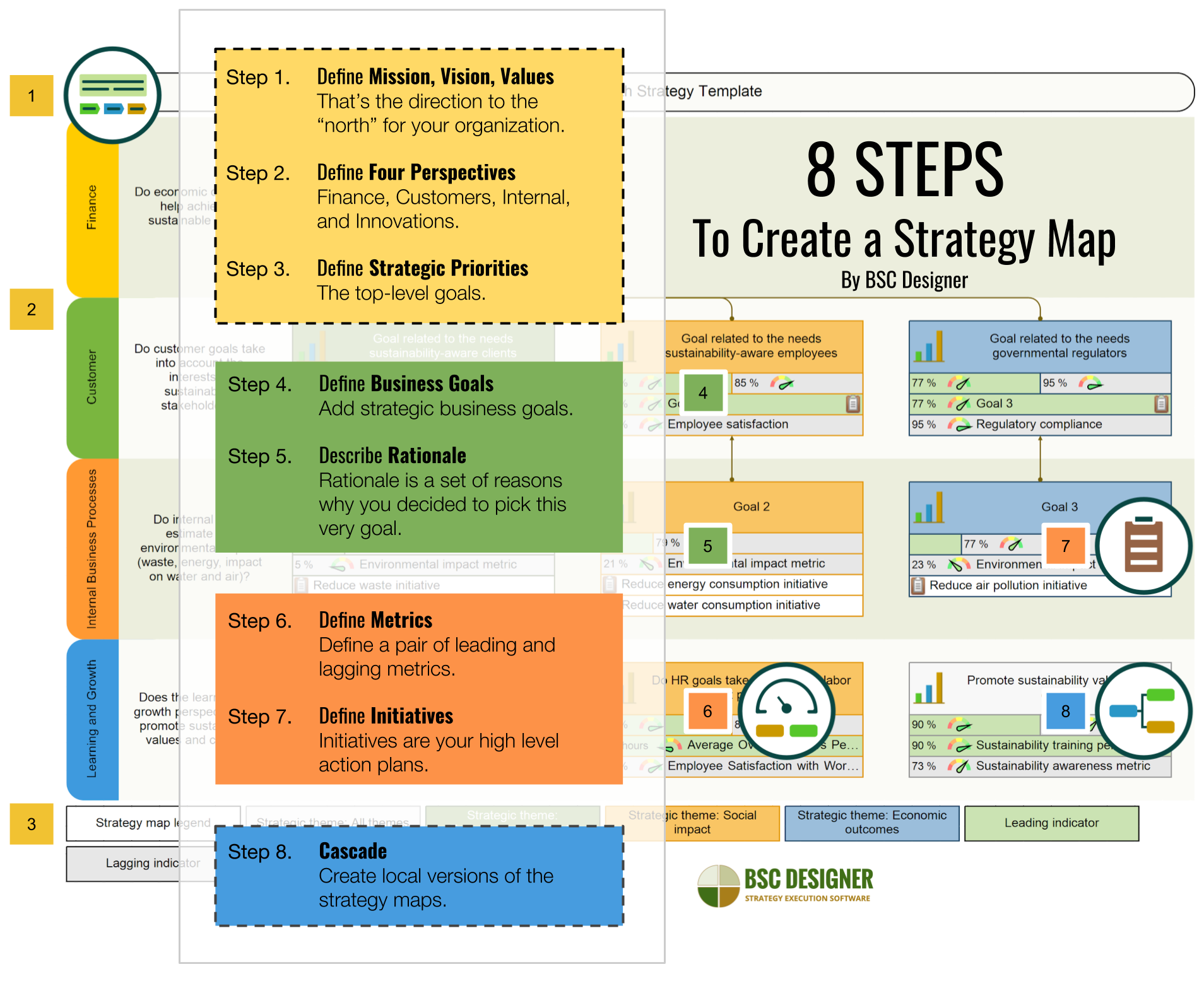
The strategy map term was popularized by the authors of the Balanced Scorecard, the strategy execution framework. This framework suggests using four perspectives to describe strategy:
 Financial Perspective
- Customers Perspective
- Internal Business Processes Perspective
- Learning & Growth Perspective




It’s important that any objective on the map have:
- An owner(s) responsible for it,
- Strategic initiative that provides a proper business context (action plan, rationale) to achieve the objective, and
- Metrics (KPIs) that tell that the company is on the right track.
3.3. Making Goals Tangible with KPIs
We have mission as a highest level of abstraction. Then we have the pillars of our strategy – strategic priorities, then come business goals that are more specific but still not detailed enough.
How can we make the goals more tangible? We need to quantify them!
Let’s take Maintain excellent conditions for the team goal as an example. We can make it more specific by quantifying it in different ways:

We can look at:
- Fast response to the safety issues as a leading factor of safe environment, or
- Track average overtime hours per person as a lagging indicator to make sure that the working environment is becoming safer
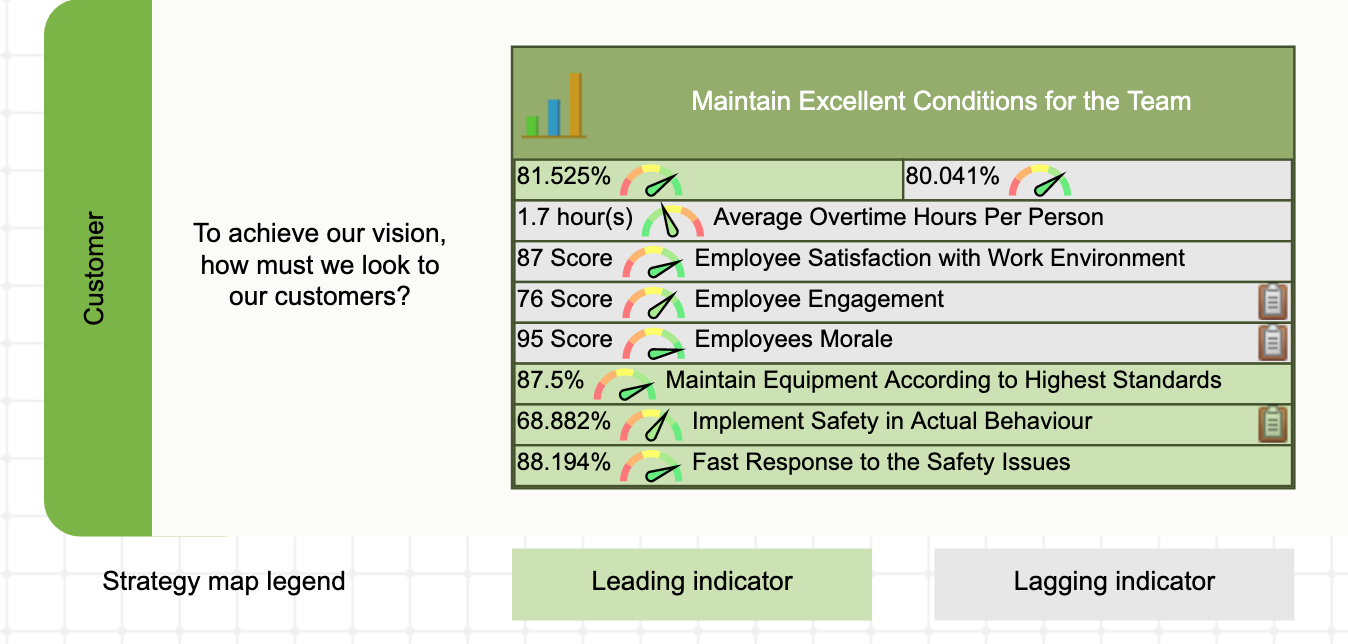
BSC Designer for immediate access to 31 scorecard and KPIs templates. We discussed this specific case in the safety KPIs article.
Besides solving the problem of making goals more tangible, with the KPIs, we introduced an effective tool to monitor the execution of strategic plan.
Leading and Lagging Metrics
An ideal situation is when there is at least one leading and one lagging metric associated with each objective. Here, we explained the difference.
Needless to say that to monitor strategic plan effectively, one needs to specify respective targets, thresholds, and benchmarks.
Finding Metrics
Metrics cannot be just copied from the list of popular KPIs.
A good metric needs to be formulated during the discussion around the strategy.
It needs to be aligned with business objectives and needs to pass validation (confirm that this metric is measurable, realistic, and aligned with business goal). Use this KPI Template to get started with your new metrics. More ideas about metrics and their validation were discussed in “KPI System.” 8
3.4. Initiatives or Action Plans
We moved from a very abstract mission statement to relatively specific goals measurable by the KPIs. The final level of abstraction in strategic planning is execution controlled by the action plans and initiatives. Here is where we can apply our project management skills, assign budgets, timeline, define more specific priorities, and have full control over execution.
Users of BSC Designer can align initiatives with business goals or KPIs, assign budgets, persons responsible, and timelines:
BSC Designer for immediate access to 31 scorecard and KPIs templates. 3.5. Strategy Budget
A side product of the strategy description is that it is possible to give a rough estimation of the strategy budget – a cost of the future strategy execution. I did not include budgeting as a separate step, as strategy planning should not be reduced to the budgeting.
In the context of strategy execution, we are interested in a top-level view on budget:
- Budget assigned to each goal
- Budget actually used
- Budget variance – the difference between assigned and used budgets
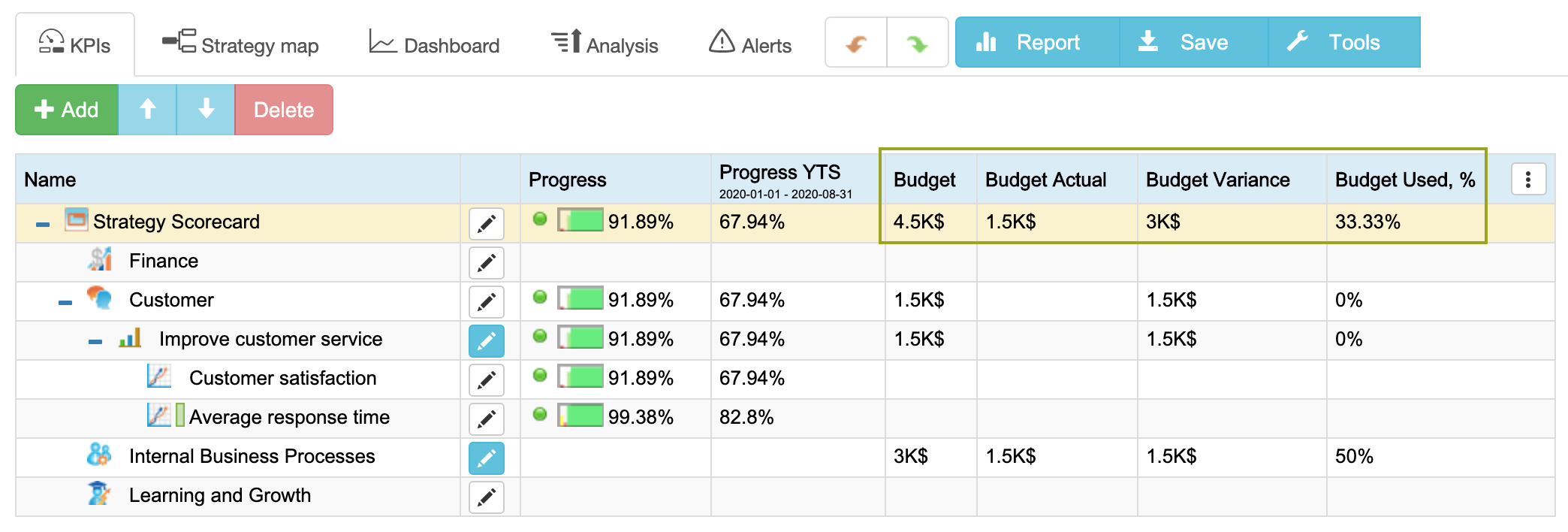
BSC Designer for immediate access to 31 scorecard and KPIs templates. A strategy scorecard is a hierarchy of the goals, and we can assign several initiatives each with its own budget to any goal. With all this information, we can calculate:
- The available budget for specific initiatives
- The overall budget for a business goal, taking into account all its initiatives
- The budget for the perspective with many sub-goals
- The cost of strategy – the total budget for the whole scorecard
The total budget for a scorecard will be an estimation of the cost to execute the described strategy.
3.6. Risk
Typically, a goal is defined from the positive perspective – we focus on what will be achieved and what value we will create. For effective strategy execution, we must also think about the other side – the possible risk. Each strategic objective should be supported by identified risks.
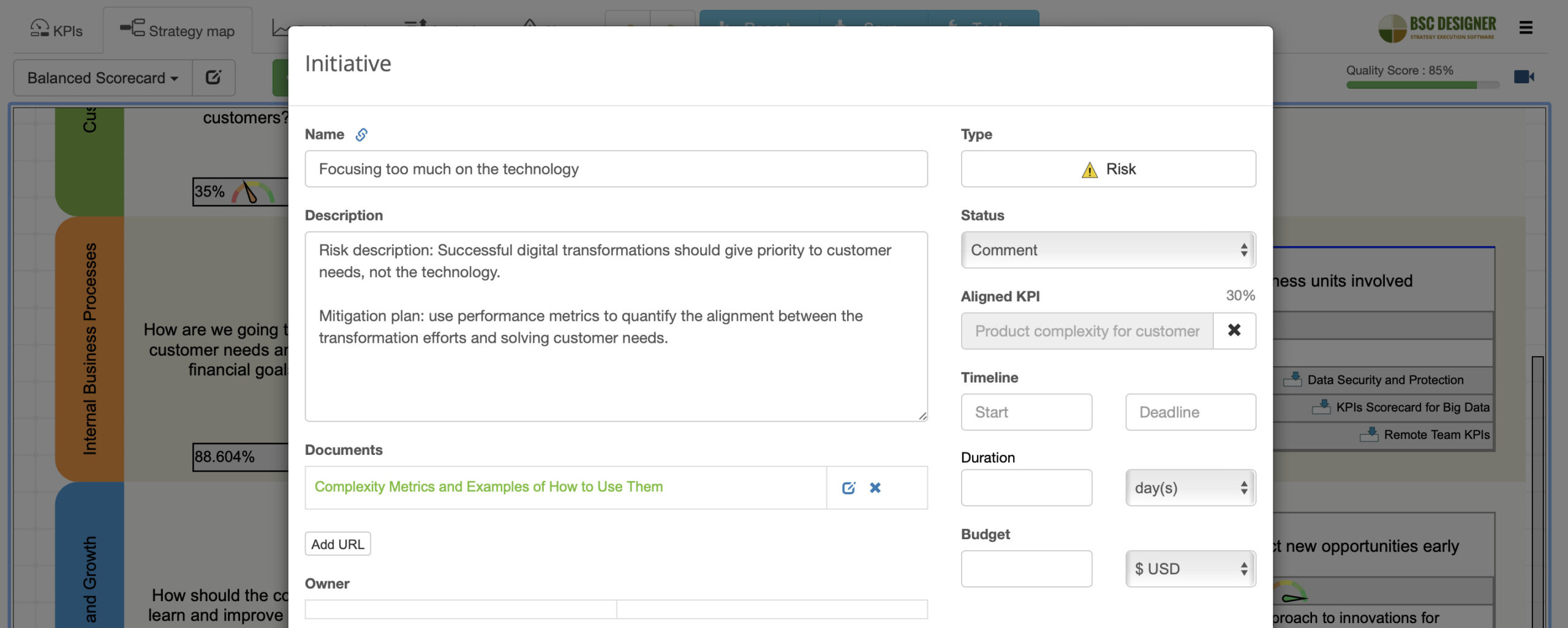
A risk is well described when there are:
- Risk definition
- Risk mitigation plan
- The way to quantify risk (KRI) with thresholds that define risk appetites
Learn more about the best practices of managing risks.
Step 4. Strategy Cascading
In simple words, a strategy alignment (cascading) is a discussion around business goals that helps participants to understand how desired business outcomes can be achieved on a certain business level (alignment of business objectives, initiatives, and action plans), and how the success/failure can be measured (alignment of respective measures).
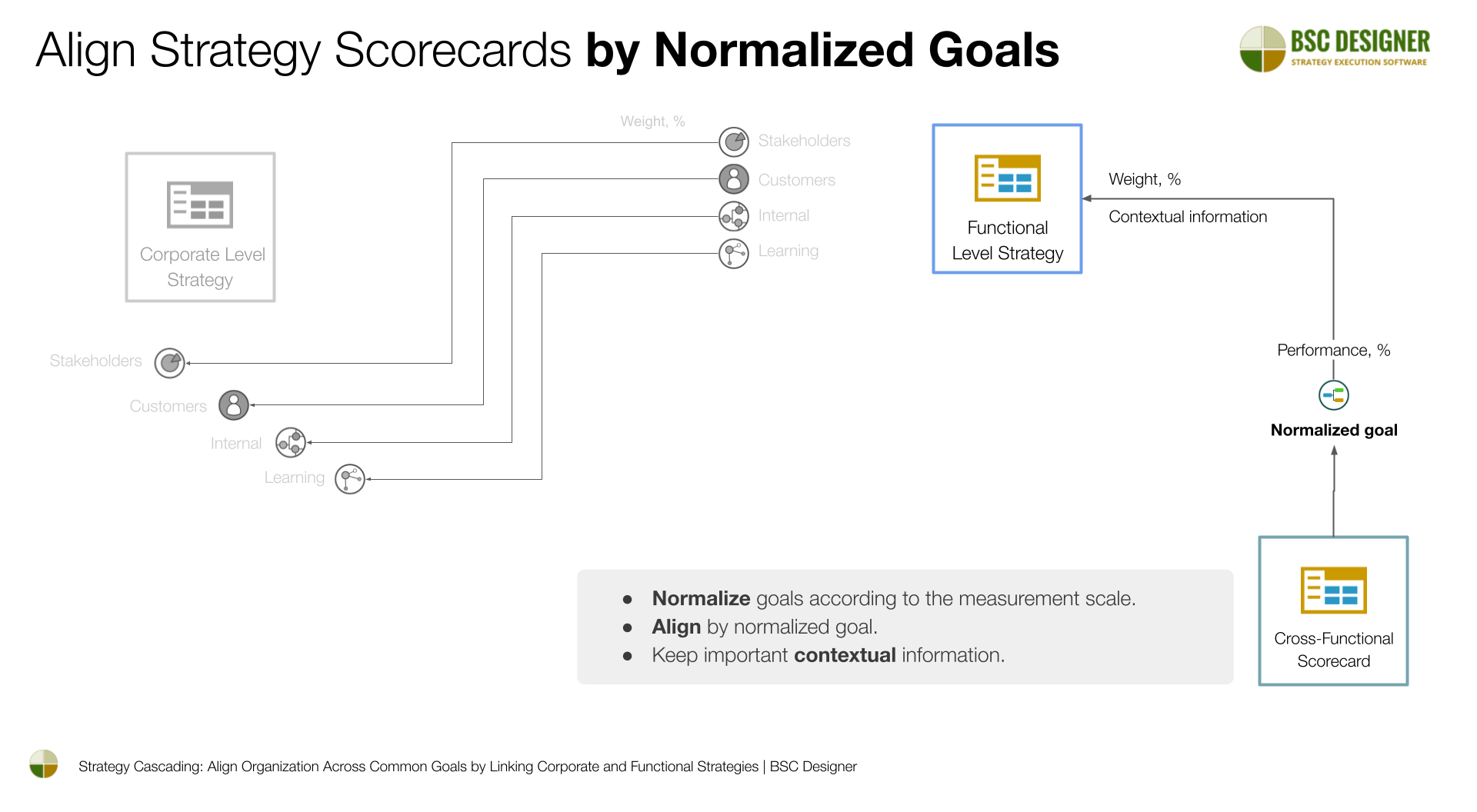
Strategy is not just for the top management (Tier 1) only. The idea is that everyone in the company, including business units (Tier 2) and employees (Tier 3), are aware of the strategy and understand how their job is linked to the ultimate goal (achieving company’s vision).
On the diagram, Strategy Alignment is a separate section, but it should not be treated as a separate step of the strategy process.
Bi-Directional Cascading:
The alignment process doesn’t need to be top to down, actually, in the best case, it is bi-directional.
This means that department managers are involved in strategy discussion in the early stages. The resultant strategy will reflect various perspectives, and will be much more realistic. One of the best realizations of this idea is the Catchball process from the Hoshin Kanri method.
Cascading in BSC Designer
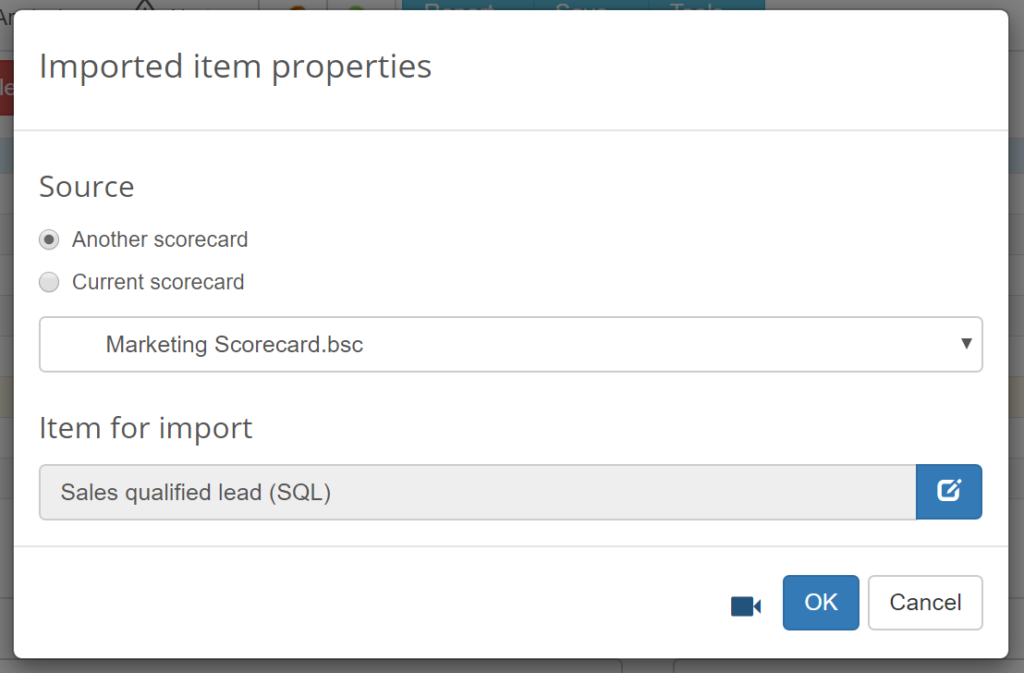
In BSC Designer, you can create separate scorecards for each business unit and connect them in the way you need. Using this approach, you can build not only hierarchical links but link goals in more agile, OKR-style.
Step 5. Strategy Execution
Once a strategy is formulated and cascaded, we can start the strategy execution. A well-defined and described strategy in front of your eyes will be your company’s navigation system.
- Strategy map will help to focus the company’s resources on the important objectives
- Leading and lagging metrics will help managers to track the execution process
- Aligned/cascaded objectives will make strategy everyone’s job
Strategy Planning and Execution Software
Does the use of strategy execution software make sense? For sure, one might survive using old-school tools like MS PowerPoint or MS Excel to catch important ideas about a company’s strategy.
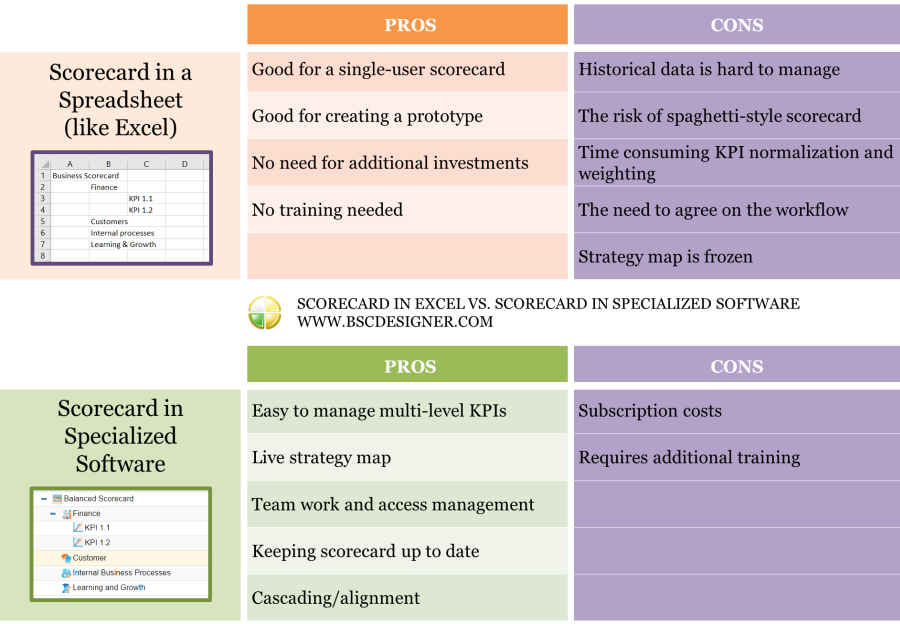
Actually, Excel is a great tool to build a prototype of a strategy scorecard.
When the strategy discussion is done:
- Regularly and
- Involves many persons,
A professional strategy execution software will be a good investment.
We’ve also shared some best practices concerning the challenges of procuring strategic planning software.
Strategy Execution with BSC Designer
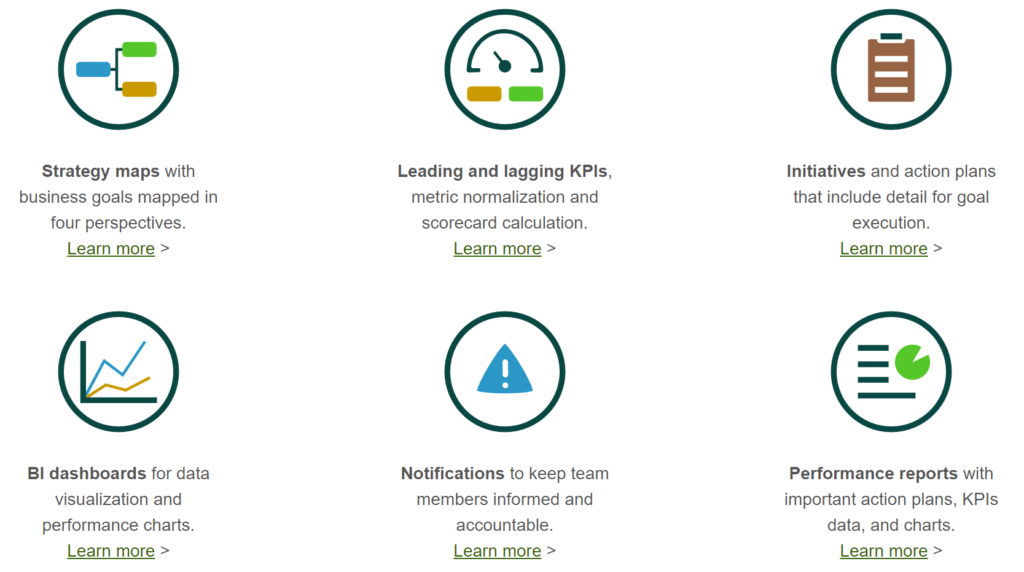
BSC Designer is a strategy execution software recognized by business professionals all over the world. Here is how it can help your organization with strategy execution:
- Automate strategy maps
- Keep track of KPIs
- Facilitate reporting
- Keep the team informed via Alerts
- Analyze performance data
- Build BI dashboards
- Control access rights to the scorecards and KPIs
Frequently Asked Questions
Feel free to formulate your questions in the comments for this article or contact our team. Here are some topics that we discussed with our clients.
What is the Difference Between Mission and Vision?
The terms “mission” and “vision” are used interchangeably. Some authors say that “mission” is the purpose of the organization; others use the same explanation for the “vision” term. Some resolve this ambiguity by using just one term.
In this context, my main recommendation is simple:
Agree about the terms in your organization
In the article, I explained an approach that we use at BSC Designer, which has worked for many of our clients due to its simplicity (see the diagram in the beginning).
What’s the role of strategy meetings in strategic planning?
In another article, we discussed an example of doing a strategy meeting for a distributed team.
Strategy meetings follow the strategic planning process, focusing on few emerging challenges and limited number of stakeholders.
A starting “big picture” strategy can be designed in a day. Regular strategy meetings are how this strategy evolves over time.
What’s the Benefit of Having Formal Mission, Values, Priorities?
Do all organizations have their values and mission written down? Not at all! For example, a startup company first builds something useful, testing an idea. When it comes to seeking investments, they start looking for the right words to describe what they have done so far.
Does it mean that they had no values, vision or mission in the beginning? They had them, but those were personal values, a vision of the founder, and mission formulated as a hypothesis (we do that product and probably, people will like it).
Any organization has values and mission behind it, but not all of them have it formally described on the paper.
In my opinion, the formal description of mission, vision, values, and strategic priorities have some important benefits:
- It is a business self-analysis that helps to understand better what is important for you.
- It is a way to articulate the guiding principles of your culture and explain it to others (your team).
- Last but not least, they form your culture that will eventually lead your brand. And as Peter Drucker said: “Culture eats strategy for breakfast.”
How it works for BSC Designer
In our case, if someone asks me about BSC Designer and what makes us special, I can answer by looking at our values:
- If you want to learn more about strategy execution frameworks, then you will find a lot of ideas on our website, as we are not just building the software; we are writing books, participating in industry events, running a coaching program, doing workshops; we are experts in the domain.
- If you want to use our products, you can expect excellent customer service. We give out a lot of materials for free; for example, our ready-to-use Balanced Scorecard templates help business professionals get started easily with their KPIs/strategy tasks.
- If you work with us, then we will make it easy for you, as we like hiring talent all over the world. We look at your impact, not your schedule.
What is Strategy Deployment? How Does it Compare to Strategic Planning?
In practice, there is no agreement about the name for the process described above. Sometimes, it is called “strategy planning” or “strategy formulation.”
One of the alternative names is strategy deployment that comes from the Hoshin Kanri framework.
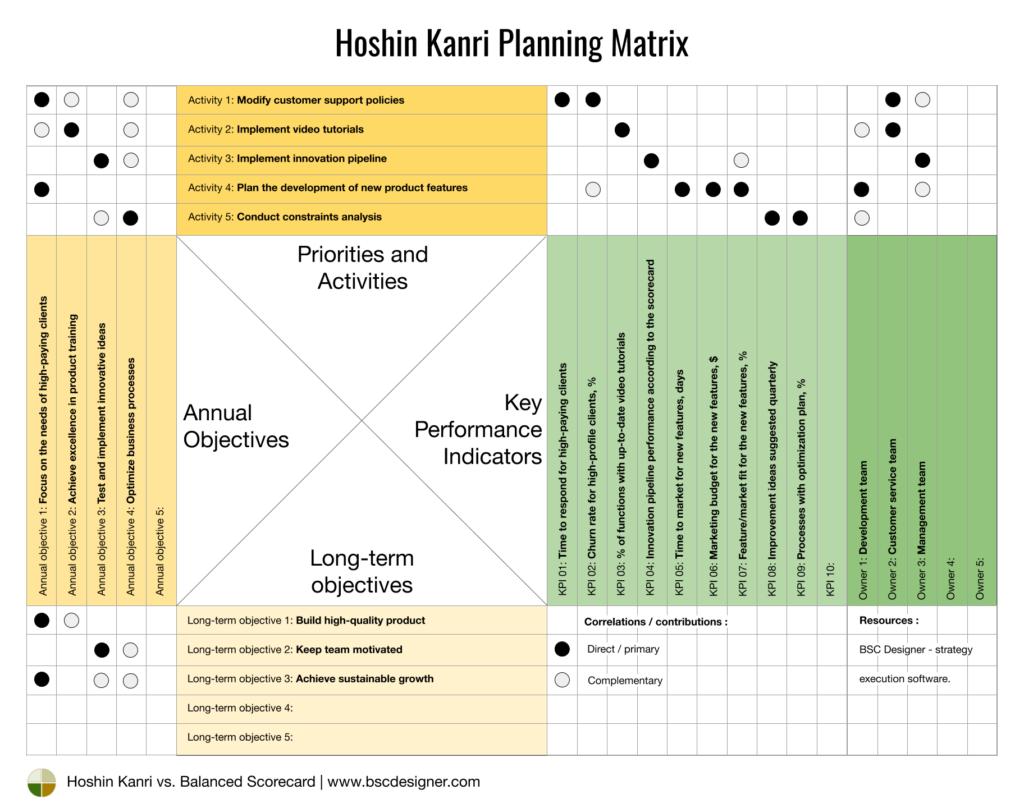
In essence, it is the same process that starts with higher levels of abstraction and moves to the lower levels defined by the performance indicators and action plans.
Can Mission and Vision Change?
Many strategy consultants insist that they should not, but I cannot agree with this. Our personal values and goals evolve over time, so why should organizations be different?
A good example is how the brand promise of Zappos changed over the years. The company’s CEO, Tony Hsieh talks about that in his book9:
- 1999 – Largest Selection of Shoes
- 2003 – Customer Service
- 2007 – Personal Emotional Connection
- 2009 – Delivering Happiness
Could Zappos or any other company start with such brand promise like “delivering happiness”? I don’t think so…
- In 1999, Zappos needed something more tangible, like “provide largest selection of shoes,” that was a good function-oriented mission.
Zappos implemented a focus on the client in their business DNA and by 2009, “Delivering Happiness” was the best explanation of their brand promise or mission.
How is the purpose of the company formulated now?
- To live and deliver WOW
Overview of Strategic Process
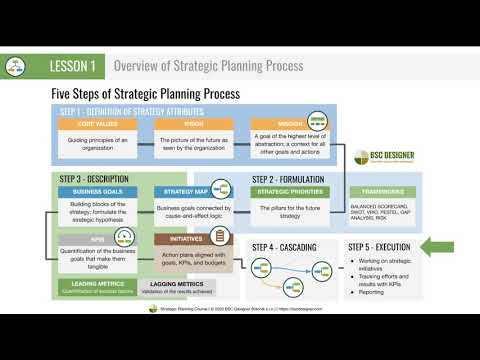
As a part of the free strategic planning course, we did a video overview of Strategic Process. You can join the free course or check out the overview vide below:
Summary
Let me summarize the key steps of strategic planning:
- Step 1. Definition of Strategy Attributes. Define the mission, vision, and core values of your organization.
- Step 2. Strategy Formulation. Use a diverse set of business frameworks to formulate the hypotheses of your strategy.
- Step 3. Strategy Description. Describe your strategy on a strategy map, align objectives with leading and lagging KPIs, write down strategy commentary.
- Step 4. Cascading. Explain what your strategy means for other business units and teams.
- Step 5. Execute. Use a strategy map and supporting documentation to execute your strategy. Track execution with KPIs.
Feel free to ask your questions and share your feedback in the comments for this article.
- Apple’s ‘Mission Statement’ is Making People Worry That the Company Has Gone to Hell http://www.businessinsider.com/apples-new-mission-statement-2013-8 ↩
- The Value of Corporate Culture Luigi Guiso, Paola Sapienza, Luigi Zingales NBER Working Paper No. 19557 Issued in October 2013 ↩
- Strategy Safari: A Guided Tour Through The Wilds of Strategic Management, Henry Mintzberg, Joseph Lampel, Bruce Ahlstrand, Free Press, 2005 ↩
- Richard Rumelt “Good Strategy. Bad Strategy. The difference and Why it Matters”, 2012, Profile Books LTD ↩
- The strategy focused organization. How Balanced Scorecard companies thrive in the new business environment. Robert S. Kaplan, David P. Norton, 2001, Harvard Business School Press. ↩
- Porter’s generic strategies, https://en.wikipedia.org/wiki/Porter’s_generic_strategies ↩
- Strategy Maps: A Guide for Getting Started, Aleksey Savkin, 2014, https://bscdesigner.com/strategy-maps-guide.htm ↩
- 12 Steps System for the Most Challenging Metrics and KPIs, Aleksey Savkin, 2014, https://bscdesigner.com/kpi-system.htm ↩
- Delivering Happiness. A path to profits, passion, and purpose, Tony Hsieh, Business Plus, 2010. Book’s website. ↩

 CEO | Author | Speaker
BSC Designer is strategy execution software that enhances strategy formulation and execution through tangible KPIs. Our proprietary strategy implementation system reflects our practical experience in the strategy domain.
Thank you for the presentation!