The OKR framework, idealized as a lightweight goal-setting tool for tracking the most ambitious objectives, is making its way to becoming a general-purpose strategic planning tool.
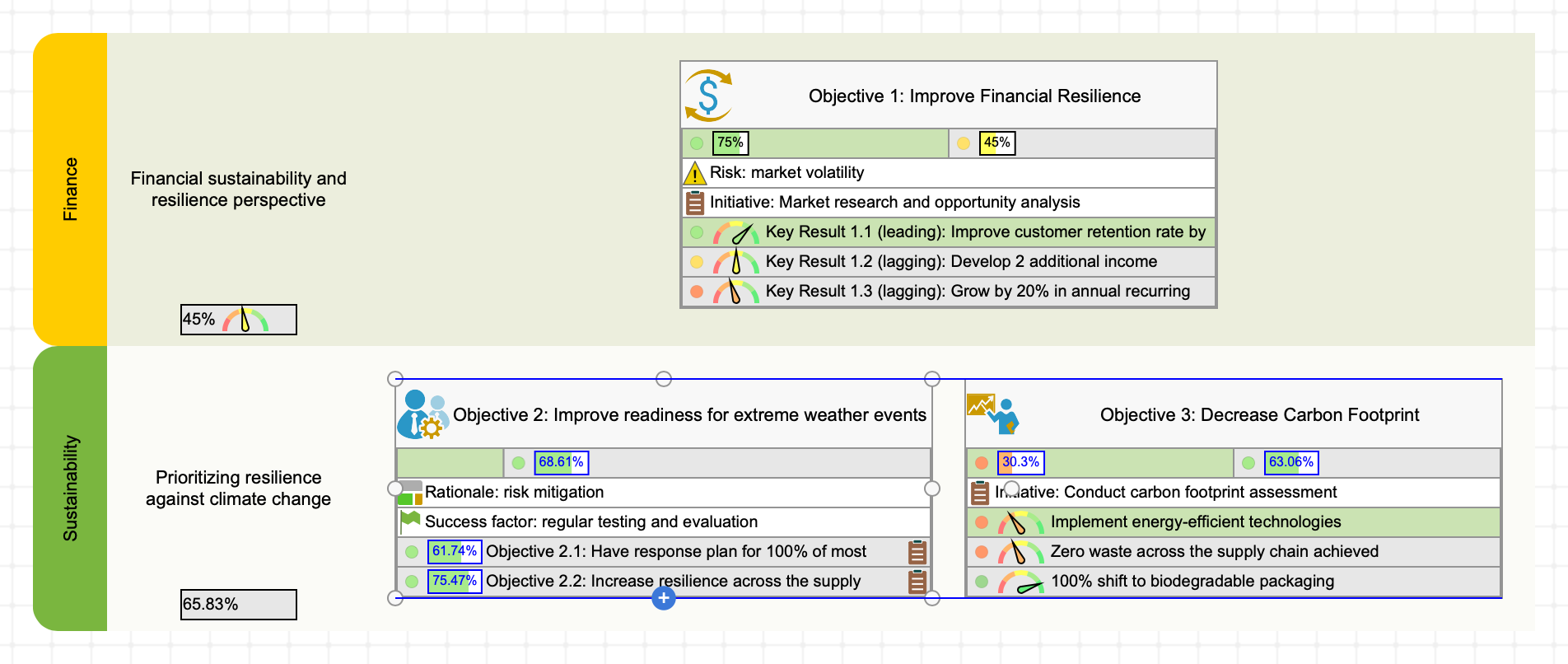
 OKRs - Example.
Content:
The Role of OKRs in Strategic Planning
Initially, OKR was a goal-setting framework with a focus on rather vague decomposition criteria – ambitious/inspirational goals supported by a few tangible Key Results. Today, its simplicity has led organizations1 to implement it for overall strategy planning and execution, creating competition for the Balanced Scorecard and Hoshin Kanri.
In our ecosystem diagram for strategic planning frameworks, we placed OKR in the Strategy Execution segment together with the Balanced Scorecard and Hoshin Kanri.
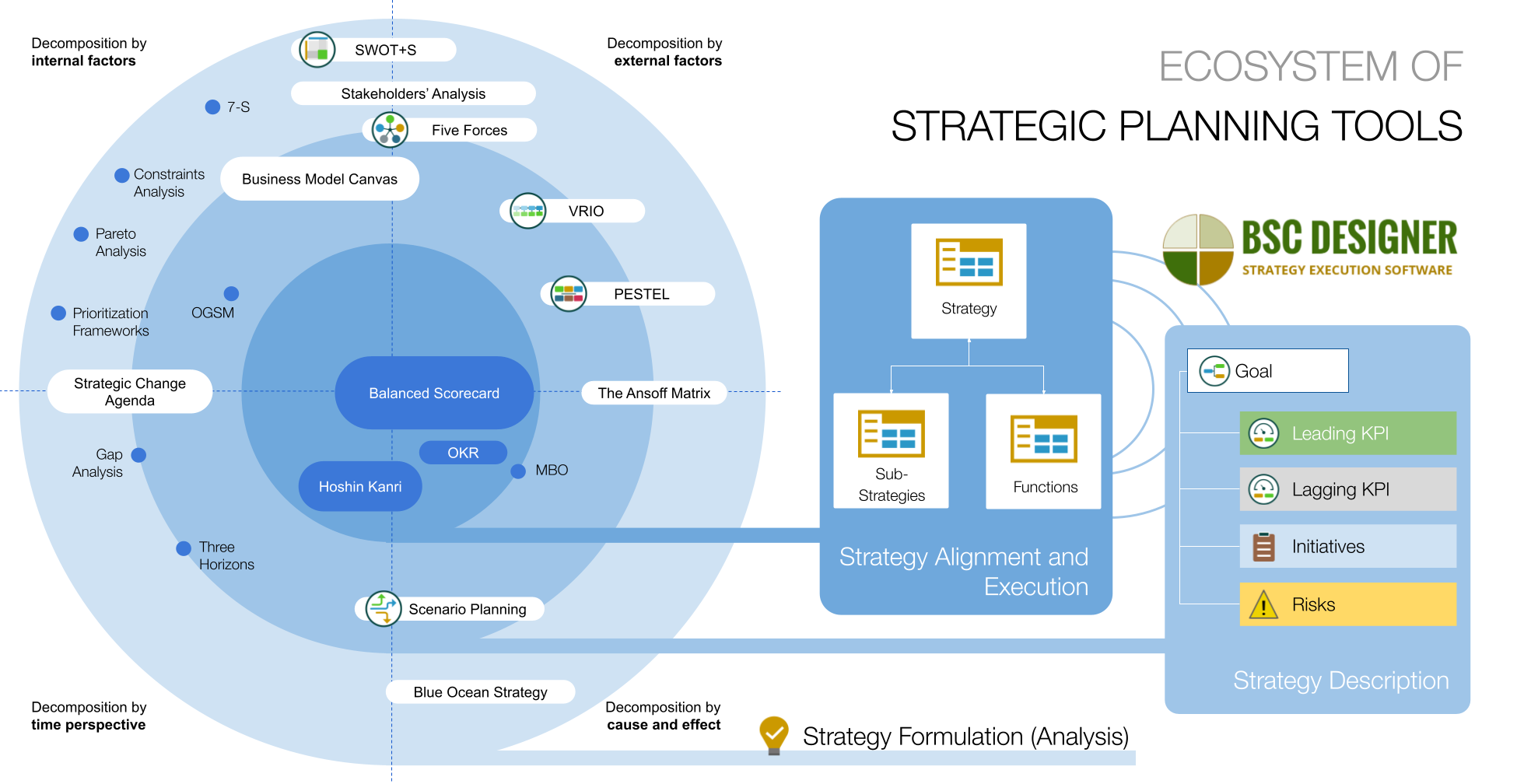
Ecosystem of Strategic Planning Frameworks.In OKR, we find the required building blocks for strategy description and execution:
- Definition of the objectives
- Quantification of the objectives with Key Results
- Defining risks and action plans for the objectives
- Alignment between objectives and functional strategies
By integrating OKR with strategy definition tools and perhaps some internal rebranding, the framework can be easily adapted for use as a primary strategic planning solution.
OKR – Best Practices
Let’s start with outlining some best practices for the practical implementation of OKRs:
- Track outcomes, not just outputs.2 Look beyond the immediate results of the activity to get to the results that have an impact on performance.
- Skip individual OKRs, especially for small companies.3 OKRs are meant to focus on high-level choices, not to create a list of things to do.
- Don’t link the reward system to the OKRs. Employees will find a way to game the system. Instead, use OKRs for self-assessment, replacing monetary rewards with intrinsic rewards.4
- Target a 70% success rate for Key Results.5 This criterion ensures that the objectives were ambitious enough.
- OKRs must be public within an organization.6 Encourage cross-functional OKRs where the objectives of one team are aligned with the objectives of another team.
- The OKR system is time-bound (normally reported quarterly) with weekly check-ins.7 The quarterly planning period helps to keep OKRs more agile and differentiates them from annual strategic planning.
Automation of OKR
Below, we will share some practical advice about automating OKRs using BSC Designer software.
We will talk about:
- Preparing workspace for OKRs
- Setting up Objectives and Key Results
- Cascading of OKRs and alignment with other strategy and functional scorecards
- Automating regular check-ins and final review of OKRs
Preparing Workspace for OKRs
Before setting up specific OKRs, let’s prepare a workspace.
Onboarding Team Members
Add members of your team to BSC Designer as users (via Menu > Users section) and organize them into teams.
Assign a user or a team to be an owner of OKRs. Owners will receive reminders about check-ins and other relevant notifications about their OKRs.
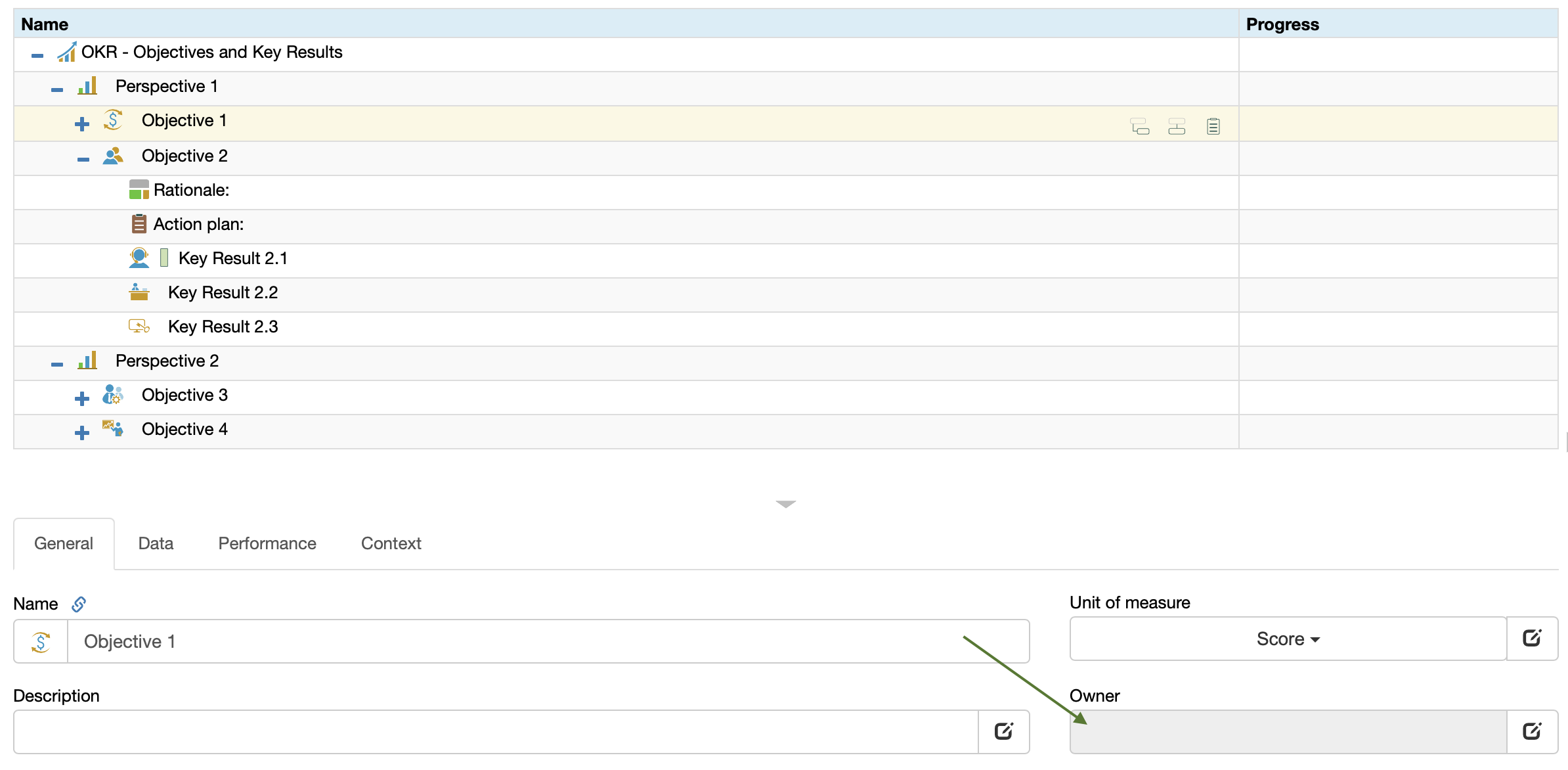
OKR Template.OKR Transparency within an Organization
One of the OKR best practices is to make team and individual OKRs visible across the organization. In BSC Designer, use the Share function to assign appropriate access rights to the OKRs.
A typical setup is that:
- All user teams have view access to all OKRs
- Owners have modification rights for their OKRs
Making OKR a Default Template
If OKR is the main strategic planning tool in your organization, you can make it a default template for all new scorecards.
- Create and open an OKR scorecard that you will use as a template for all new OKRs
- Select Tools > Save as a template
- Navigate to Menu > Settings > Workflow tab
- In Scorecard Templates, set the required template as the default one for new scorecards
Planning for OKR Retirement
At the end of the quarterly period, the OKRs will accumulate valuable information in the form of initiatives, rationales, and performance data of Key Results.
When it’s time to rewrite your OKRs, make a copy of the current version (My Scorecards > Manage > Copy) to use it as a reference for future analysis.
Setting Up Objectives and Key Results in BSC Designer
Below, we discuss the steps to set up OKRs in BSC Designer, including:
- Using the OKR template
- Setting up Objectives
- Setting up Key Results
- Adding Initiatives and Risks
- Customizing performance calculation
Creating OKR from a Template
A ready-to-use OKR template will facilitate the initial setup:
- Navigate to My Scorecards section
- Select New > New scorecard > More templates…
- Choose OKR from the business frameworks group
OKR Template.Create an Objective
The OKR template already has some template objectives. If you need to add a new one:
- Select a parent item for a new objective (a root element or another objective)
- Click the Add button on the toolbar

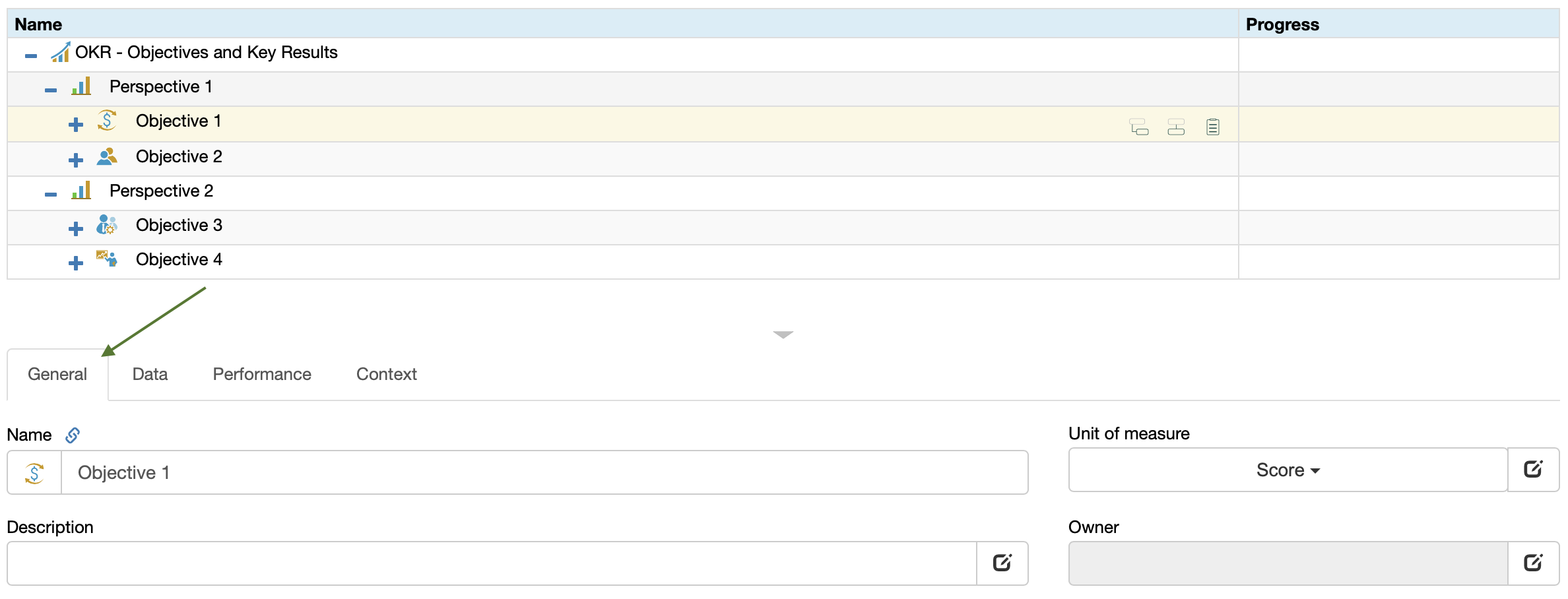
To modify the objective’s properties:
- Switch to the General tab to change the name of the objective
- Specify the description of the objective
- Use the Owner field to assign one of the users of your account as an owner
- Click on the Icon next to the objective name to change it
OKR Template.Create a Key Result
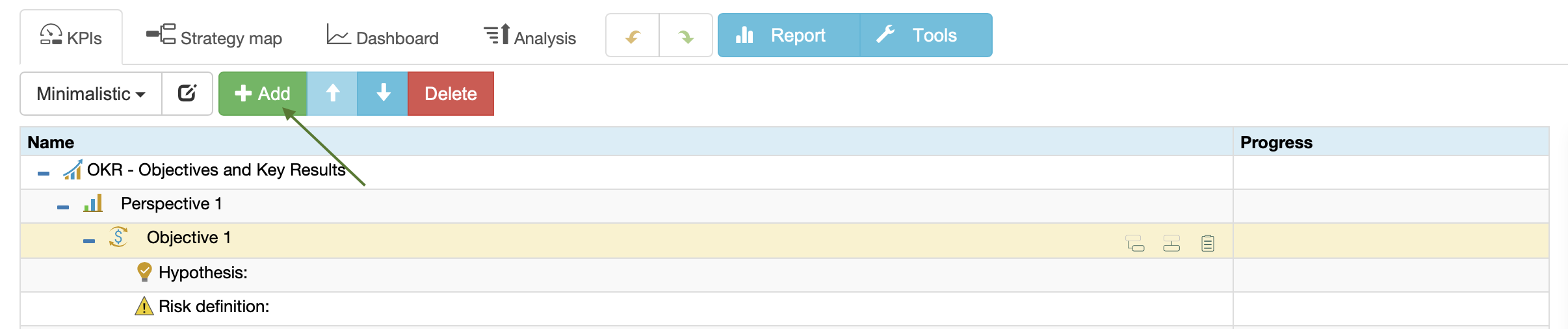
The OKR template has some Key Results aligned with objectives. If you need to add a new Key Result:
- Select an objective
- Click the Add button on the toolbar
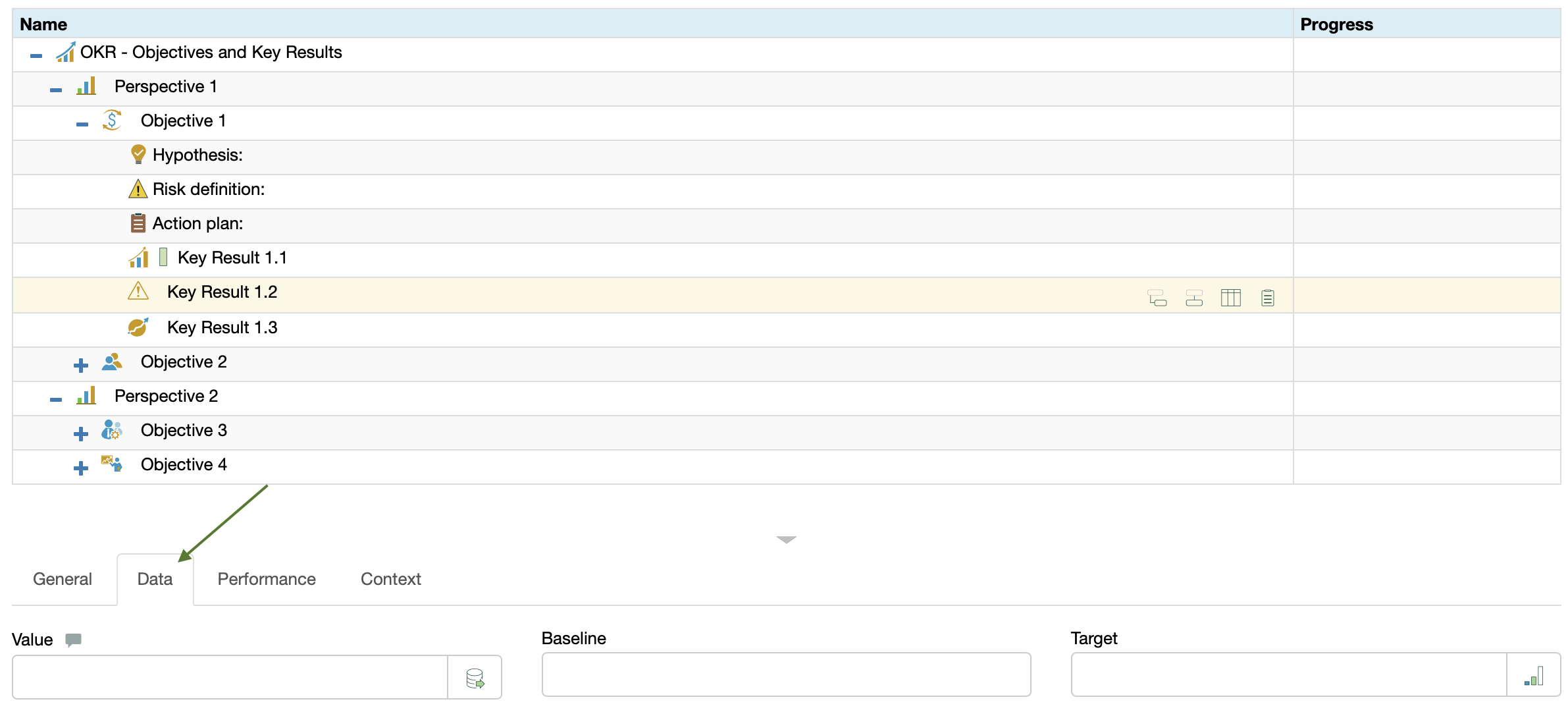
To customize the properties of the Key Results:
- Switch to the General tab to define the name and description of the Key Result
- Switch to the Data tab to quantify Key Results by setting the current state and the desired target state
- Switch to the Context tab to define the type of the Key Result
OKR Template.One of the best practices for OKRs is to combine leading and lagging Key Results:
- The Lagging type should be used for results related to outcomes
- The Leading type should be used for the quantification of activities
Create Initiatives
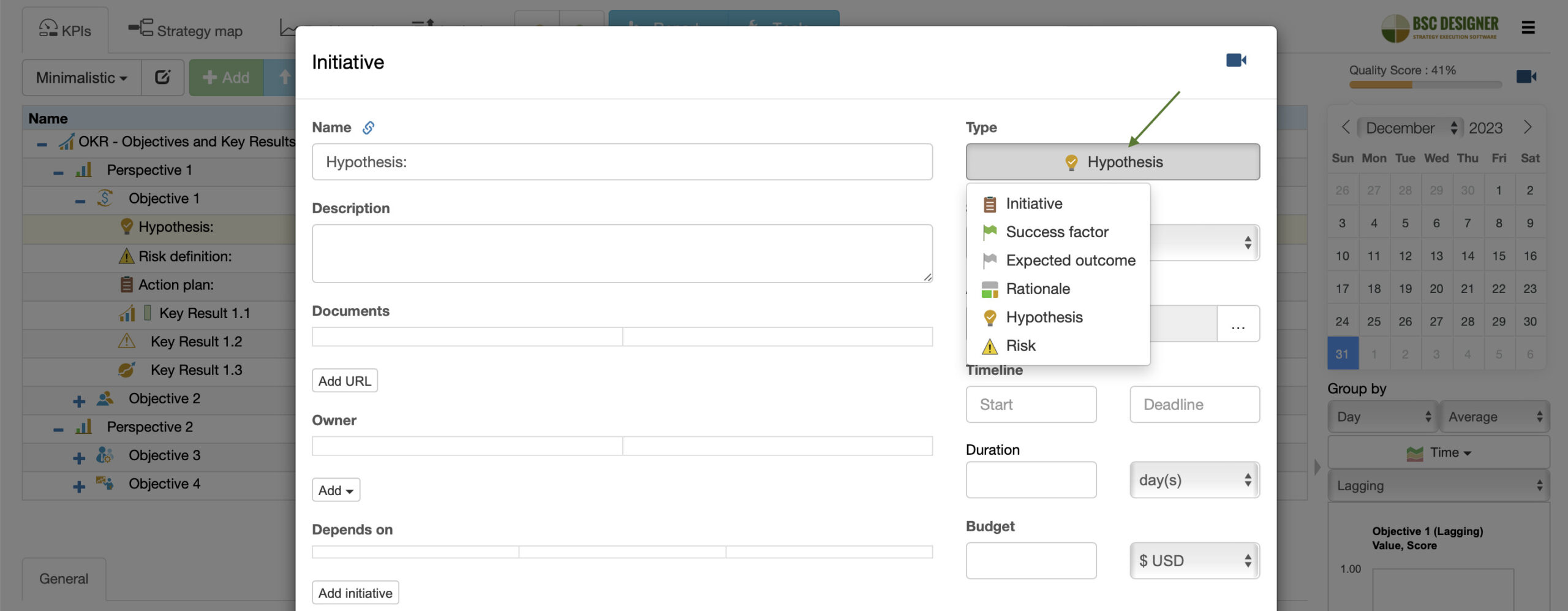
The OKR template has initiatives of different types aligned with objectives. You will find rationale, risk, success factor, expected outcome, and action plan.

OKR Template.To add a new initiative to an objective:
- Select an objective
- Click the Initiatives button next to the objective
- Change the type of the initiative if needed
Calculating the Performance of Objectives
By default, the performance of an objective is calculated as the weighted average of the performance of the Key Results.
To customize performance calculation:
- Select an objective
- Switch to the Performance tab to specify how the performance of the objective should be calculated
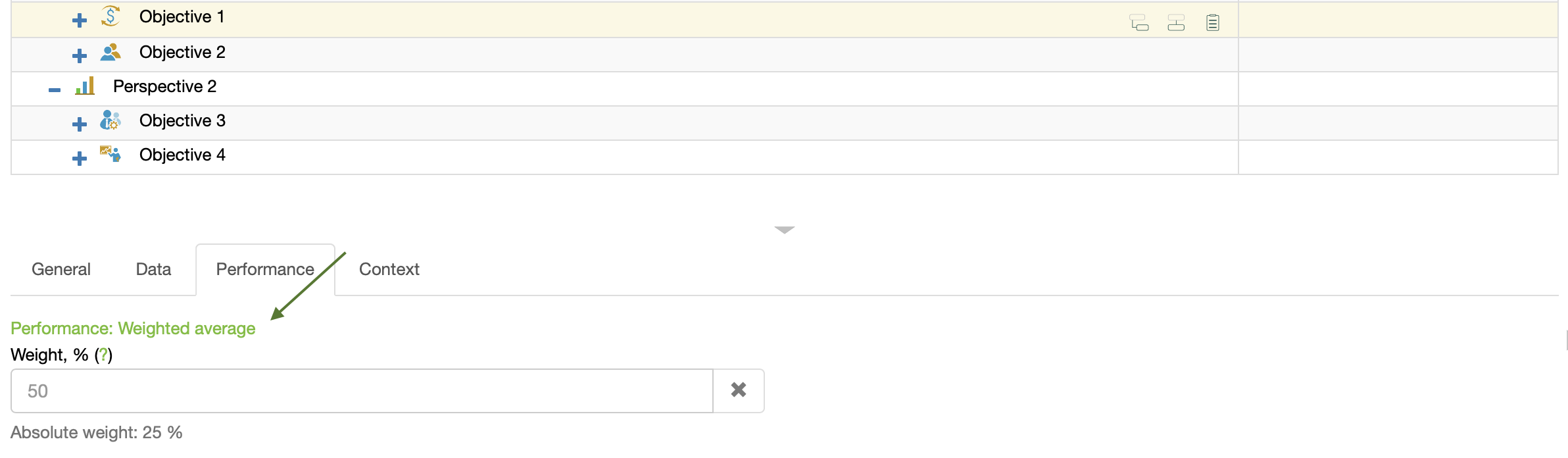
To change the weight of the Key Results:
- Select a Key Result
- Switch to the Performance tab
- Change its relevant weight in the overall performance score of the objective
Calculating the Performance of Key Results
To make the Key Results comparable, BSC Designer calculates normalized performance. It uses the current state of the Key Result and a measurement scale (baseline… target) to calculate its performance.
To customize the performance function for a Key Result:
- Select a Key Result
- Switch to the Performance tab
- Change the formula in the Optimization section
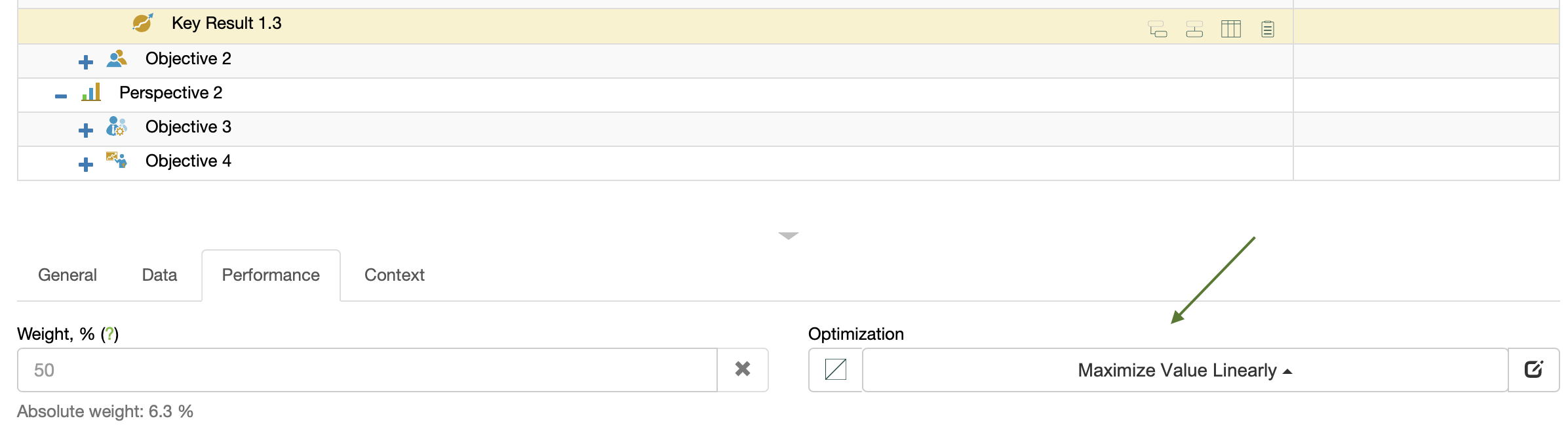
OKR Template.For example, use “Minimization” for the “less is better” case, or customize the formula according to more specific requirements.
Cascading and Alignment of OKRs with Functional Scorecards
OKRs can be grouped in hierarchies. Let’s discuss how these connections are automated with BSC Designer.
Sub-objective
When creating an objective, we select a parent item that can be another objective. In this case, the software will create a sub-objective.
- If there are existing objectives that need to be connected to another objective, move an objective (drag-and-drop) into another objective.
In both cases, the software will automatically consider the outcome of the sub-objective as a Key Result for its parent objective.
Cross-links
In this case, we deal with different branches of objectives. An objective from one branch should contribute as a Key Result to an objective in another branch.
To link objectives in this way:
- Select an objective that will play the role of the Key Result
- Select Tools > Copy indicator
- Select an objective that will accept the Key Result
- Select Tools > Paste indicator
- When asked, click the Link Item button
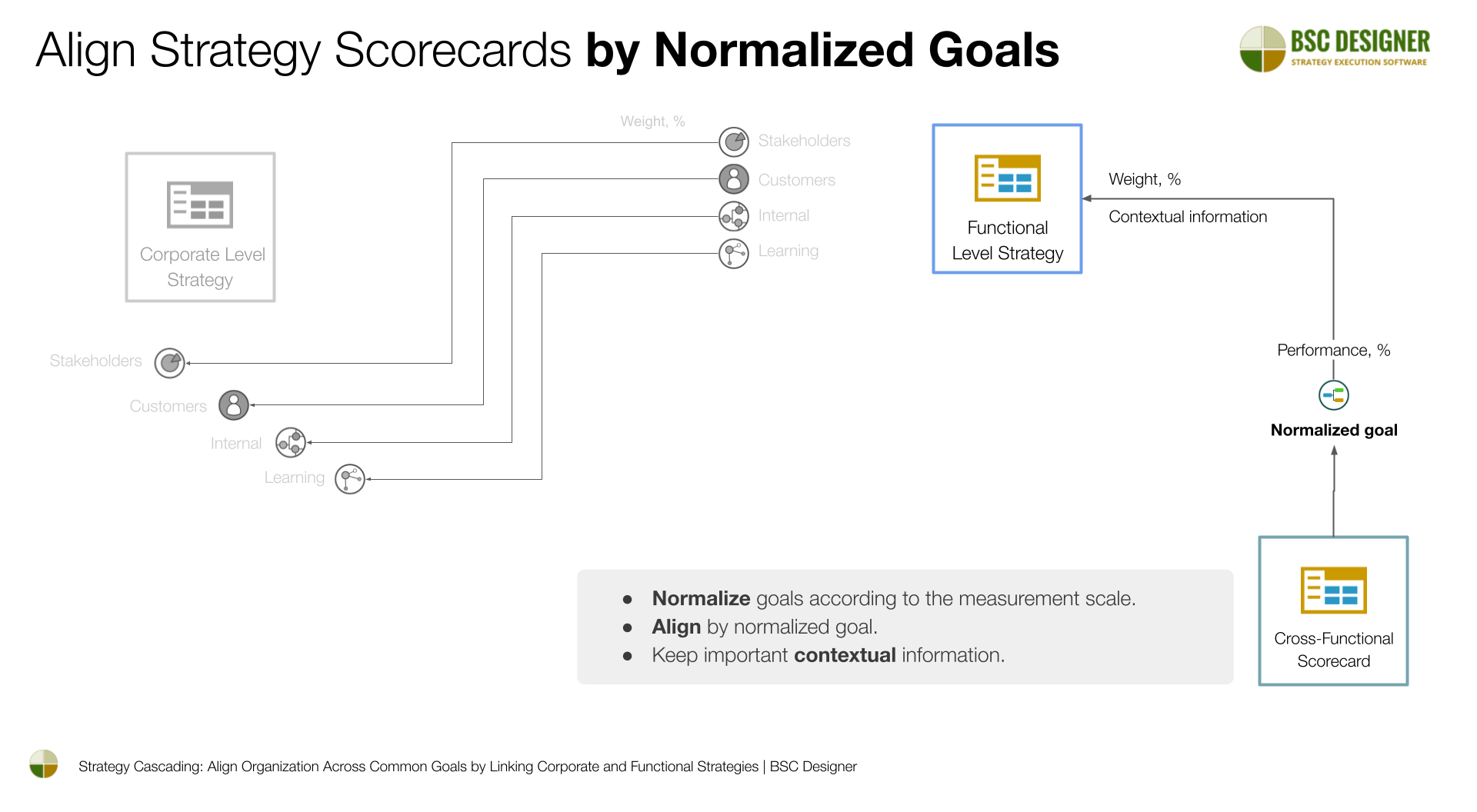
Cross-Scorecard Links
Similar to the previous cross-link case, but the objective that is supposed to be the Key Result for another objective is located in a different scorecard.
The steps to connect Key Results and objectives are similar:
- Open a scorecard with an objective that will play the role of the Key Result and select the objective
- Click Tools > Copy indicator
- Open a scorecard with an objective that will accept Key Results
- Click Tools > Paste indicator
- When asked, click the Link Item button
Following the same logic, we can link OKR-based scorecards with strategies in the Balanced Scorecard, as well as functional scorecards.
Check-Ins and Review of OKRs
Use OKRs weekly to focus on the high-priority goals. In BSC Designer, there are some automation functions that will help.
Automating Check-Ins Frequency
The review frequency is automated via the update intervals used for Key Results.
- Owners of the OKR will receive automatic notifications about upcoming check-ins (updates) for the Key Results.
In the OKR template, the default update interval for the Key Results is set to “monthly” (see Tools > Options > Default update interval). If needed, this can be customized via the Values Editor for specific Key Results.
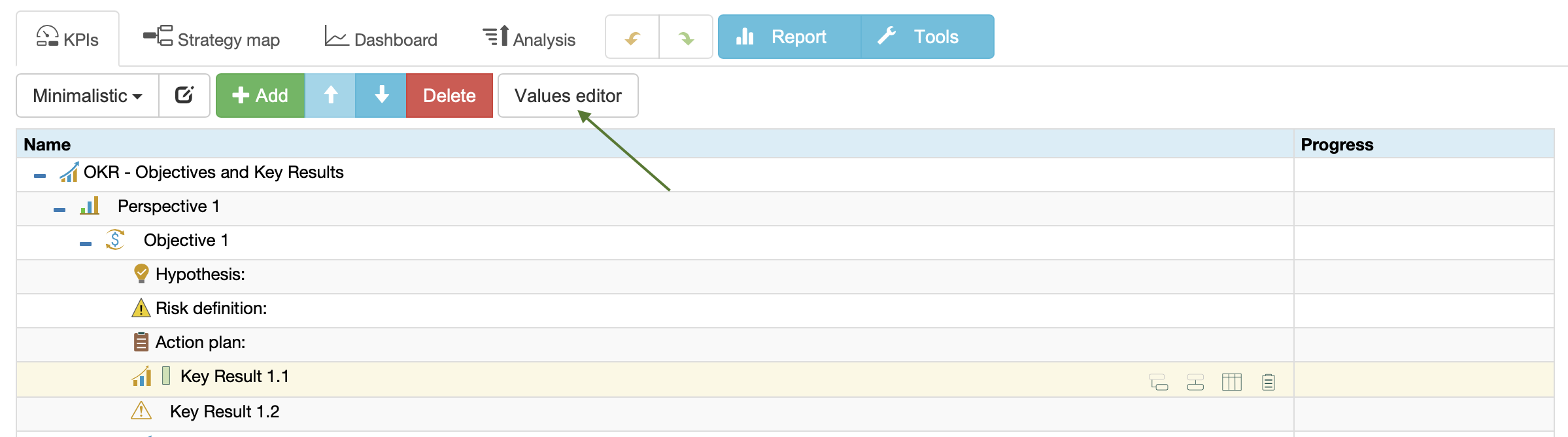
OKR Template.Assigning a Score to Key Results
To assign a score to a Key Result:
- Select the appropriate date (quarter) in the internal calendar
- Select a Key Result
- Switch to the Data tab
- Enter the current score into the Value field
Use the Values Editor to check out the current scores, as well as consult the audit trail for the changes made.
Commenting on the Results
Why are some OKRs not improving as expected? What can we do better for the next period?
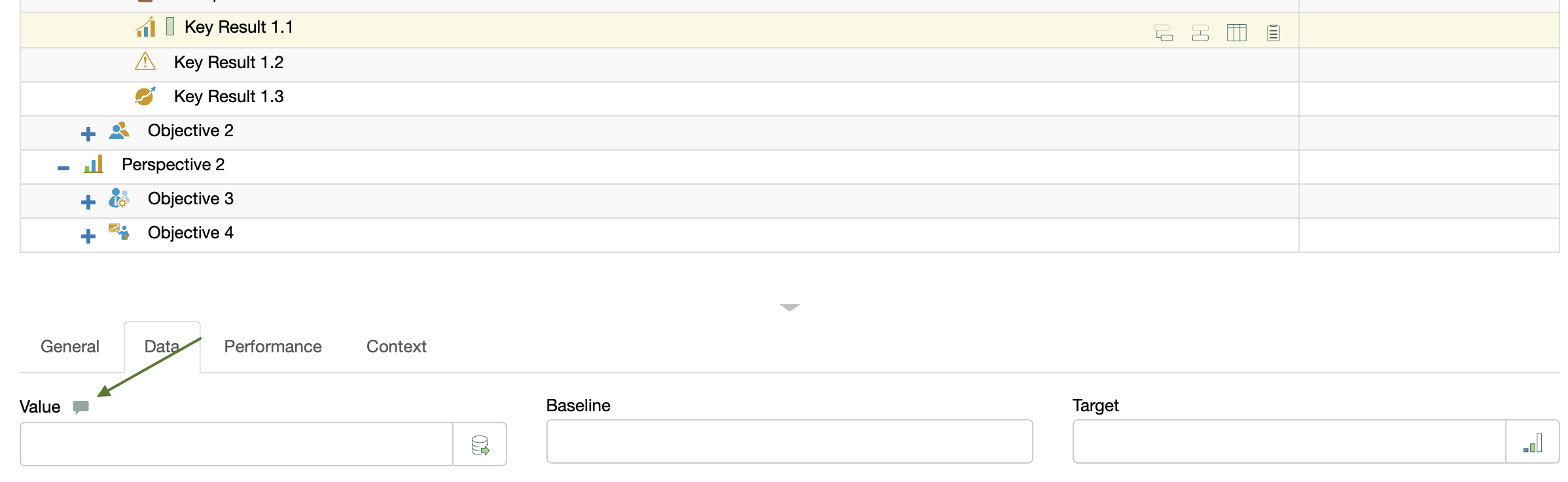
OKR Template.In BSC Designer, click on the comment icon (next to the score of the Key Result) to write down your thoughts about current achievements and insights for the next OKR cycle.
Direct Link to OKRs
During strategy discussions, you might need to make a reference to a specific objective, Key Result, or initiative. Use the link tool available for these items to create a direct link.
Visualizing Objectives on the Map
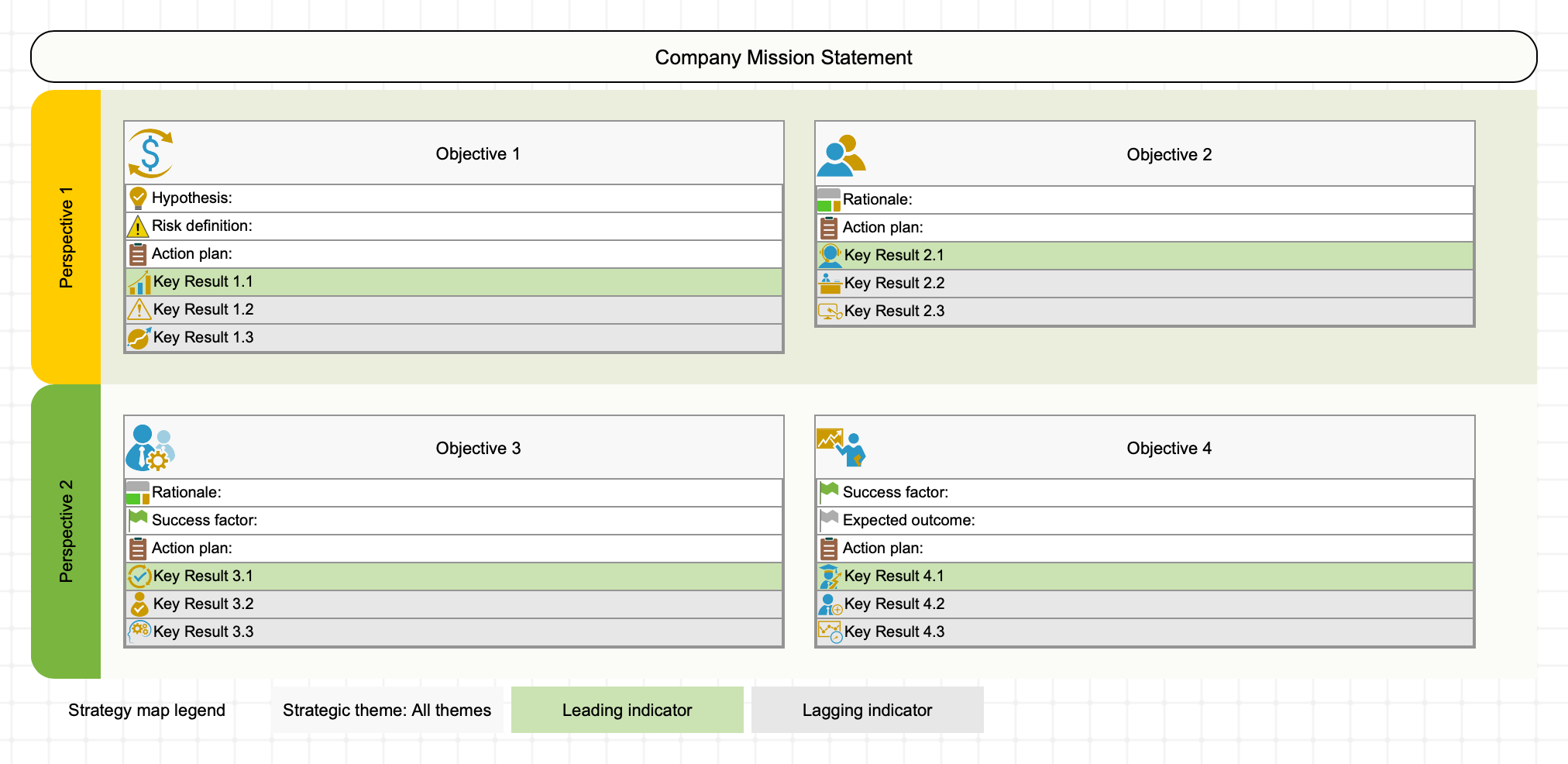
BSC Designer automatically visualizes OKRs on the strategy map.
- The objectives are visualized as rectangles within perspectives
- The Key Results are visualized as lines of gray (lagging outcomes) and green (leading activities)
- The Initiatives are visualized with the corresponding initiative icon
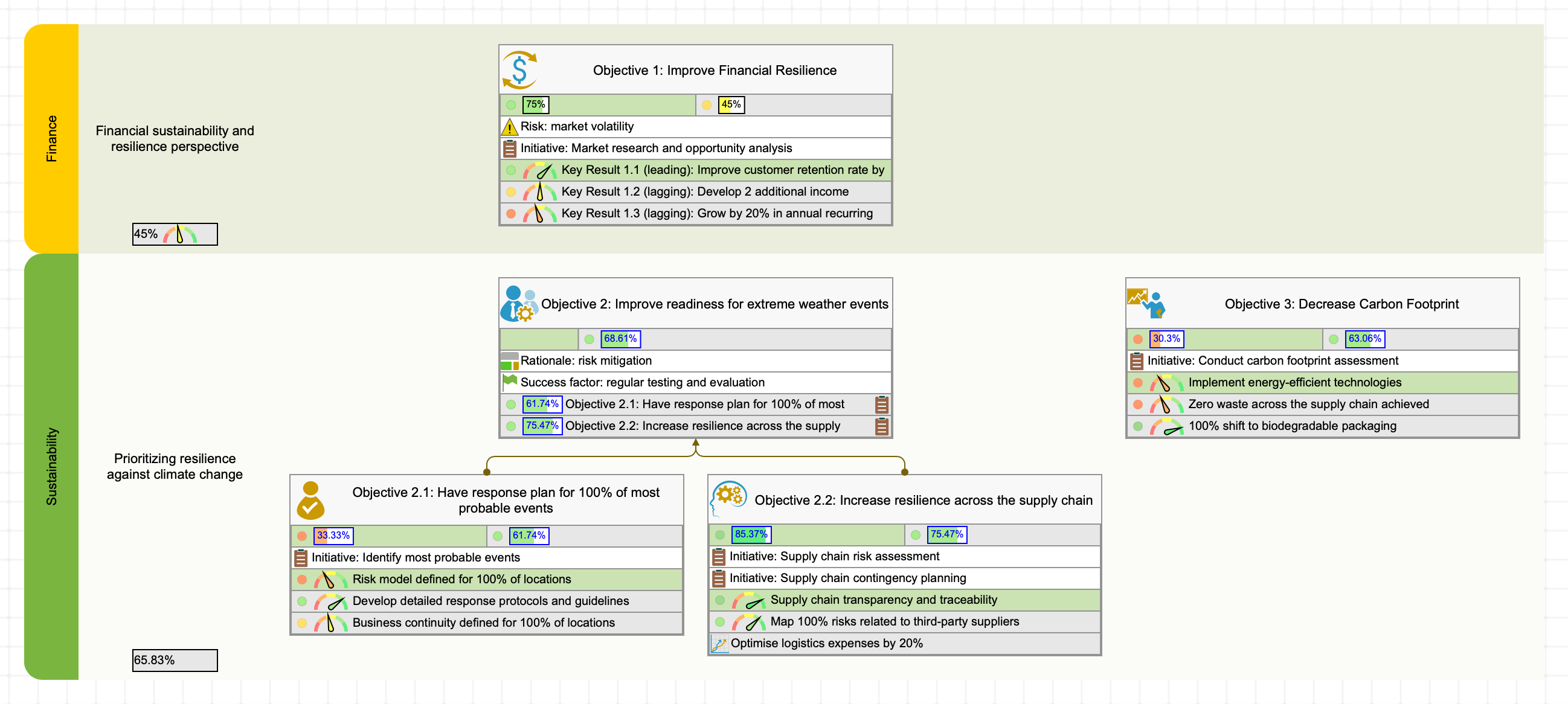
OKRs - Example.By default, BSC Designer visualizes all Objectives on the map. To limit the level of details:
- Select an objective on the strategy map
- Use the Fold / Unfold buttons (blue buttons with + and – symbols)
To stop visualizing selected OKRs on the map:
- Switch to KPIs tab
- Select an objective
- Switch to the Context tab
- Use the Display on strategy map setting
Visualizing Key Results and Initiatives on the Dashboard
The default dashboard of the OKR template lists all the initiatives available in the OKR.
- Add the Gantt chart to visualize initiatives that have start and end dates
- Add relevant diagrams for the Key Results
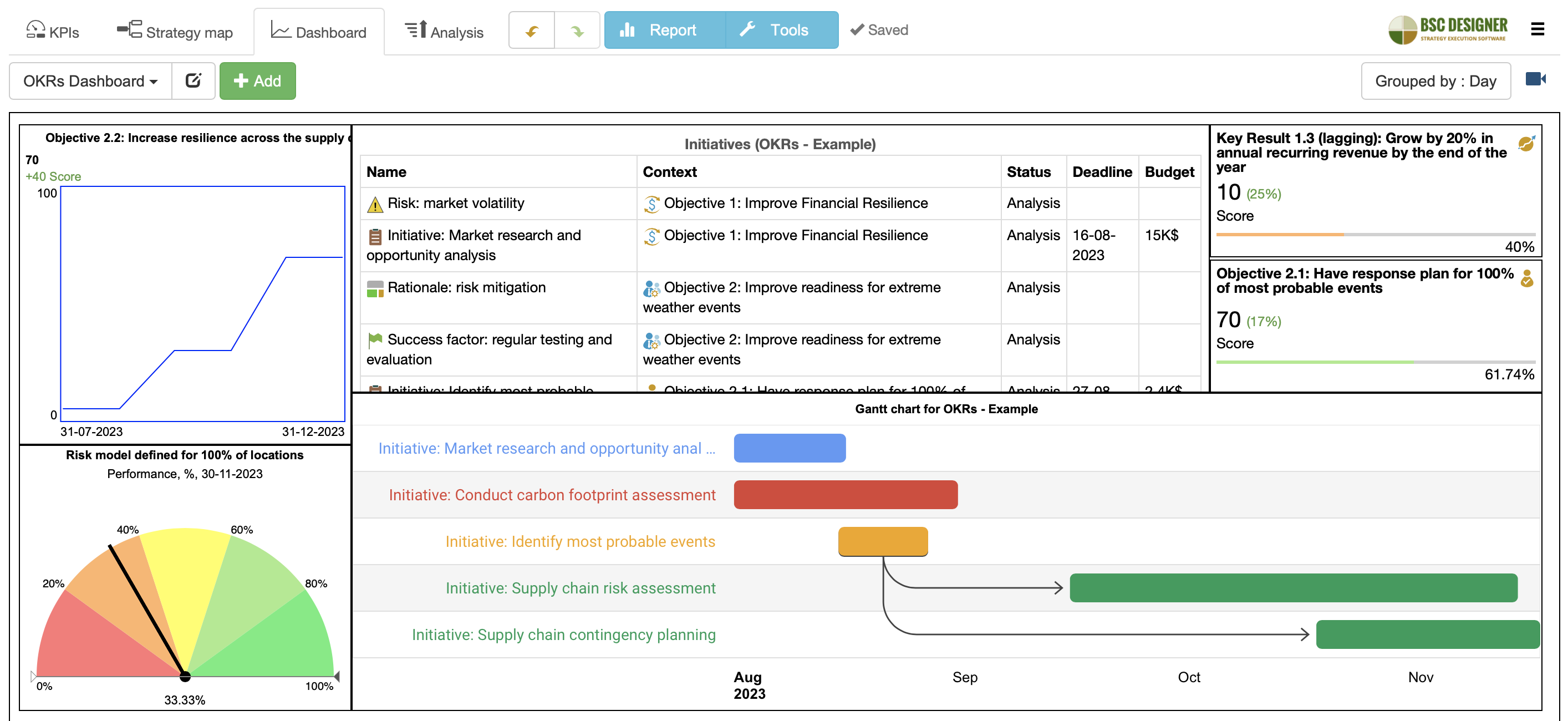
OKRs - Example.Scheduled Reports
Schedule a weekly/monthly report that the system can send to key stakeholders as a PDF file with up-to-date OKR state, a dump of the current strategy map, and dashboard.
Conclusions
The agile OKR framework adapts perfectly to the business environment defined by high volatility and complexity.
With properly defined and automated OKRs, organizations can focus on their priorities and learn quickly from mistakes.
The key steps of OKR implementation include:
- Stories about triumph and failure and moments in between, What Matters, Accessed 26 October 2023. ↩
- Five Mantras for the OKRs Coach, Ben Lamorte, 2020, OKRs.com ↩
- Rick Klau, Google: OKRs (Objectives and Key Results), https://www.youtube.com/watch?v=6iFPyyXlQSw ↩
- The Four Intrinsic Rewards that Drive Employee Engagement, Kenneth Thomas, 2009 ↩
- Measure What Matters: How Google, Bono, and the Gates Foundation Rock the World with OKRs, John Doerr, 2018, Penguin Publishing Group. ↩
- Transparency: How OKRs Can Restore Public Trust, 2019, What Matters ↩
- How VC John Doerr Sets (and Achieves) Goals, Daniel McGinn, 2018, HBR ↩

 CEO | Author | Speaker
BSC Designer is strategy execution software that enhances strategy formulation and execution through tangible KPIs. Our proprietary strategy implementation system reflects our practical experience in the strategy domain.