Who else wants an easy to follow Balanced Scorecard implementation guide? Here is a simple 5 step formula that will help to create and implement a business scorecard that will actually work and that you can be proud of.
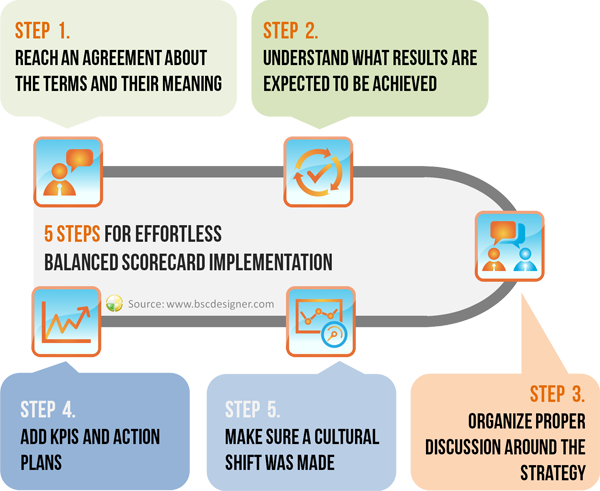
This formula was tested by our clients, and we have had some positive feedback. This formula doesn’t pretend to be a comprehensive source of information, but it will definitely get you on the right track with the Balanced Scorecard. Check out the steps below, try it, and share your experience in the comments.
Here are the Balanced Scorecard implementation steps:
- Step 1. Terms and Their Meaning
- Step 2. Understanding Expected Results
- Step 3. Discussion Around the Strategy
- Step 4. KPIs and Action Plans
- Step 5. Cultural Shift
- Frequently Asked Questions
Additionally, to make the material even more useful, at the end of each of the 5 BSC steps, I have asked strategy execution expert Prof. Jeroen De Flander to share his experiences.
Step 1. Reach an Agreement about the Terms and Their Meaning
I often hear something like “we need some good KPIs to build our balanced scorecard.” Statements like these are not only wrong, but dangerous.
Balanced Scorecard is not the synonym for KPIs set.
Balanced Scorecard and KPI scorecard are not the same:
- Balanced Scorecard (BSC) is about strategy description, execution, strategy maps, business goals, and for sure about some metrics. BSC helps to organize the discussion around strategy and focus your team on “doing the right things.“
- KPI scorecard is a measurement tool. It follows the idea summarized in the saying “what gets measured gets managed,” but actually it is more about measurement, than about management. It teaches you to “do things right,” but it doesn’t tell you a lot about where you need to focus your efforts in order to succeed.
Understand this difference, and make sure your team understand it as well. There are some other terms that might be confusing, they were discussed in these two articles:
One of the best solutions to this issue is simply renaming the “Balanced Scorecard” buzz word into something inspiring:
- At Tolko Industries management the Balanced Scorecard is named “How We Will Win” 1
- At Tesco they re-branded it as “Steering wheel” 2
Strategy execution expert Jeroen De Flander:
Getting the different BSC terms right is a crucial first step. An objective is neither a measure nor a target. A short overview of the key words and what they mean helps to avoid confusion. Choose the words that fit your organization and make sure people stick to them. And do make sure you know what you are talking about!

Step 2. Understand What Results Are Expected To Be Achieved
We agreed that BSC is about strategy discussion and execution. How can one say that BSC was implemented and that it was implemented correctly?
- Our main goal (and the sign of the successful BSC implementation) is a cultural shift, when employees start seeing their jobs in the context of the company’s strategy.
In other words, we need to achieve what is called strategy alignment.
Strategy Alignment Can Be Achieved by Various Means
Is BSC the only way to achieve it? No!
You’ll see a lot of companies that have achieved excellence in strategy execution and use many principles similar to the ones that we are discussing here, but they don’t call it a “balanced scorecard.”
Example of Thinking in the Context of the Strategy
I’m sure you have faced a situation when someone is trying to convince you that the company cannot survive without this new thing …, and that it’s a good time to buy, as there is a discount. Here is what you will hear depending on how well your team understands the strategy:
IT Guys: Let’s buy this super-fast server!
IT Guys: According to one of the company’s strategic themes we need to achieve excellence in the customer experience online. After researching the topic, we have learned that our current server is fast enough; what people actually need is that our website works well on mobile devices.
Example of the Alignment Through KPIs
KPIs might help to justify some decisions, as long as they are properly aligned with business goals and strategy.
Have a look at this example for HR that we discussed before 3:
We need to invest more in HR!
Our profit per employee has increased 12% since we started doing appraisals 4 times a year, so can we roll this out across the board?
On the other hand, using the KPIs only might be confusing. Let’s take turnover indicator for HR and turnover in Apple company for example:
Our turnover is higher than the average over the industry… we need to do something about this!
Our general turnover is high, but we can afford it. Moreover, this allows us to actively find and keep the best professionals, which is part of our innovation and product leadership strategy.
Here some additional thoughts about this step from strategy execution expert, Jeroen De Flander:
I agree, it’s crucial to agree on the desired BSC results. I see 4 major Balanced Scorecard results you can / should aim for:
- Result 1: The Balanced Scorecard helps you cascade your strategy.
- Result 2. The Balanced Scorecard measures your strategy progress.
- Result 3. The Balanced Scorecard communicates your strategy.
- Result 4. The Balanced Scorecard boosts your strategic thinking skills.
Like Aleksey points out, a scorecard improves the strategy discussion. It’s a result few advertise or promote. And that’s a shame, as I believe it’s one of the most important returns you can have.
Step 3. Organize Proper Discussion Around the Strategy
We now know that Balanced Scorecard is about strategy description and execution and our final goal is to achieve a strategy alignment. Let’s see how we can do this.
- Two keywords are “strategy” and “alignment.”
The best way to build excellent strategy that will be aligned with all the business units and employees is to start the discussion around the strategy involving your team from the very beginning.
Top manager defines priorities and goals; employees follow orders.
Top manager shares his/her perspective with employees; employees share their thoughts about the best ways to achieve specified goals.
In the Balanced Scorecard this process around the strategy is called cascading, but if you have organized a strategy discussion in the proper way from the very beginning, you will make the process much easier.
- Make sure you are not doing this journey alone. There should be at least one person from each department, who will later become the evangelist of the approach for his own team.
Here are the steps suggested, they were discussed in the details before:
1. Get an Agreement about Company’s Vision
Vision is an inspiring picture of the future that you want to create. This advice might sound inappropriate for small business; probably you won’t come up with some high-sounding statements like “a computer on every desk and in every home,” but at least this exercise will help to sort out your thoughts and what motivates you.
2. Define Your Strategy
Understand your challenges, discuss the possible ways to address them. Key questions to answer are:
- What challenges/opportunities do we face?
- Why do we face them?
- What might help to solve these problems/use opportunities?
This article will help to get your discussion on the right track.
On this step you need to use all the tools from the arsenal of executive: SWOT, gap analysis, risk assessment, etc.
3. Describe You Strategy
When you defined your strategy you have got a long list of ideas; these ideas might not be realistic or even might be contradictory; now the goal is to group them properly so that various business insights form a coherent strategy.
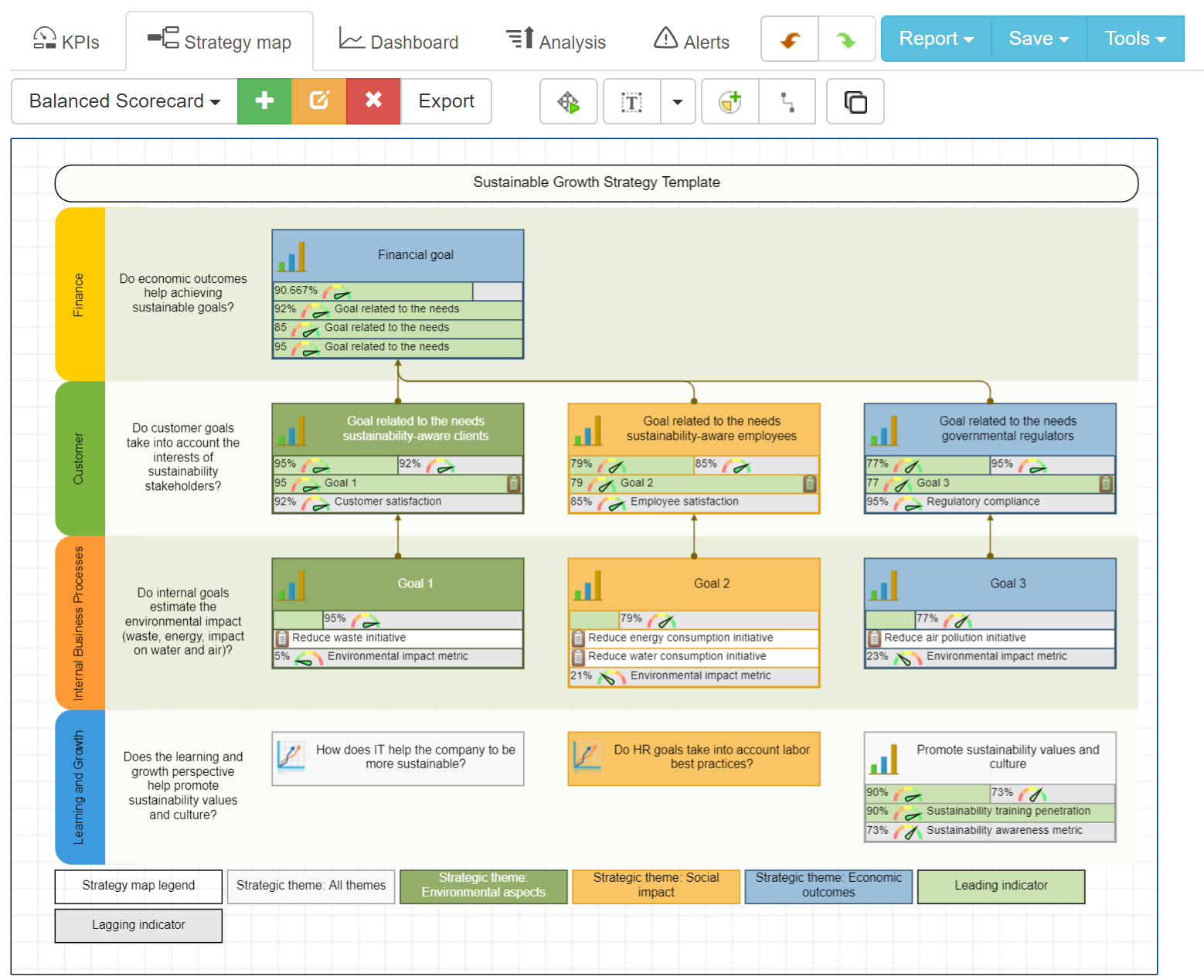
Balanced Scorecard suggests 4 to follow certain principles that will help you with this task. Starting point is a diagram (strategy map) divided into four sectors (perspectives). These perspectives imply that all your objectives need to be grouped in a specific order, which is similar to the value creation chain.
 BSC Designer for immediate access to 31 scorecard and KPIs templates.
 - You start with expected outcomes for the stakeholders (Financial perspective),
- In the Customers perspective you map objectives related to the customer value.
- The objectives from the Internal business processes perspective explain internal goals that need to be achieved in order to provide customer value.
- Finally, Learning and Growth perspective is a place where you map goals that will focus learning efforts of the company.
Don’t forget that:
- It is important to reflect the cause-and-effect connections between the objectives.
- Each business objective needs to have a person responsible for it
A strategy map won’t include all of the supporting ideas; for this purpose you need might a separate document:
- A short strategy commentary document that explains your logic, e.g. what lead you to choose these objectives.
Here is what strategy execution expert Jeroen De Flander suggests in the context of strategy discussion:
It’s crucial to have a sound strategy discussion. But although most people love to talk about strategy, I have learned that most people don’t really know what strategy is all about. I always advise spending time and energy to explain strategy to all managers. Here’s a short video you could use to explain strategy to others.
It’s a good idea to measure strategy awareness from time to time. The starting point is to simply ask employees if they know what the strategy is and if they can explain it in their own words. The next level is looking at the actual behavior of the team and find tangible indicators of strategy awareness.
Step 4. Add KPIs and Action Plans
We have not talked about the metrics/indicators yet (and I’d be careful with KPI term, as it was explained, not all metrics are actually KPIs). On this step you need to come up with indicators that your team will use to measure the success/failure in the execution of the strategy.
- The best option is to have leading and lagging metric aligned with each business goal you have. Normally, there are no problems with lagging metrics, while leading ones as hard to find.
In the real business you won’t be able to find good metrics for 100% of the business objectives, so in the beginning some might go without any trustworthy way to measure them. This is normal case, and this is much better than getting on the scorecard KPIs that are not relevant to the strategy.
What I do recommend is to brainstorm metrics in any case (this guide will help). There is not a guaranty that you will find some meaningful indicators, but just focusing on the “How we are going to measure this?” question helps.
Another important note is that indicators should not be mandated from executives or taken from 3rd parties.
As business objectives were formulated during the discussion around the strategy, so indicators have to be formulated during the similar discussion.
Employees understand the details about specific goals much better, so they must take part in defining the way their job will be measured.
Action Plans
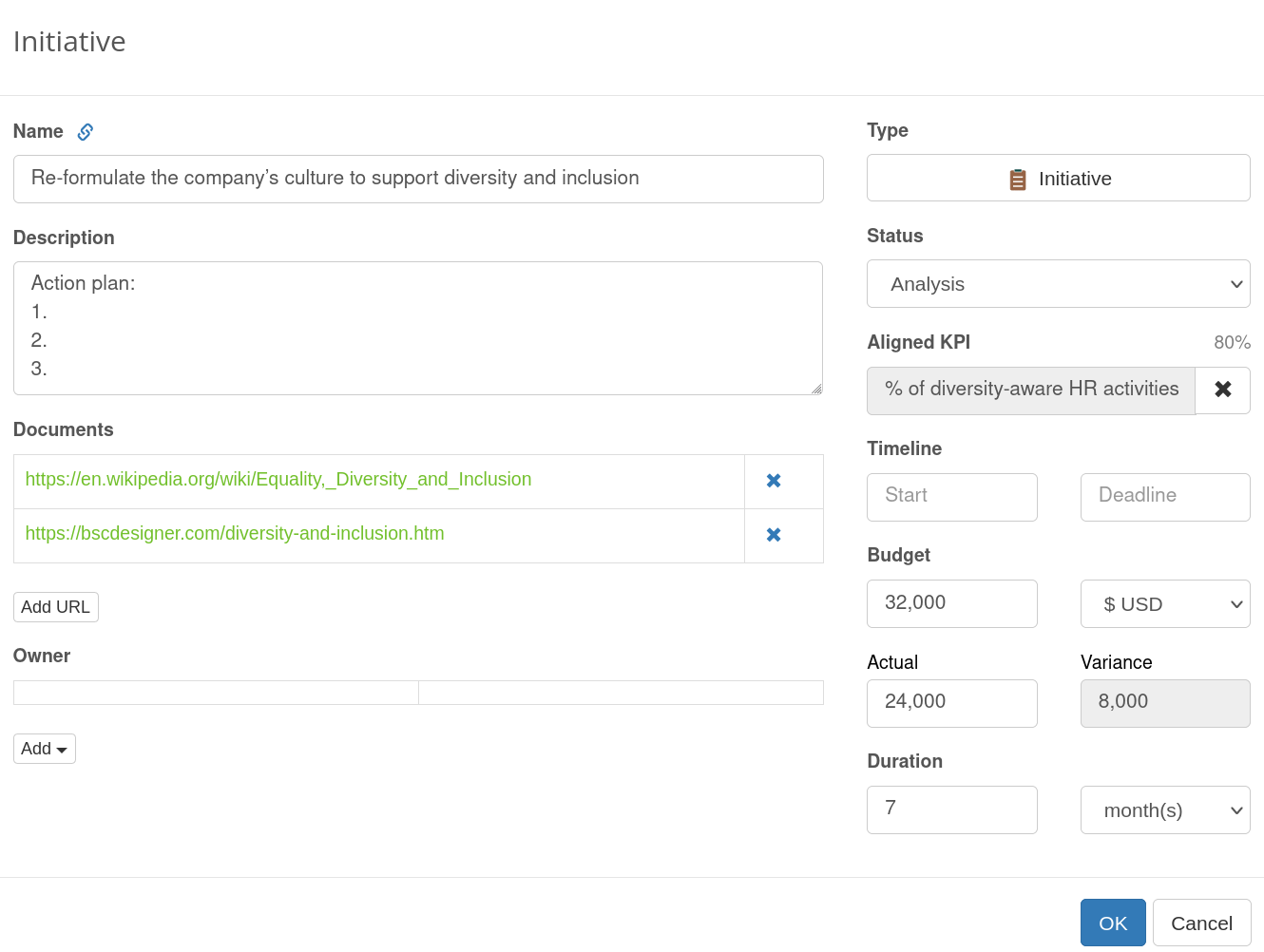
BSC Designer for immediate access to 31 scorecard and KPIs templates. Most of what was said before applies to the action plans:
- Give employees a freedom to participate in the discussion of action plans
- There might be business objectives without action plan (you simply might not have enough information to come up with one)
Strategy execution expert Jeroen De Flander:
It’s clear that having the right KPIs is crucial to achieve strategy execution success. I see, however, too many managers getting carried away when they hear the word KPI. Dashboards, traffic lights, …. the more colors, the better. But using KPIs that way, they can do your organization more harm than good. So the question is: how do you measure strategy progress the right way? What are the KPIs you need to track your strategy? Here are 6 important KPI tips to focus on. You can use them to challenge existing KPIs or check the quality for new ones.
Step 5. Make Sure a Cultural Shift Was Made
Now you are ready to start a crash-test of your Balanced Scorecard.
- Wait for a new decision that you will need to make; for a question that your employees will ask; or for a new idea that will be discussed. Pay attention to how your team is going to discuss option, how they are going to make some conclusions.
Here are some examples that will help to estimate the success:
Situation: Here is the list of the ideas
Let’s do all of them;
Here is our strategy map. Let’s start a discussion around the strategy and see if/how these new ideas are relevant to the current strategy.
Situation: Sales dropped
Our sales dropped because marketing drives very poor leads, and developers have no idea about what market needs.
We continuously monitor the needs of our customers. Our sales increased as marketing identified new problems that customer faced; our developers responded quickly with an innovation.
Situation: Our top managers decided that being in European market is our priority
We have now a goal to enter European market!
We discussed with our managers the reasons that prevented our company to enter European market before; the way we can overcome those obstacles, and the way we are going to measure if new ideas work.
Situation: Redesign of company’s website
They sent me the task to build a website on ABC platform, but they don’t know anything about website design.
I participated in strategy discussion and explained how mobile-friendly website fits our customer excellence strategy. My recommendations about the platform were taken into account.
Situation: Boss use KPIs
Our boss use KPIs to control us!
We designed these KPIs together with our boss and now we understand our job better.
Situation: All indicators need to be in green zone
I need to hire someone to keep my “Time to hire” indicator in green zone
My goal is to find an appropriate person for this position; I’m not pressed by indicators that are not aligned with our strategy.
Situation: Indicators and real business problems
We are using KPI scorecard for reporting, but those indicators have nothing to do with real business problems.
With strategy map we have a better understanding of what we need to do; we use just few indicators, but they help us to keep on track.
Still Need to Work on Your Business Scorecard?
If it looks like your business scorecard is not implemented in company’s DNA yet, then check these typical pitfalls, probably you need to resolve one of them first. And for sure, feel free to post your observations in the comments below.
Strategy execution expert Jeroen De Flander: Regarding culture, I have the same remark as I made earlier regarding “strategy.” Many people talk about it. Few know how to really change culture. I have learned that the best way to tackle a cultural challenge is to replace the word culture by habits. A simple exercise I like a lot is to identify with each team the 2 behaviors that need to be reinforced / put in place and the two behaviors that have to disappear.
Frequently Asked Questions
Here are some typical questions that people ask about BSC implementation:
Who Is Responsible for the BSC Implementation?
I believe when people ask this question they actually mean “Who should manage all those implementation steps?” All persons involved in the BSC are responsible for its success, so the implementation cannot be delegated to one person only.
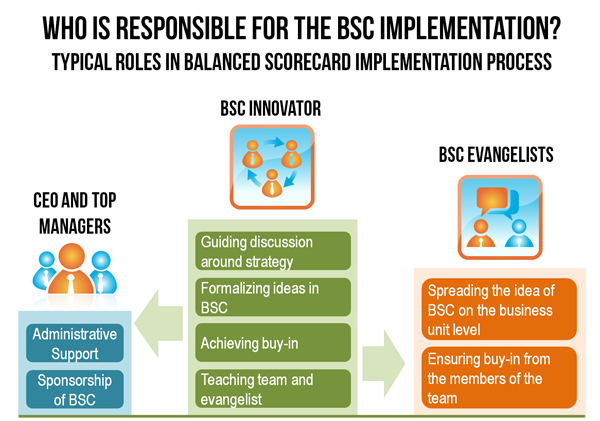
Talking about typical roles in BSC I like this approach:
- CEO and Top Management. CEO and top management need to feel that daily operational routines are getting too complex and strategic goals are lost from the sight of business units and individual employees. They formulate the need for some strategy execution framework and are ready to support and sponsor further efforts. This premise will make things much easier.
- BSC Innovator. In theory the role of innovator who will introduce BSC to the company plays CSO (Chief Strategy Officer) or simply strategist. In practice innovative ideas might be promoted by IT who have found BSC software, or by HR specialist that decided to understand a strategic context of his employee engagement metrics, or from guys from quality department. For sure, BSC innovation might come from outside of the company (check out Do we need an external consultant? question below).
- BSC Evangelist. During the implementation of BSC in each business unit should appear a person (let’s use term evangelist) who will support the BSC idea on the level of this business unit, and promote it to his team.
Thus, a BSC Innovator is the person who makes the biggest impact on BSC implementation. Needless to say that the success of the implementation depends more on buy-in from the team, than on technology; so BSC Innovator is more likely a person with leadership skills (not necessary on the leadership position) influential enough to convince stakeholders to start using another strategy execution framework.
You can find more examples of the typical roles that appear during BSC implementation and cascading in this article. Instead of suggesting “one size fits all” model, the article will help to sort out your thoughts on the topic of cascading and understand where your organization is now and what can be improved.
How to Integrate a Strategy-related Business System into Existing Management Structure?
Dr. John P. Kotter suggests 5 to use two business operational systems:
- one traditional hierarchical organizational structure, and
- another network-like structure that helps to achieve strategic agility.
In his articles and books Dr. Kotter explains how to achieve synergy when running these two business systems.
Do We Need an External Consultant?
Hiring someone who will guide a strategy discussion is a good idea, but don’t expect that this person will create a final product for you. The Balanced Scorecard is a lot about your strategy and company’s expertise, in this sense a consultant can only train you to use certain approaches.
- Check out some general thoughts about BSC consultants in this article.
Do We Need a Software to Run All This?
It depends on your scale. If it is just you and your small team, then you can probably do everything with Excel and PowerPoint, while a lot of effort will be invested in unnecessary design job. Taking it on a serious level requires a professional software. BSC Designer is one of them, you can start using it at no cost.
- This article give some more advice about the choice of proper automation tool.
Does It Make Sense “Starting Small”?
A common sense approach tells that instead of implementing BSC across the whole company it might be a better idea to start with a single business unit and see how it will work. The problem with this approach is that the strategy map of the business unit needs to be logically linked to the business goals of the higher level.
In other words, there should be a good understanding of strategy, and this understanding need to be formalized in a form of strategy map. “Starting small” is possible, but the project needs to start from the top.
Do We Need to Schedule Update of the Balanced Scorecard?
Treat Balanced Scorecard as another business system. Define roles, responsibilities, specify implementation costs and time frames. Plan regular performance reviews, maintenance, and updates.
Are There Any Requirements for the Balanced Scorecard Implementation?
BSC deals with strategy and its execution, so the most important requirement is “to be ready for the detailed analysis of the strategy.” If you are in the “fire-fighting” situation when you need quick patches to the operational problems, then most likely you simply won’t have enough resources and engagement from employees/top management to think about strategic problems.
Do We Really Need All These Four Perspectives in Our Implementation?
Yes, you need all of them. Try removing “Learning and growth” and you’ll find your company spending their training budget on something that is not relevant to the strategy. Remove “Internal business processes” and your HR will bureaucratize your hiring process with indicators focused on speed, but not on the quality.
Do We Need to Have Perspectives Grouped in This Very Order?
The classical four perspectives help to visualize how your objectives support the creation of the value for the customer, and how the created value is linked to your financial outcomes.
You might want to rename some perspectives to better reflect your business (for example, non-profits rename Finance into Stakeholder Interests; according to the 2GC survey, most companies (70%) use classical names for their Balanced Scorecard perspectives), but talking about the order – you need a classical one.
Can We Have More Perspectives?
I saw some business scorecard where strategists added “Risk,” “HR,” “Market,” or other perspectives on the scorecard. Those were some nice tailor-made scorecards that looked logical and followed the cause-and-effect flow incorporated into the BSC, but I wouldn’t recommend copying this idea in your implementation.
A better approach is to put the details about risks, market, and other aspects that define or depend on your strategy into the supporting documentations, but not on your strategy map. Also, using several strategic themes is a good solution to reflect various aspects of the business strategy.
We Have so Many KPIs… Is It a Problem?
A short answer is: “Yes, this is a problem!” Most likely what you are doing is implementing a dashboard, not a balanced scorecard (what’s the difference). On your Balanced Scorecard you should focus on your business goals; metrics are important, but they don’t play the main role.
It is more important to focus on the quality of the metrics than on their quantity. Make sure that each business goal has at least one leading metric and one lagging metric aligned with it (check “Step 4. Add KPIs and action plans” above).
It’s Your Turn
Now you have a formula for how the Balanced Scorecard can be implemented. Feel free to follow these 5 steps and share your results in the comments. To make sure that you are on the right track with your efforts check out this checklist with some key points that one needs to keep in mind.
- Tolko Industries Ltd. Case Study, www.balancedscorecard.org, http://www.theinstitutepress.com/uploads/7/0/0/1/7001740/tolko_case_study_gp7_august_2013.pdf ↩
- Learning from Tesco Strategy Map and Scorecard, Aleksey Savkin, BSC Designer, 2013, https://bscdesigner.com/tesco-balanced-scorecard.htm ↩
- How HR Can Boost Their Credibility By Using KPIs, Kazim Ladimeji, BSC Designer, https://bscdesigner.com/hr-scorecard.htm, 2014 ↩
- The Strategy Focused Organization, Robert S. Kaplan, David P. Norton, Harvard Business School Press, 2001 ↩
- Accelerate!, John P. Kotter, Harvard Business Review, 2012, https://hbr.org/2012/11/accelerate/ar/1 ↩

 CEO | Author | Speaker
BSC Designer is strategy execution software that enhances strategy formulation and execution through tangible KPIs. Our proprietary strategy implementation system reflects our practical experience in the strategy domain.