Review an example of the non-profit scorecard: learn how nonprofit organizations can use the Balanced Scorecard framework, find out what objectives and indicators should be mapped in the financial perspective.
Recently I was approached by an executive director of a nonprofit who asked me about the possibility of the Balanced Scorecard implementation in their organization. His biggest concern was about the financial perspective; and for sure, most standard financial indicators were not applicable in their case.
My answer was short:
“If you have a strategy and you want to execute it effectively, then you can design and implement a BSC for your nonprofit.”
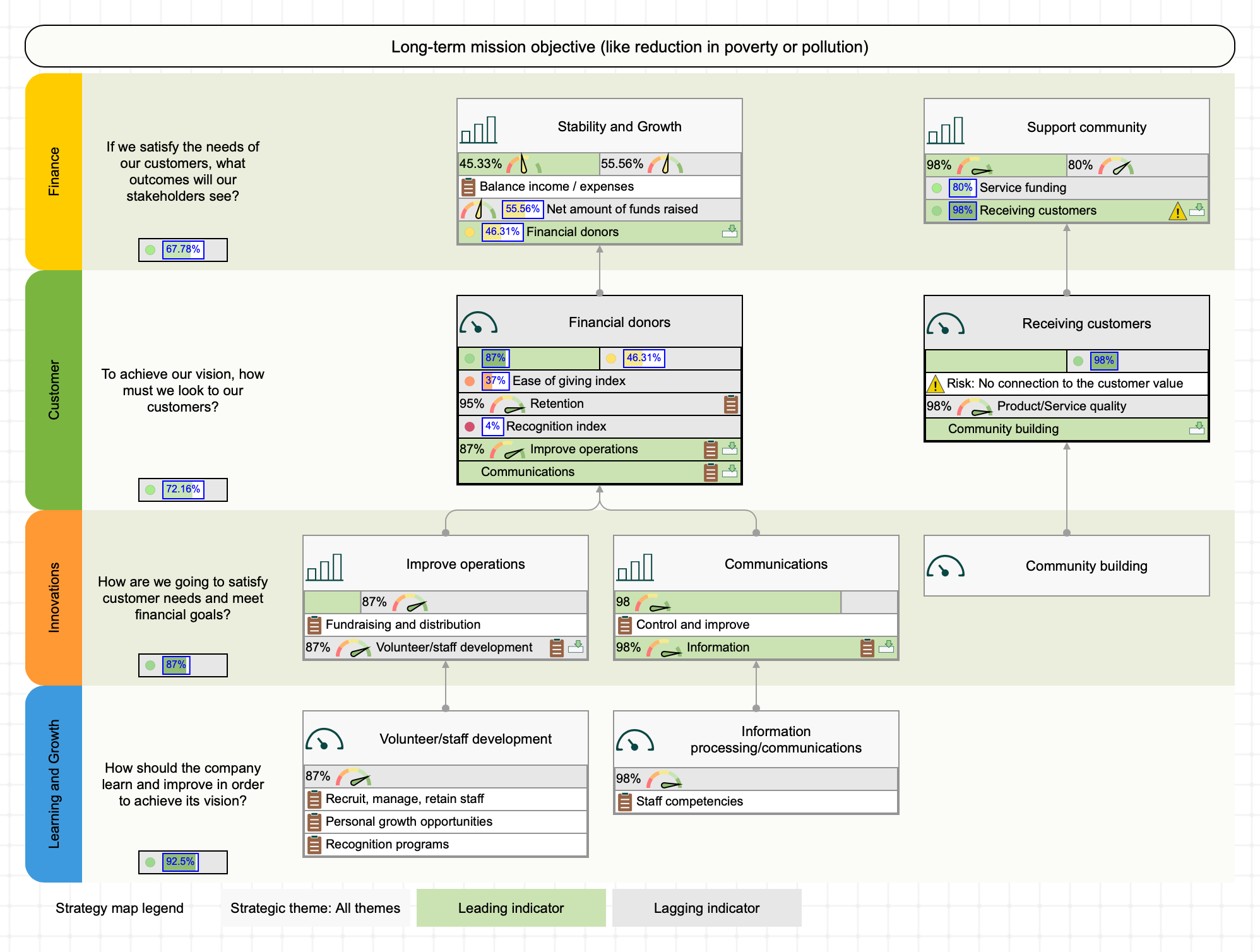
 Nonprofit Balanced Scorecard.
In this article I’d like to show how government and nonprofit organizations can adapt the Balanced Scorecard approach, and what to do with the financial perspective of the BSC. As always, a good example will help to illustrate my points.
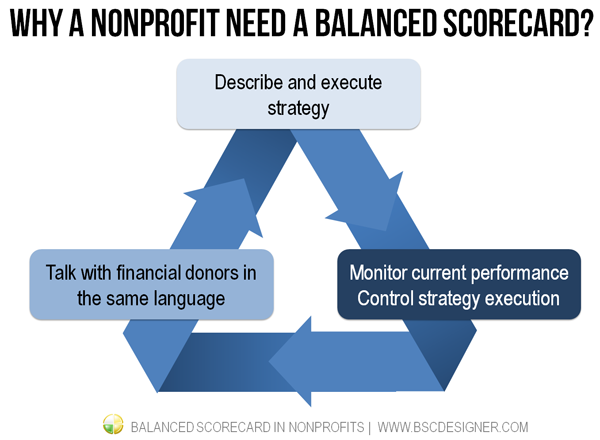
Why do nonprofits need the Balanced Scorecard?
There are two reasons for this.
1. It helps to describe and execute strategy
First of all BSC helps to describe a strategy, focus actions on what matters, and finally execute the strategy successfully.
For sure, some nonprofits might face problems with an articulation of the strategy, and so following the Balanced Scorecard approach helps to frame thoughts about strategy in the right way.
2. It helps to talk in the same language with those who make donations
Many donations to the nonprofit organizations are made by for-profit companies. Executives from these companies use BSC for their strategic planning.
In this sense, non-profits that have a strategy described with a Balanced Scorecard have more chances to get funding, as they are talking with financial donors in the same business language.
Where should nonprofit place a Financial perspective?
In most cases, for-profit organizations agree (see the workshop exercise) about the order of the BSC’s perspectives: 1.  Financial, 2.
  Customer,
  3. Operational, 4.
  Learning. Within the nonprofits, there is no such agreement yet. The logic here is to put the most important long-term outcome (which, in the case of nonprofits, are not financial outcomes) on the top of the diagram.
- Robert S. Kaplan in his article1 recommends nonprofits putting long-term mission objectives (like “reduction in poverty, diseases, pollution”) on the top.
Nonprofit Balanced Scorecard.What’s goes next?
As it was explained above, for-profit business are those who frequently invest into the social programs of nonprofit organizations. They see financial indicators on their own scorecards, so they like to have a similar way to track the performance of their social investments in nonprofits. Probably for this very reason many nonprofits choose a standard order of their perspectives:
Standard order:
- 1.
 Financial
 - 2. Customer
- 3. Operational
- 4. Learning
In some scorecard I saw financial perspective was located on the bottom of BSC diagram. Managers in such organizations treat finance as a resource and don’t want to have it on the top. The problem with this approach is that it will be hard to track the cause-and-effect logic of such BSC.
Finance on the bottom:
- 1. Customer
- 2. Operational
- 3. Learning
- 4. Finance
These are two most popular approaches to the BSC diagrams for non profits. There are a number of others as well, like renaming “Finance” perspective into “Success” or “Stakeholder interests”2, or putting it on the same level with Customer perspective3.
- A test question that one need to ask in these cases is whether the cause-and-effect logic is still trackable on such strategy maps or not.
Who are the customers?
A nonprofit organization deals with at least two groups of customers:
- Paying customers (customers that make donations)
- Receiving customers (those who benefit from the existence of nonprofit)
Also, there might be mixed cases. Let’s take any professional community as an example with an annual membership fee, its members are both paying and receiving customers at the same time.
An example of nonprofit scorecard
Now, let’s build a Nonprofit Balanced Scorecard that will take into account the nuances described above. I’ll use BSC Designer Online as an automation tool. You can re-use the template that I’ll create to build your own scorecard.
Adding strategic themes
Nonprofits deal with two type of customers – financial donors and recipients. On the respective strategy map we might need to distinguish goals related to these two groups.For this purpose our team used a “strategic theme” function.
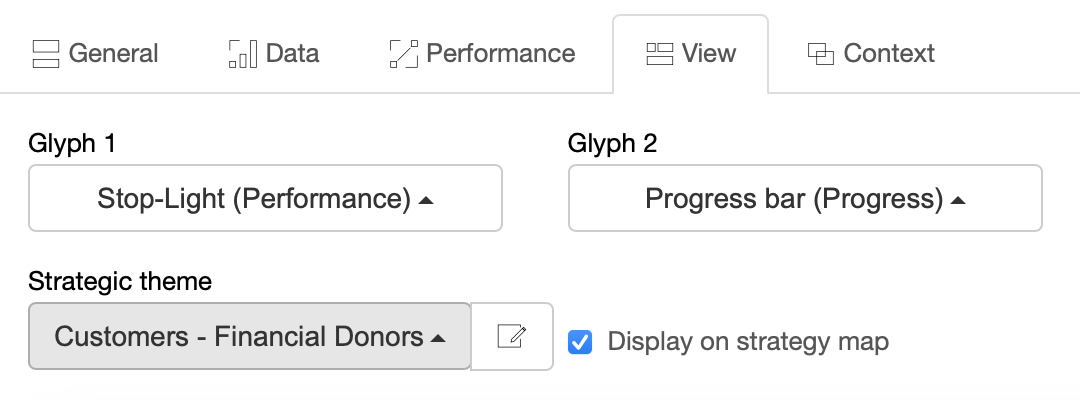
Nonprofit Balanced Scorecard.Instead of a one “Customer intimacy” theme we created two:
- Customers – Financial Donors (blue color on the map)
- Customers – Recipients (green color on the map)

Nonprofit Balanced Scorecard.Two other standard schemes – Operational Excellence and Product Leadership remained unchanged.
Preparing perspectives and nonprofit mission
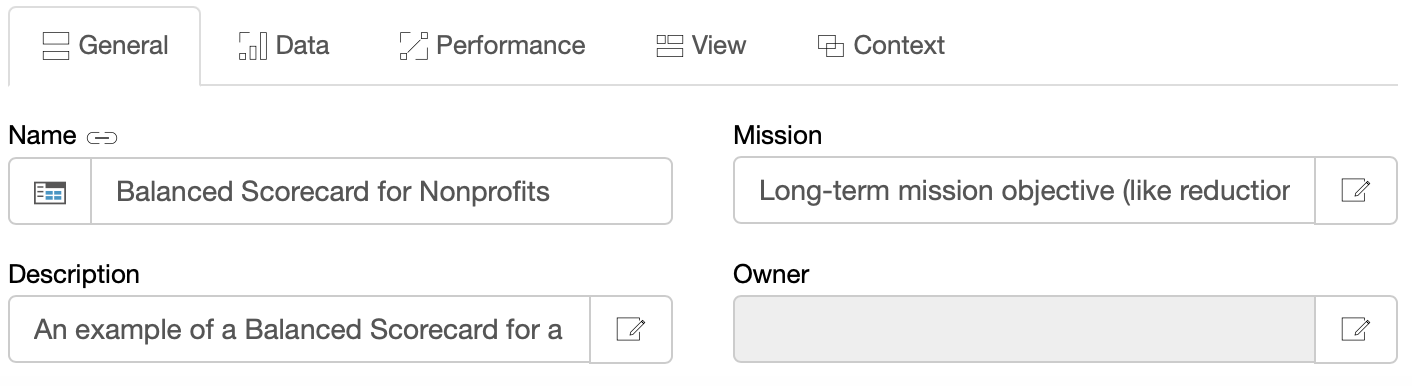
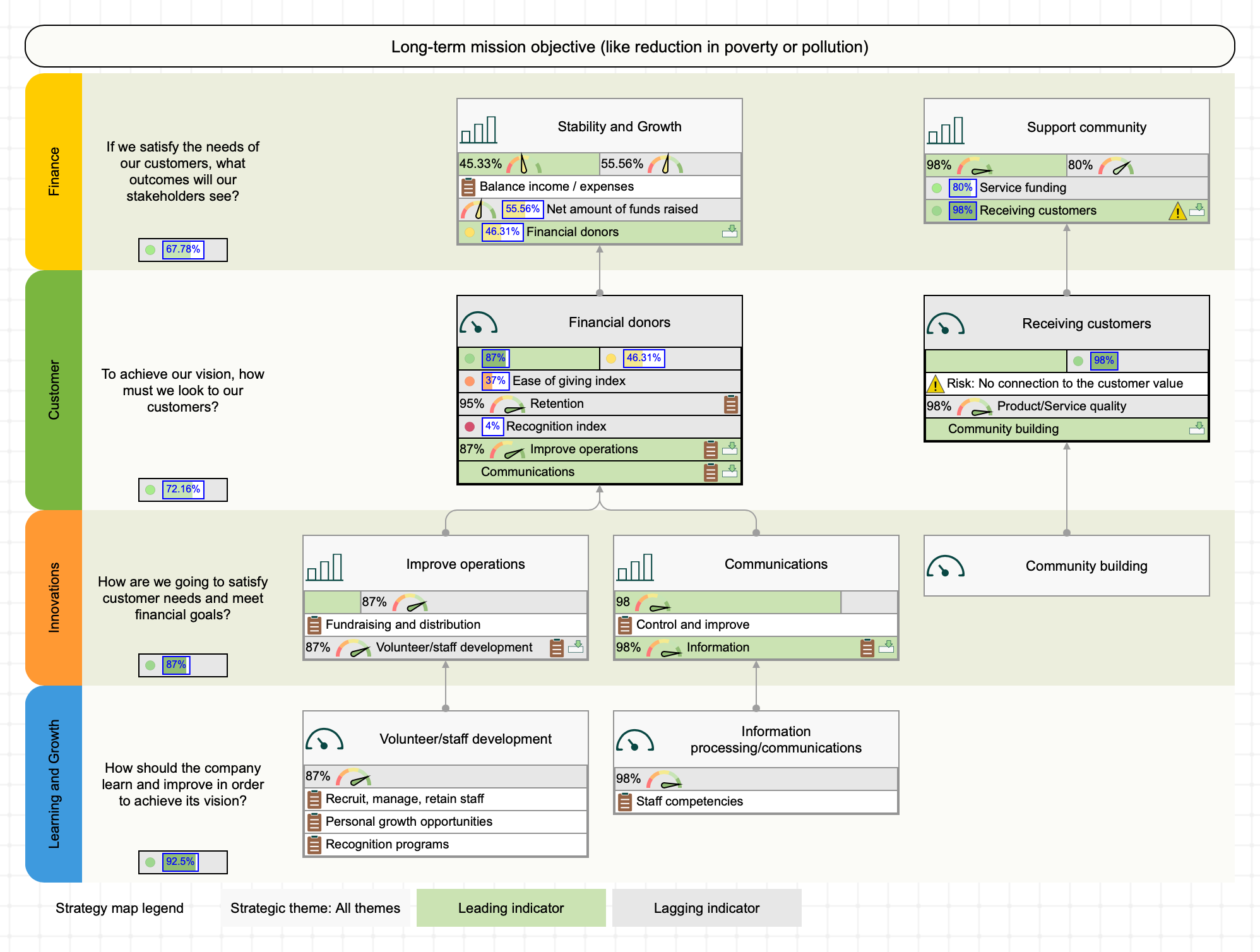
On the next step, we prepared four BSC perspectives with proper descriptions.On the top of the diagram there is a long-term mission objective (like reduction in poverty or pollution).
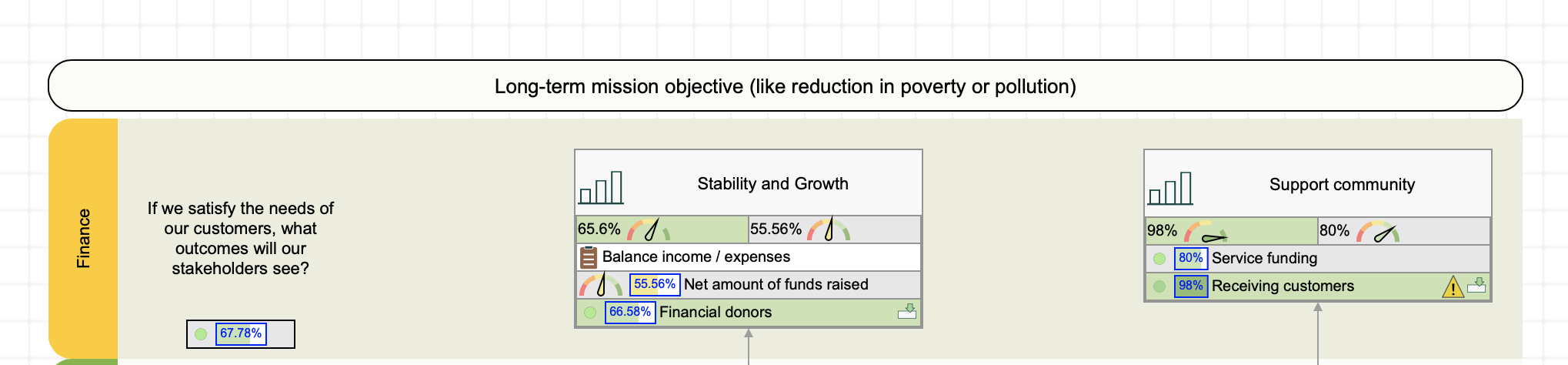
Nonprofit Balanced Scorecard.Objectives and cause-and-effect links between them
We have added some generic objectives to the strategy map. Each objective was assigned to a strategic theme, and cause-and-effect connections were specified.
Initiatives and KPIs
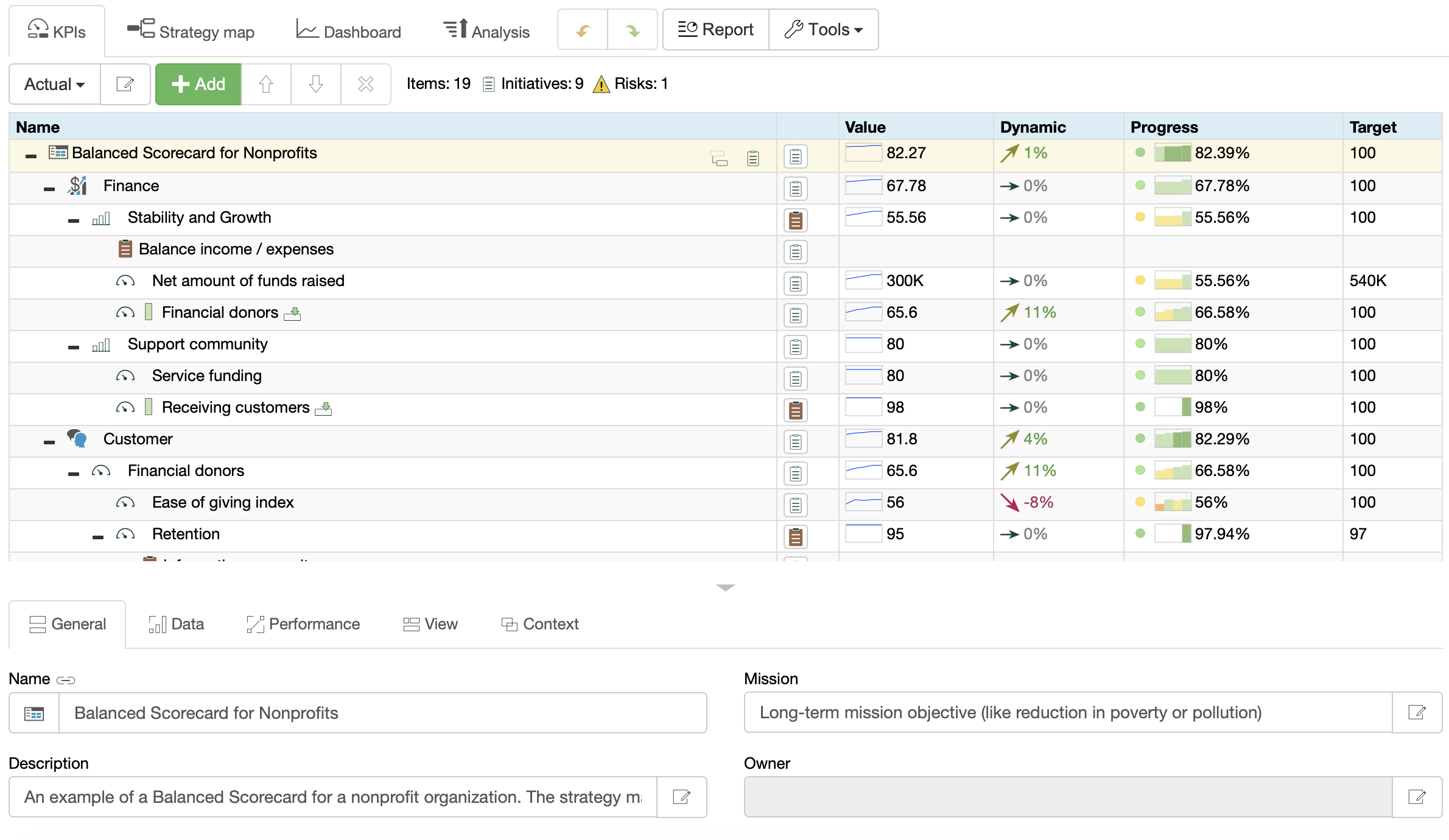
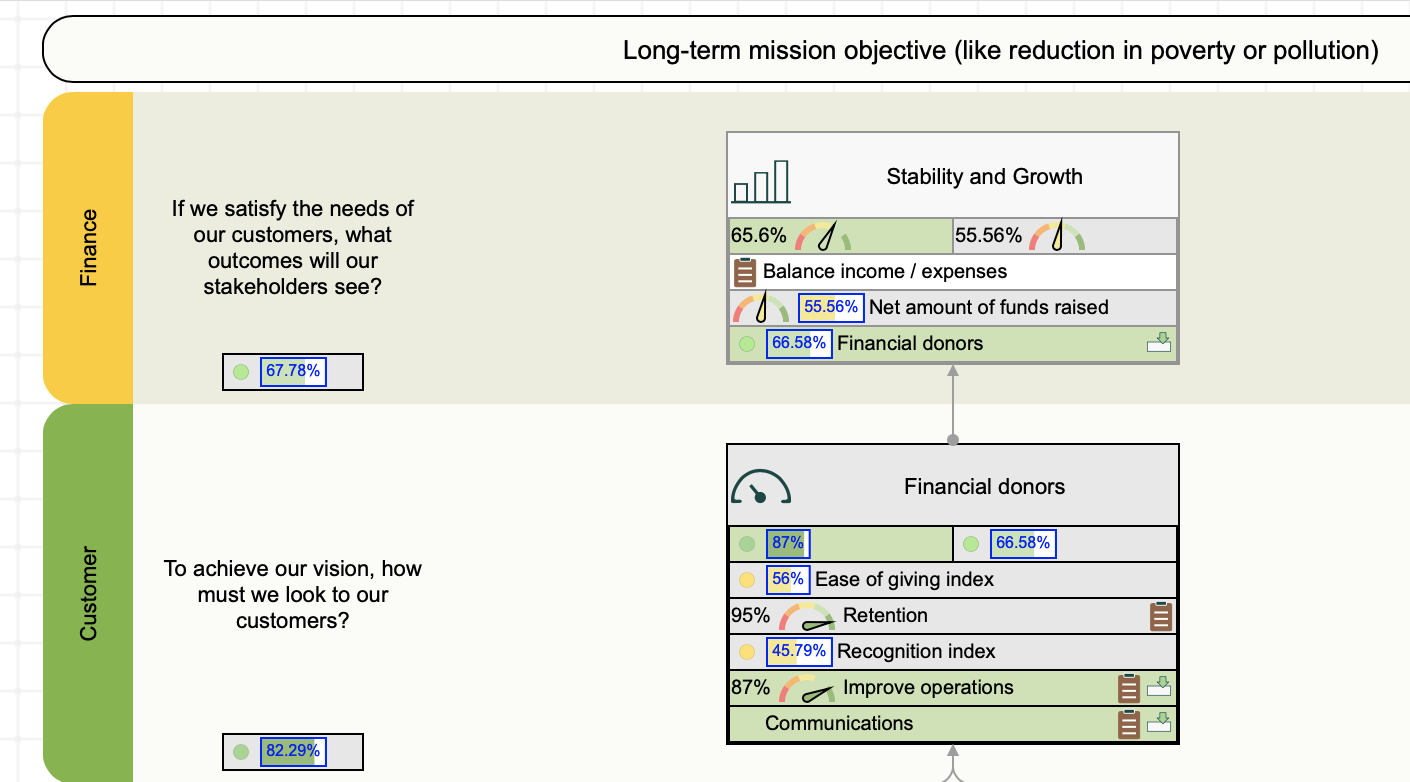
Finally, we aligned some initiatives and metrics with business goals. Let’s take the “Stability and Growth” objective from a financial perspective as an example to review.
- An initiative “Balance income / expenses” was aligned with this objective (we chose to visualize this initiative on the map)
- A lagging indicator “Net amount of funds raised” was aligned with this objective (we chose gauge chart and progress bar as the visualization means for this indicator)
- A leading indicator “Financial donors” is the result of the connection of this goal with the “Financial donors” goal from the Customer perspective (the lagging part of the Financial donors goal contributes as a leading indicator to the “Stability and Growth” goal).
Check out this article to learn more about leading and lagging metrics.
 Nonprofit Balanced Scorecard.
Here is the strategy map that we had as a result:
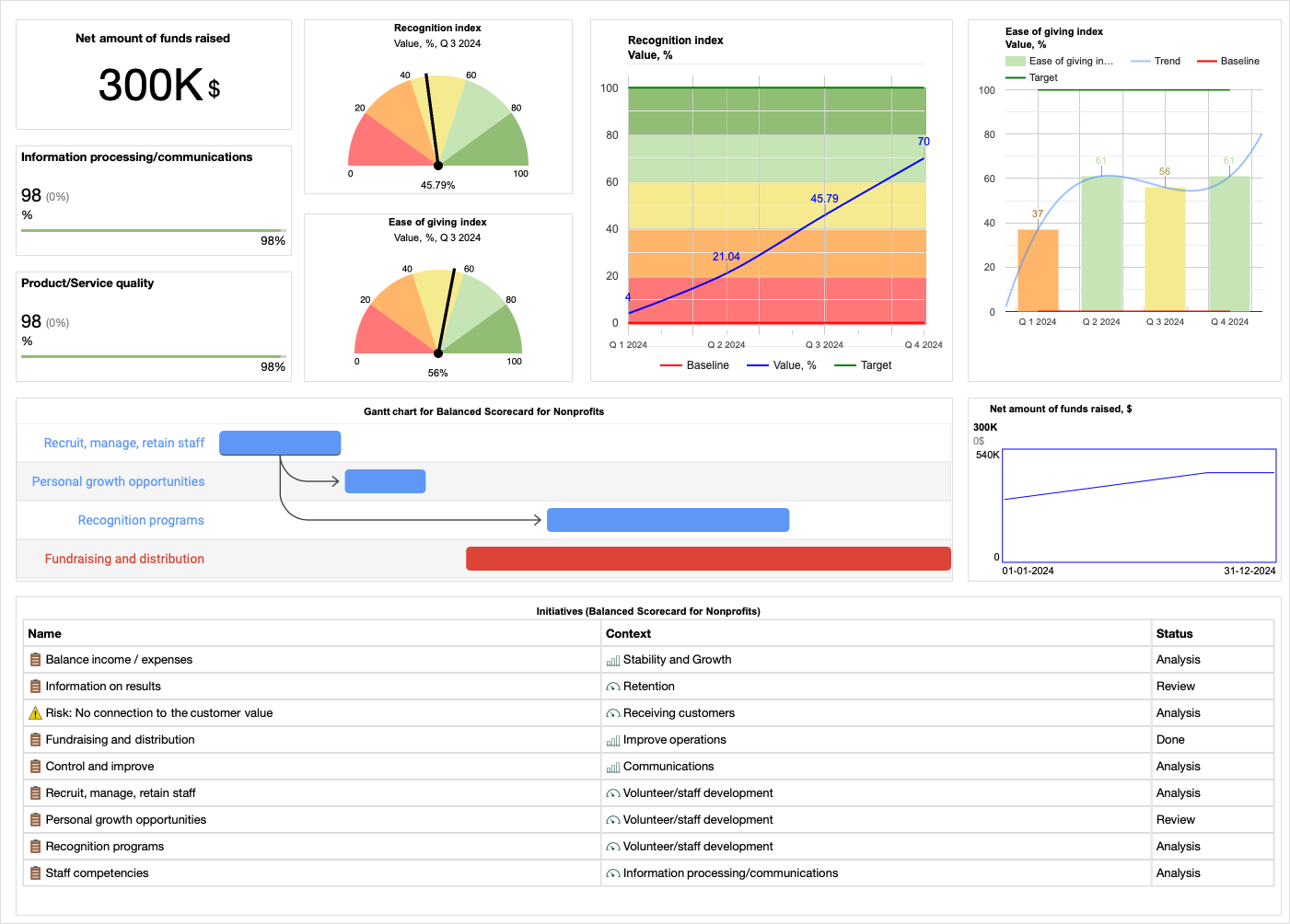
Nonprofit Balanced Scorecard.Here is an example of a BI dashboard for a non-profit:
Nonprofit Balanced Scorecard.I believe we have reviewed the most important nuances about nonprofit BSC – the rest is very similar to what we discussed talking about classical BSCs.
If you want to go ahead with your research, I’d recommend:
- A comprehensive guide by Paul Niven4
- Check out more examples of Balanced Scorecards for different domains
- The article about BSC implementation might be helpful
Feel free to share your thoughts and ask your questions in the comments.
What's next?- Follow our Strategy Implementation System to align stakeholders, strategic ambitions, and business frameworks into a comprehensive strategy.
- Automate strategic planning with BSC Designer by organizing goals, initiatives, risks, and KPIs into scorecards.
 Strategy Implementation System
More About Strategic Planning
- Strategic Performance Measurement and Management in Nonprofit Organizations Robert S. Kaplan, Jossey-Bass, A Publishing Unit of John Wiley & Sons, Inc. 2001 ↩
- Financial Perspective of the Balanced Scorecard, Aleksey Savkin, 2014, BSC Designer ↩
- Implementing A Balanced Scorecard In A Not-For-Profit Organization, Michael Martello, John G. Watson, Michael J. Fischer, Journal of Business & Economics Research – September 2008 Volume 6, Number 9 ↩
- Balanced Scorecard Step-by-Step for government and nonprofit agencies, Paul R. Niven, 2008, John Wiley & Sons, Inc. ↩

 CEO | Author | Speaker
BSC Designer is strategy execution software that enhances strategy formulation and execution through tangible KPIs. Our proprietary strategy implementation system reflects our practical experience in the strategy domain.
Hi I am looking for a score card for university strategic planning and KPI monitoring
How about this one: https://bscdesigner.com/university-kpis.htm