Sustainable growth is a key theme of most corporate strategies today. In this article, we will discuss the ways to implement pillars of sustainability (ESG) into strategy.
The content of the article:
- Introduction. What is sustainability?
- Part 1. Sustainability KPIs
- Part 2. Building a Sustainable Balanced Scorecard
 Sustainable Strategy Template.
What Do We Mean by “Sustainability”?
“Sustainability” is today a buzzword:
- Some companies are talking about “sustainable” products referring to something made of recycled materials.
- Other organizations explain their sustainability strategy by making a positive impact on society or achieving important economic outcomes.
- Dictionary definition defines sustainable as “not being harmful to the environment.”
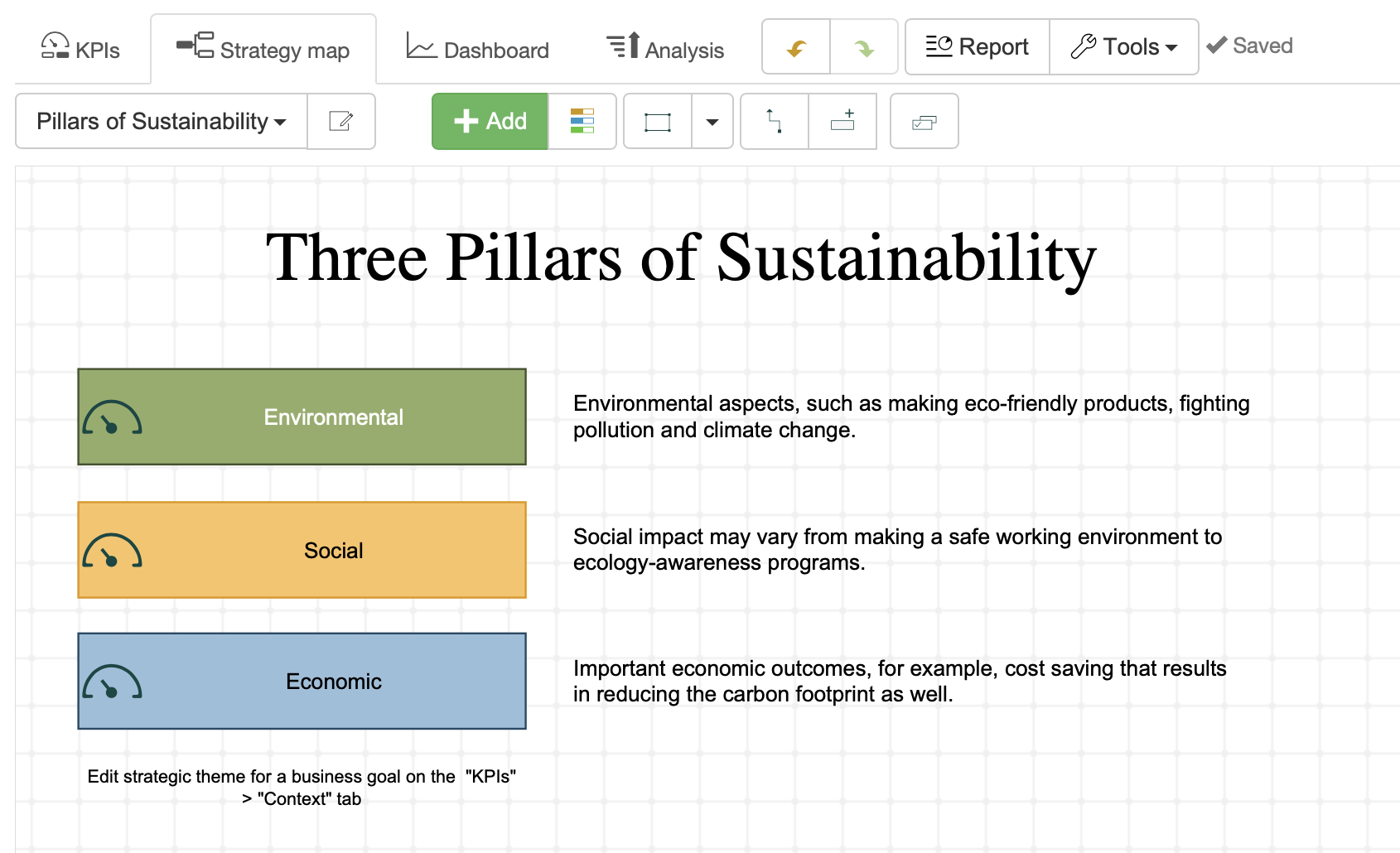
While we can find many definitions, most authors agree about three pillars of sustainability (also known under ESG acronym):
- Environmental aspects, such as making eco-friendly products, fighting pollution and climate change.
- Social impact that may vary from making a safe working environment to ecology-awareness programs.
- Important economic outcomes, for example, cost saving that results in reducing the carbon footprint as well.
Part 1. Sustainability KPIs
Here are some widely used sustainability metrics. I’m listing them here as an example of how sustainability KPIs might look like.
A better approach to sustainability KPIs would be:
- Formulating a sustainable strategy first
- Quantifying the strategy by adding some relevant performance measures or using some of the, for example, reporting frameworksSDGs or European Sustainability Reporting.
Energy
- Energy consumption, kWh / year
- Energy use in offices, kWh / m2
- Energy saved due to implemented improvements, %
Water
- Water consumption
- % of water recycled
- % of water reused
Waste
- Waste by type and disposal method
Emissions
- Toxic emissions
- CO2 emissions direct
- CO2 emissions indirect
- CO2 emissions from business travel per employee
- Nitric oxide emission
- Sulfuric oxide emission
Materials
- % of non-renewable materials
- % of recycled materials used
- Product recycling rate, %
- Packaging materials recycling rate, %
Social
- Workplace safety (more KPIs for safety)
- % of innovations that include sustainability goals
- % sustainability awareness training penetration
Management
- % of suppliers reviewed in the context of sustainability
- % of suppliers that comply with established sustainability strategy
More KPIs for procurement.
Specific sustainability metrics will change according to the business domain.
- For example, here are the sustainability KPIs for property management as presented by the United Nations Environment Program.
- Some metrics and measuring principles are established by governments, like in the case with European Sustainability Reporting.
Part 2. Sustainable Scorecard vs. Sustainable Strategy
There is no such thing as a Sustainability Balanced Scorecard:
- Talking about Sustainable Balanced Scorecard, we are actually talking about a classical strategy scorecard that describes sustainable strategy.
So, a better question to ask is:
How can we describe a sustainable strategy using the Balanced Scorecard framework?
I saw two approaches:
- Adding perspectives. Adding additional Social and Environmental perspectives (I don’t recommend this approach, see my arguments below).
- Focusing existing strategy on sustainability. Updating the goals on your strategy map with sustainability in mind.
Why Adding “Society” or “Ecology” Perspective is a Bad Idea
This approach appeared in 2002 under “SBSC” (Sustainability Balanced Scorecard) term as the result of a two-year research project sponsored by the German Ministry for Science and Education. The “Sustainability Balanced Scorecard” research was done by the Institute for Economy and the Environment (St. Gallen) and the University of Lüneburg.
The result of the research was the method of integration earlier developed sustainability ideas into an existing Balanced Scorecard framework by adding two additional perspectives to the Balanced Scorecard method: Society and Environment.
KPMG introduced a similar idea that focused on integrating environmental performance indicators.
What´s wrong new with these two perspectives? A short answer:
Adding the perspectives shifts the focus of the organization from strategy to performance measurement.
BSC Designer practice shows that companies with more perspectives tend to convert their strategy scorecard into a KPI scorecard and use perspectives as containers for their countless metrics.
Tracking sustainability KPIs is a must, but we need to track them in the context of certain goals and strategy; otherwise, their impact will be limited.
Focusing Existing Strategy on Sustainability
A better approach would be to analyze the current strategy scorecard and make sure that the goals mapped across all perspectives meet the requirements of sustainability.
Analyze Stakeholders
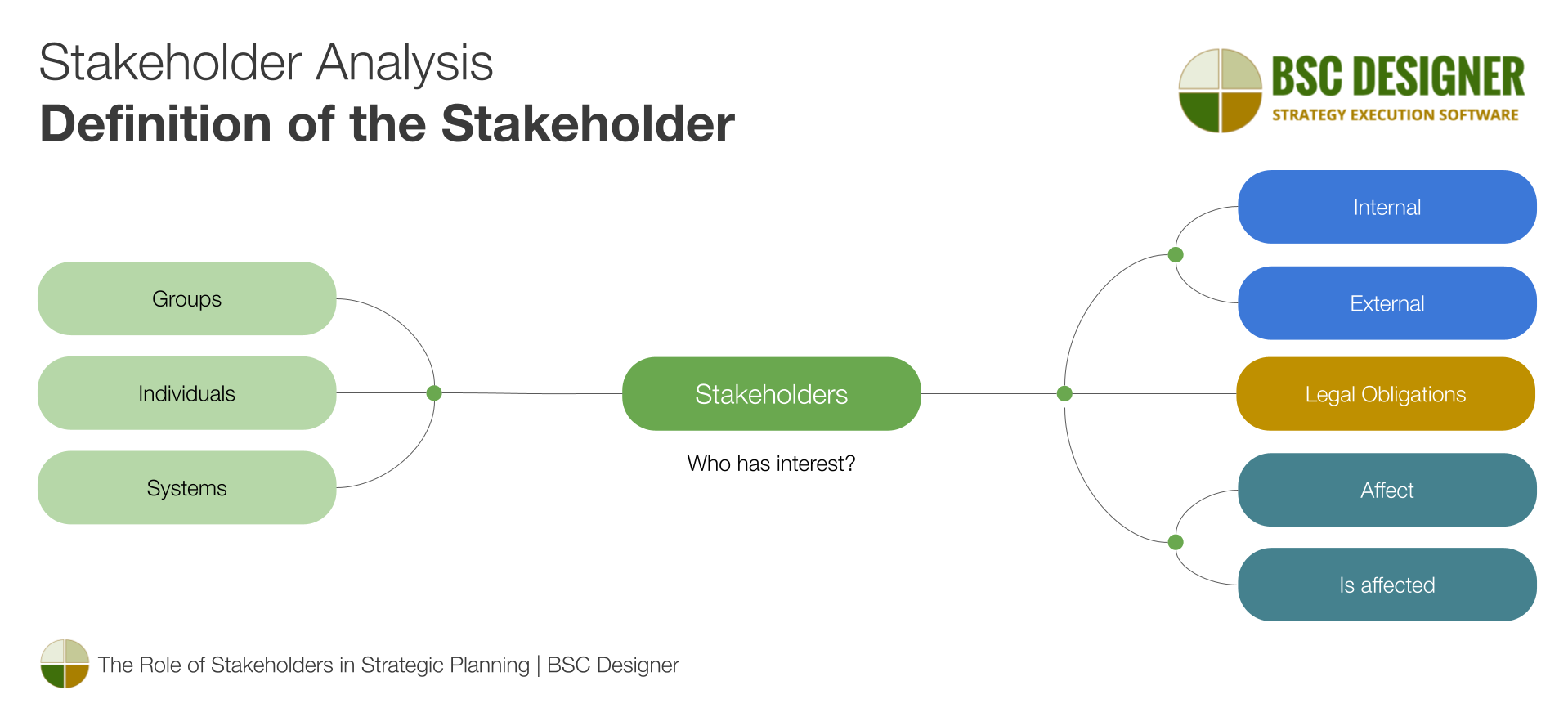
A starting point would be to expand the list of stakeholders. Who is interested in achieving sustainable goals? In the best case, all stakeholders are. The typical sustainability stakeholders are:
- Governmental regulators
- Green customers: sustainability-aware clients and employees
- Local communities
Focus the Goals in Each Perspective
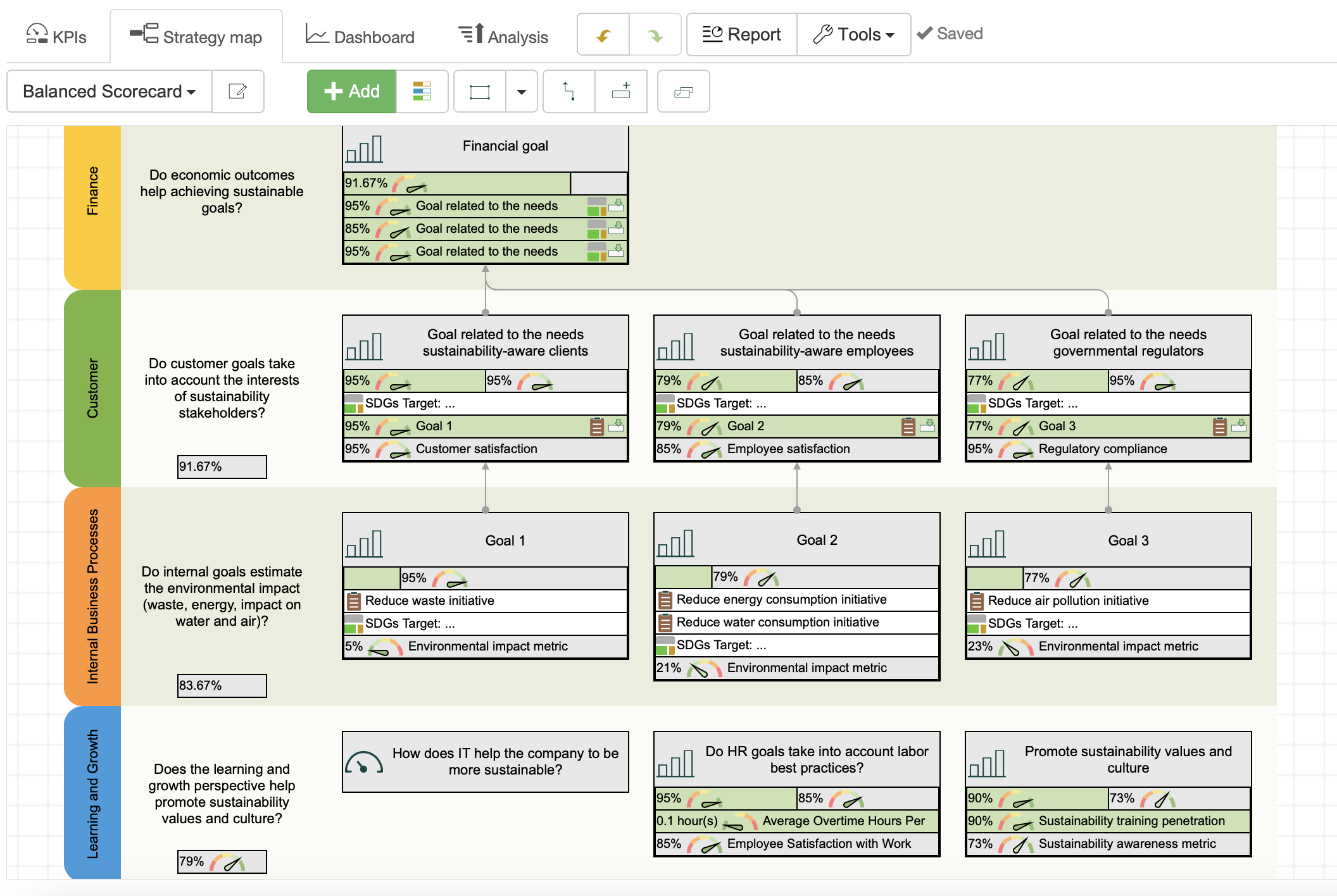
The next step is to estimate the sustainability component of the business goals. It’s similar to what we did when going through four perspectives, but in this case, the questions will be asked in the sustainability context:
- Do customer goals take into account the interests of sustainability stakeholders?
- Do internal goals estimate the environmental impact (waste, energy, impact on water and air)?
- Does the learning and growth perspective help promote sustainability values and culture? How does IT help the company to be more sustainable?
- Do talent-related goals (see the HR scorecard) take into account labor best practices, impact on community?
Sustainable Strategy Template.Reporting Sustainability with Global Reporting Initiative (GRI)
The perception of sustainability varies across domains, communities and individuals. Some initiatives promoted by the organization as environmentally-friendly might be perceived as not relevant by green customers.
Organizations need a globally recognized framework to focus their sustainability strategy. In this context, we have some important players:
- Global Reporting Initiative (GRI)
- UN Sustainable Development Goals (SDGs)
- European Sustainability Reporting (ESRS and CSRD)
The Global Reporting Initiative provides a set of reporting standards giving companies specific guidance on what information they need to report on depending on their operational domain.
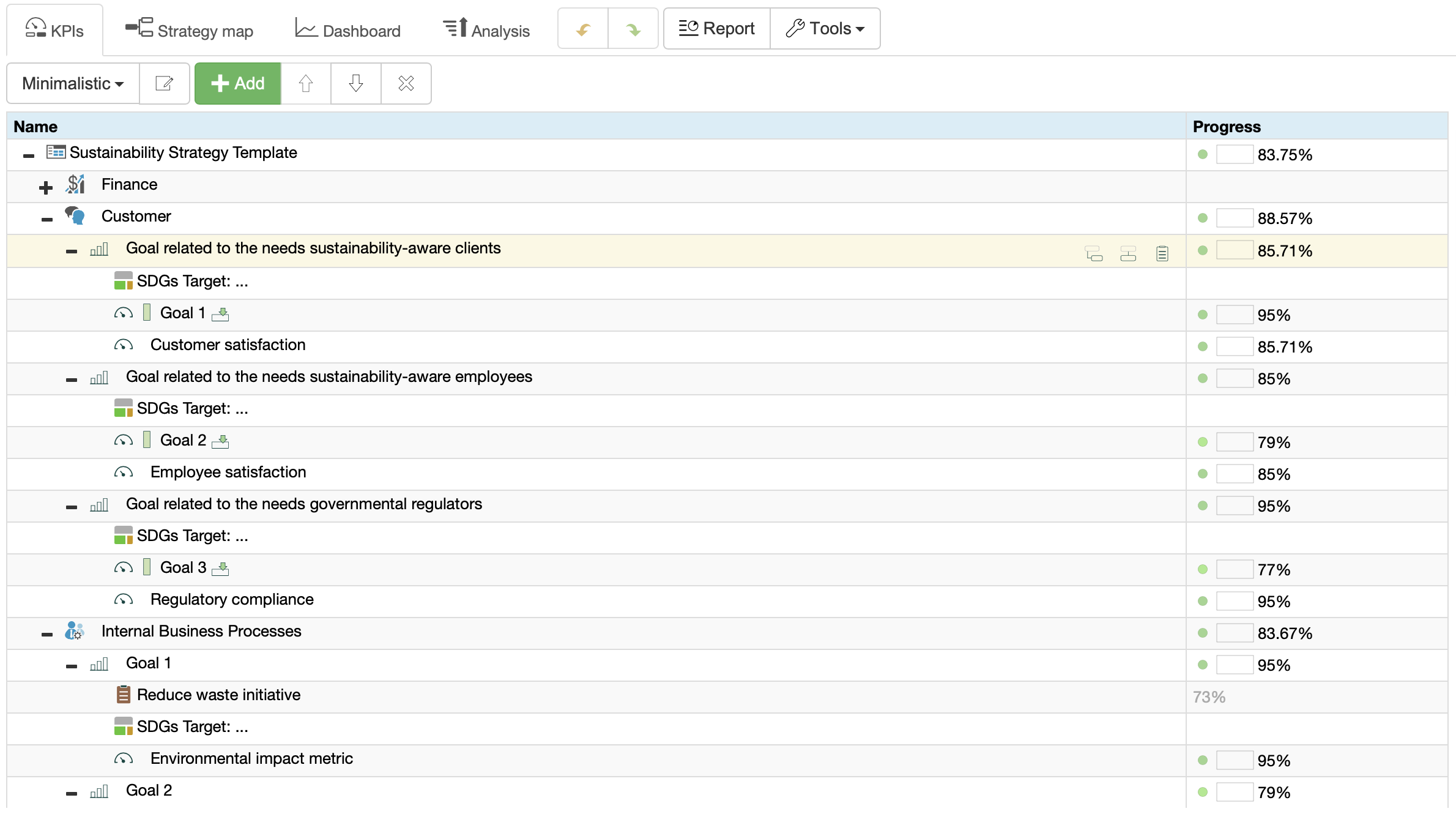
The UN´s Sustainable Development Goals (SDGs) will be more relevant to the level of strategy. Many organizations (see, for example, the “Community investment” in Bank scorecard article or The Emirates Group Environmental Report) align their strategies to the SDGs. Below, we discuss an example of such alignment.
Sustainable Strategy Template.Practical Implementation of SDGs in Organization’s Strategy
In this article, we discussed the specific steps to implement the UN Sustainable Development Goals and the goal from National Agendas into the strategy of organization.
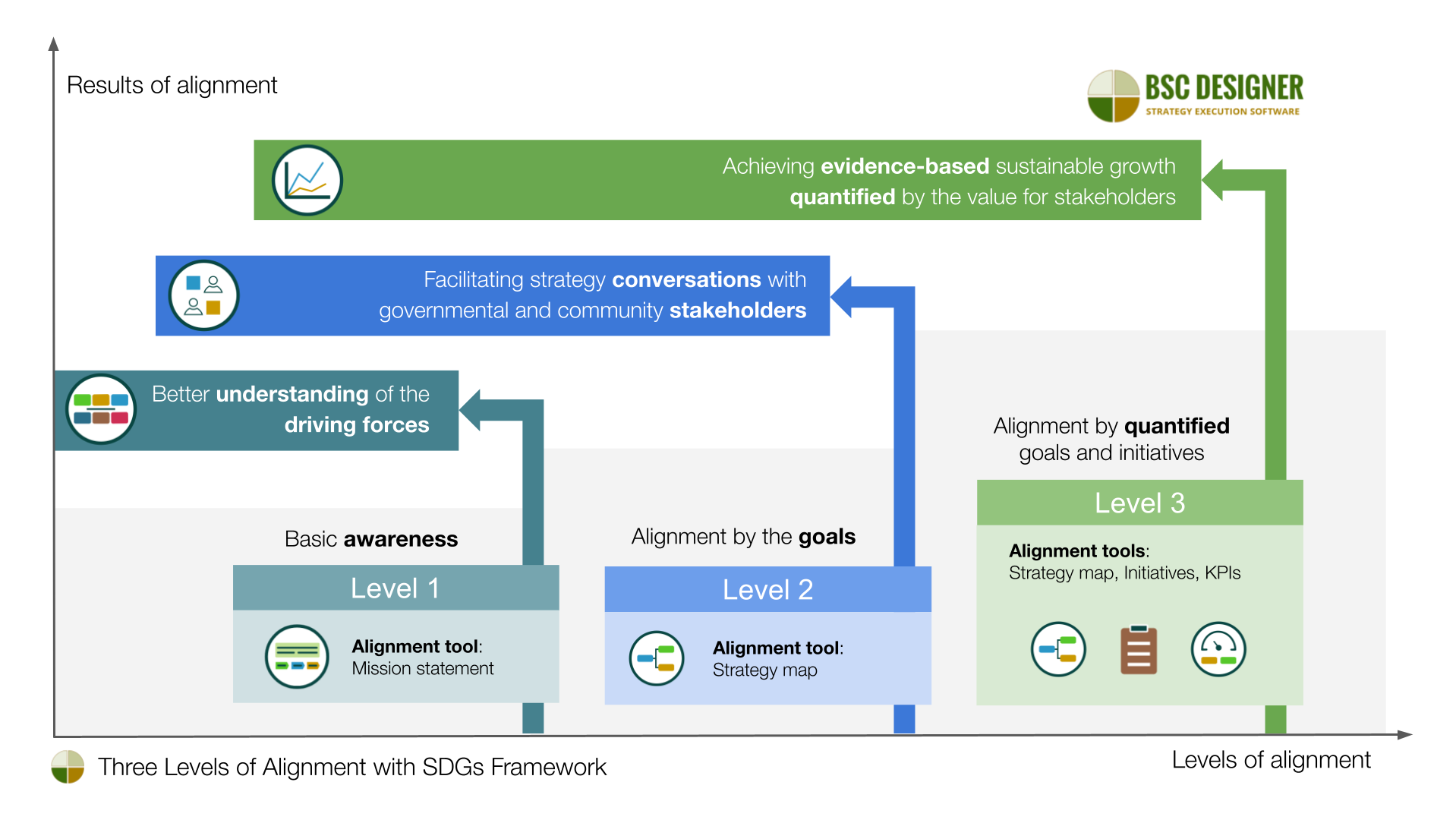
We talk about three levels of possible integration that vary from basic awareness (Level 1) to the goals and initiatives quantified by the value for stakeholders (Level 3).
- Follow our
 Strategy Implementation System to align stakeholders, strategic ambitions, and business frameworks into a comprehensive strategy.
 - Automate strategic planning with BSC Designer by organizing goals, initiatives, risks, and KPIs into scorecards.
 Strategy Implementation System
More About Strategic Planning

 CEO | Author | Speaker
BSC Designer is strategy execution software that enhances strategy formulation and execution through tangible KPIs. Our proprietary strategy implementation system reflects our practical experience in the strategy domain.
sostenibilidad y turismo con BSCdesigner:
http://www.tourism4development2017.org/knowledge/model-of-sustainability-balanced-scorecard/
Thank you for sharing and thank you for using BSC Designer to create your Sustainability model. Gracias por compartir!