Upgrade the classical SWOT framework with “S” – strategy component. Generate business insights and map them directly on the strategy map.
Navigation:
- Classical SWOT
- SWOT+S: SWOT+Strategy
- SWOT+S: Use Example + Template
- Explanatory Video
- SWOT: Advantages and Disadvantages
What is SWOT?
SWOT analysis doesn’t require any introduction – the classical four (Strengths, Weaknesses, Opportunities, and Threats) form an acronym that is easy to remember and is known in the business community for its simplicity and effectiveness.
Another point of view is that SWOT describes what is already obvious and doesn’t add any value. A sarcastic interpretation of the acronym in this case is SWOT = Simple Waste of Time.
Let’s see if and how the SWOT framework adds value.
Where SWOT Stands in Strategic Planning
First of all, SWOT is often called a strategy planning framework. It makes some sense, but let’s be specific about the exact role of SWOT.
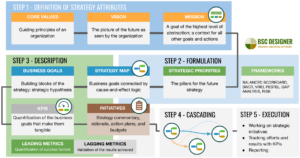
The strategy planning can be divided into five steps.
- SWOT analysis will be the most useful in step 2 – strategy formulation.
We can use SWOT for any part of the organization, from top managers to line-level employees. SWOT will help to generate a strategic hypothesis that we can later use when describing strategy.
In my opinion, the direct use of SWOT analysis for the strategy description (step 3 of strategic planning) and for the following steps won’t make any sense. A simple strategy map will always beat SWOT for the challenges of strategy description and execution.
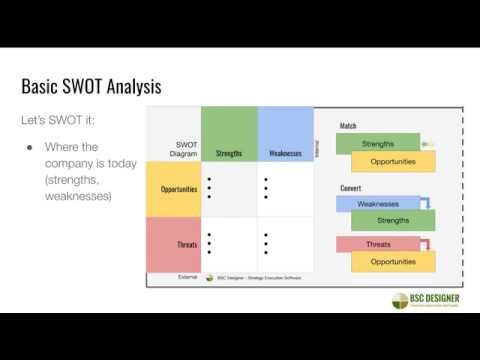
Basic SWOT Analysis
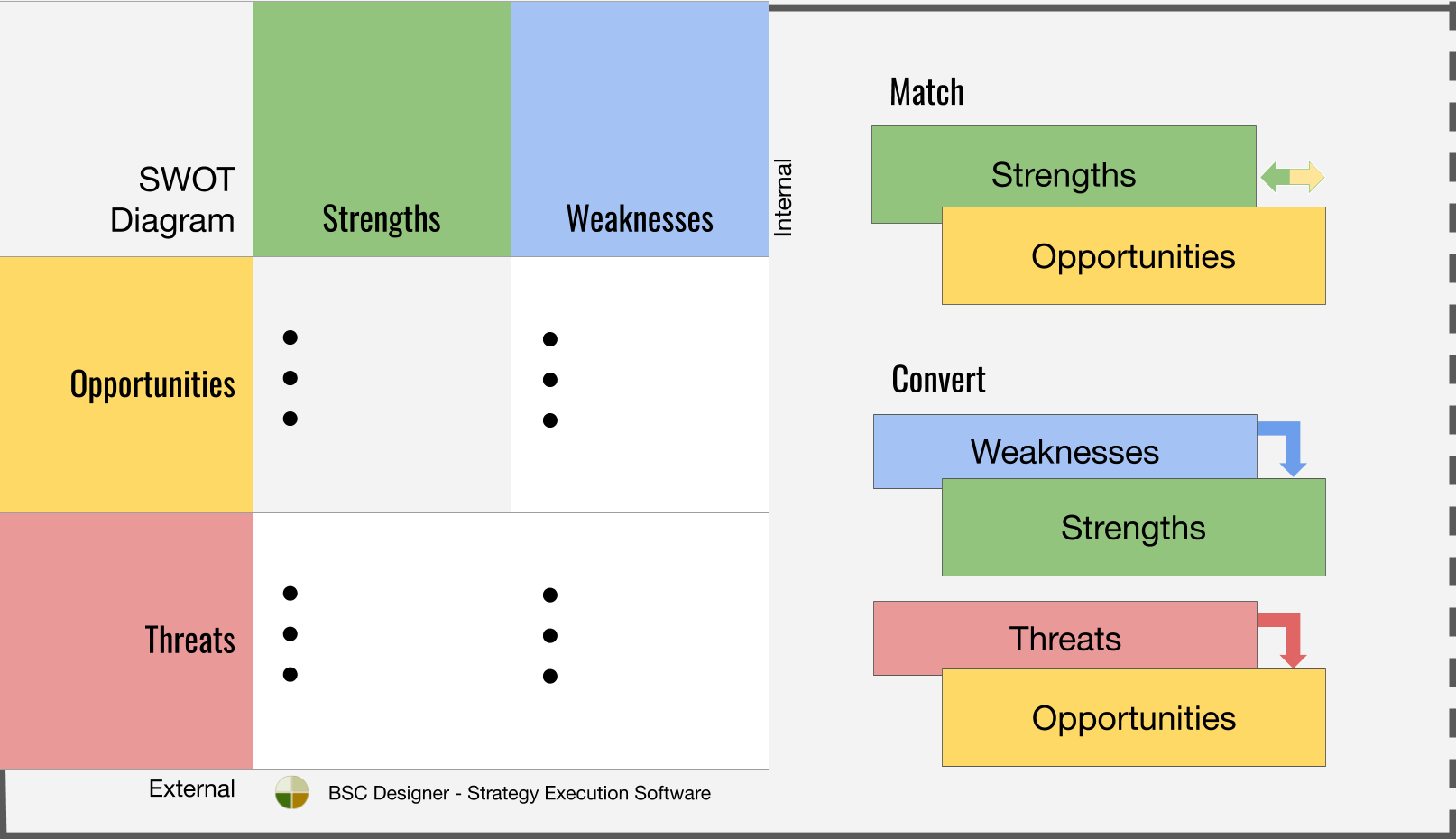
Let’s start with a basic SWOT diagram that this method is known for. This basic SWOT diagram doesn’t really take us far away from a simple checklist.
Anyway, even the most experienced business professions sometimes need to “meditate” about:
- Where the company is today (strengths, weaknesses)
- How its strategy is shaped by external factors (opportunities and threats)
Action Plan: Match or Convert
Once the ideas are categorized in the 2×2 matrix, we have two options:
- Match strength and opportunities, or
- Convert weaknesses and threats into strengths or opportunities
Let’s illustrate this with an example of BSC Designer.
Example: Matching Strengths and Opportunity
At BSC Designer, we have strong knowledge of business performance measurement domain (strength) and we do a lot of SEO (Search Engine Optimization) inhouse (strength).
We discovered that the term “SEO KPIs” is popular among those who search for information on the topic in the search engines (opportunity).
We have matched our strengths with this opportunity and compiled the ideas about measuring SEO efforts with KPIs in this article.
Example: Convert Weaknesses to Strength
Our customers are spread across the globe, so we cannot provide in-person support to all of them (that’s our weaknesses). Additionally, some of our competitors are presented locally and can provide such personal experience (that’s threat for us).
We converted the weaknesses and the threat into the strength – we focused on achieving excellence in customer support by providing very detailed video tutorials for all functions of our software.
The online training videos won’t replace in-person meetings, but in combination with an effective ticket system, they proved to work well for most of our clients.
Let’s see if we can upgrade the SWOT framework to make it more strategy-oriented.

SWOT+S – SWOT Diagram Ready for a Strategy Map
We use SWOT analysis to generate some insights for the future strategy, then why don’t we use the perspectives of the recognized strategy execution framework (K&N Balanced Scorecard with its strategy map) during SWOT analysis?
What we do:
- We add an additional dimension (the strategy map perspectives) to the SWOT diagram
What we achieve:
- We get the results of the SWOT analysis one step closer to the strategy map.
Let’s call this diagram SWOT+S (SWOT + Strategy).
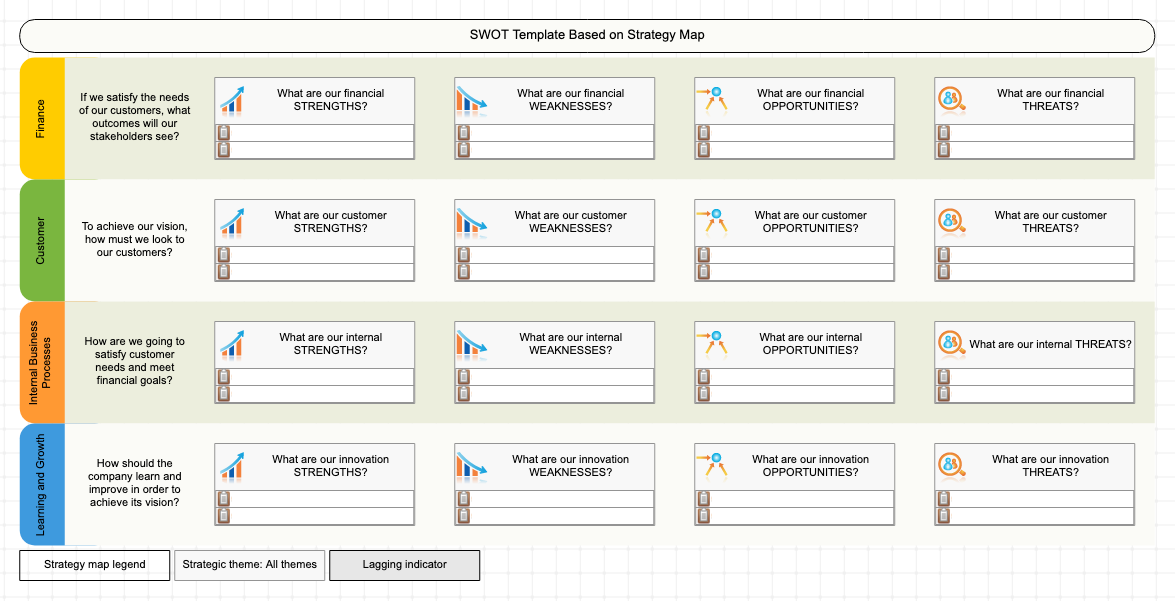
The business “meditation” approach remains the same, but now instead of the general “What are our weaknesses?” question, we will be focused on more specific questions:
- What are our weaknesses in the context of finance perspective?
- What are our weaknesses in the context of customers and other stakeholders?
- What are our weaknesses in the context of internal business processes?
- What are our weaknesses in the context of innovations?
 SWOT+S Template.
What is SWOT+S?
SWOT+S stands for Strength Weaknesses Opportunities Threats + Strategy.
It is a combination of the classical 2×2 SWOT matrix with four perspectives from the K&N Balanced Scorecard strategy map. The resulting SWOS+S can be presented on a 4×4 matrix diagram.
The purpose of SWOT+S framework is to better connect the results of insights generated by SWOT analysis with strategy description by strategy map.
Using SWOT+S Template
You can start right away with the template above. Users of BSC Designer can do even better. The SWOT+S template is available as one of the frameworks built into the software.
Create a Template
Here are the steps to use the SWOT+S template in BSC Designer Online:
- Sign up with a free plan
- Go to the My Scorecards section
- Select New > New Scorecard > More Templates … > Frameworks > SWOT+S Template
Use Initiatives to Map Your Findings
Let’s give the template a try. I’m going to use the “Initiatives” to map the findings of SWOT+S analysis.
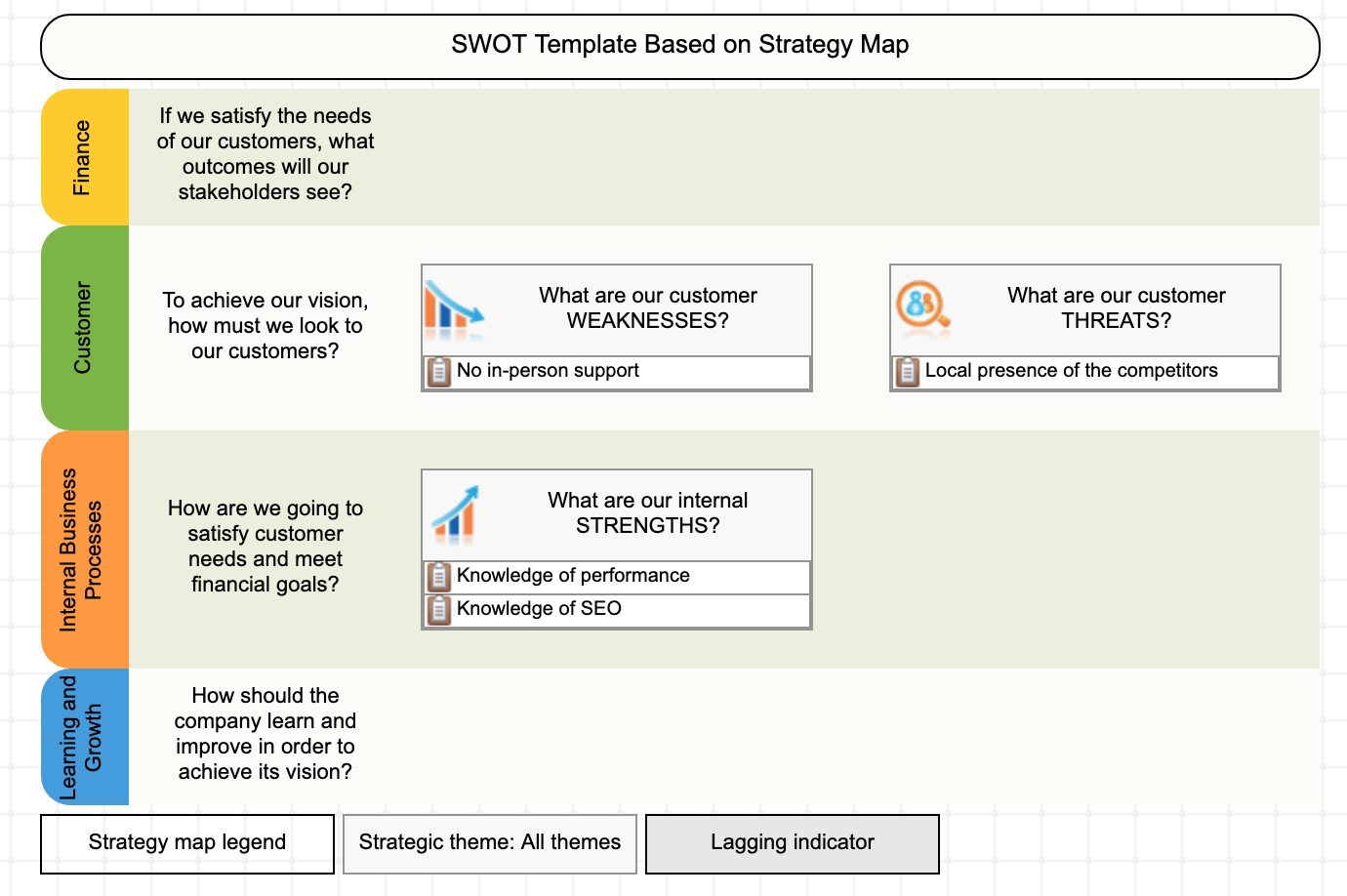
We can start with the findings I used above to illustrate the match and convert approach of SWOT:
- “Knowledge of performance measurement domain” and “Knowledge of SEO” go to the strengths column
- “No in-person support” goes to the Weaknesses column in Customer perspective
- “Local presence of the competitors” goes to the Threats column in Customer perspective
SWOT+S Template.As it was illustrated above, we:
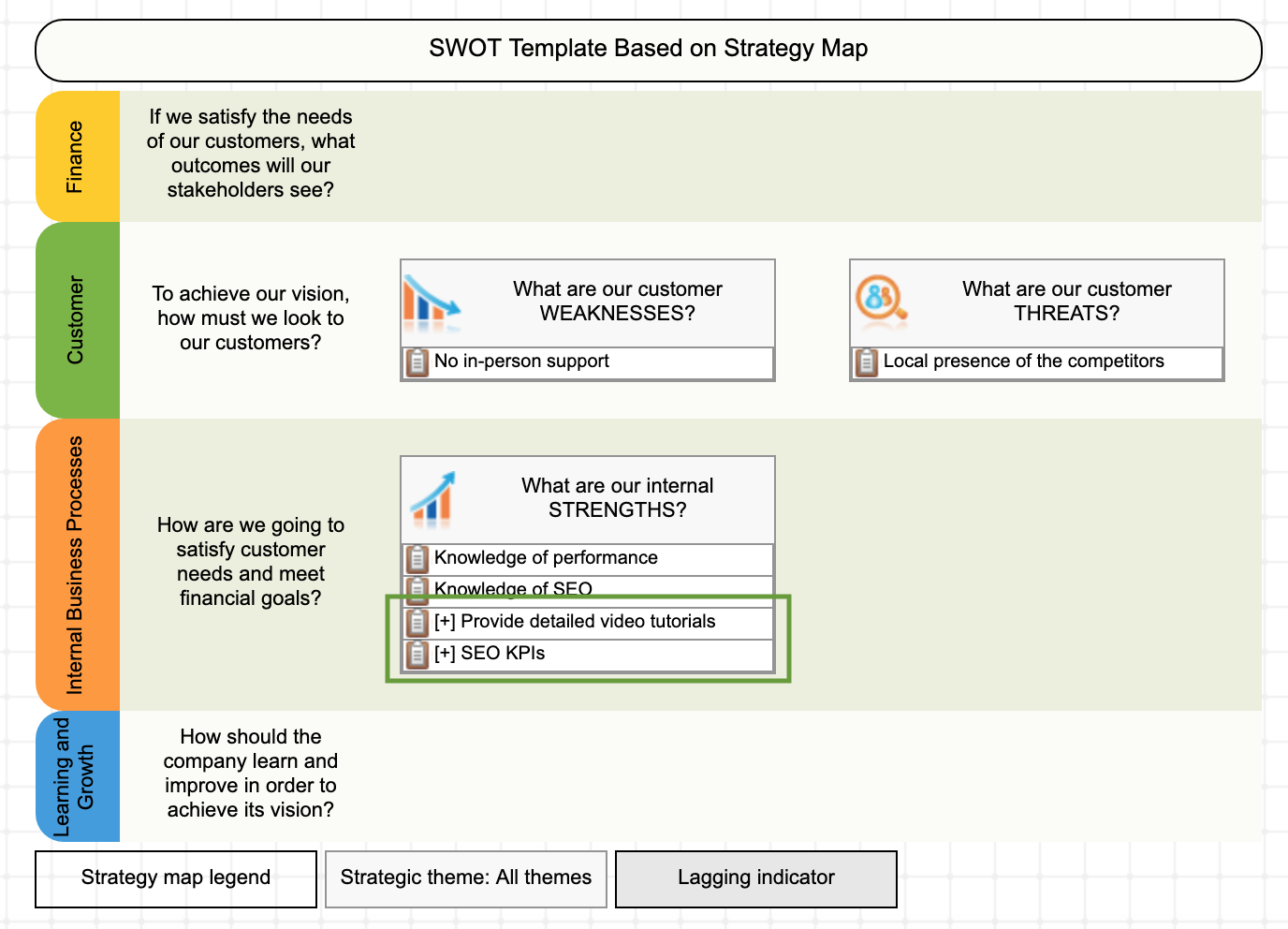
- Converted our weakness into the Provide detailed video tutorials strengths that was a lot about organizing internal video making processes, so I’ll map it in the Internal
- Matched our knowledge strengths and created “SEO KPIs” article, the article reinforced our “Knowledge of performance measurement domain” strengths.
SWOT+S Template.With classical SWOT, we could stop on this point, but I’d like to work a little bit more on the topic.
What about the ways we innovate and the ways we learn about customer needs?
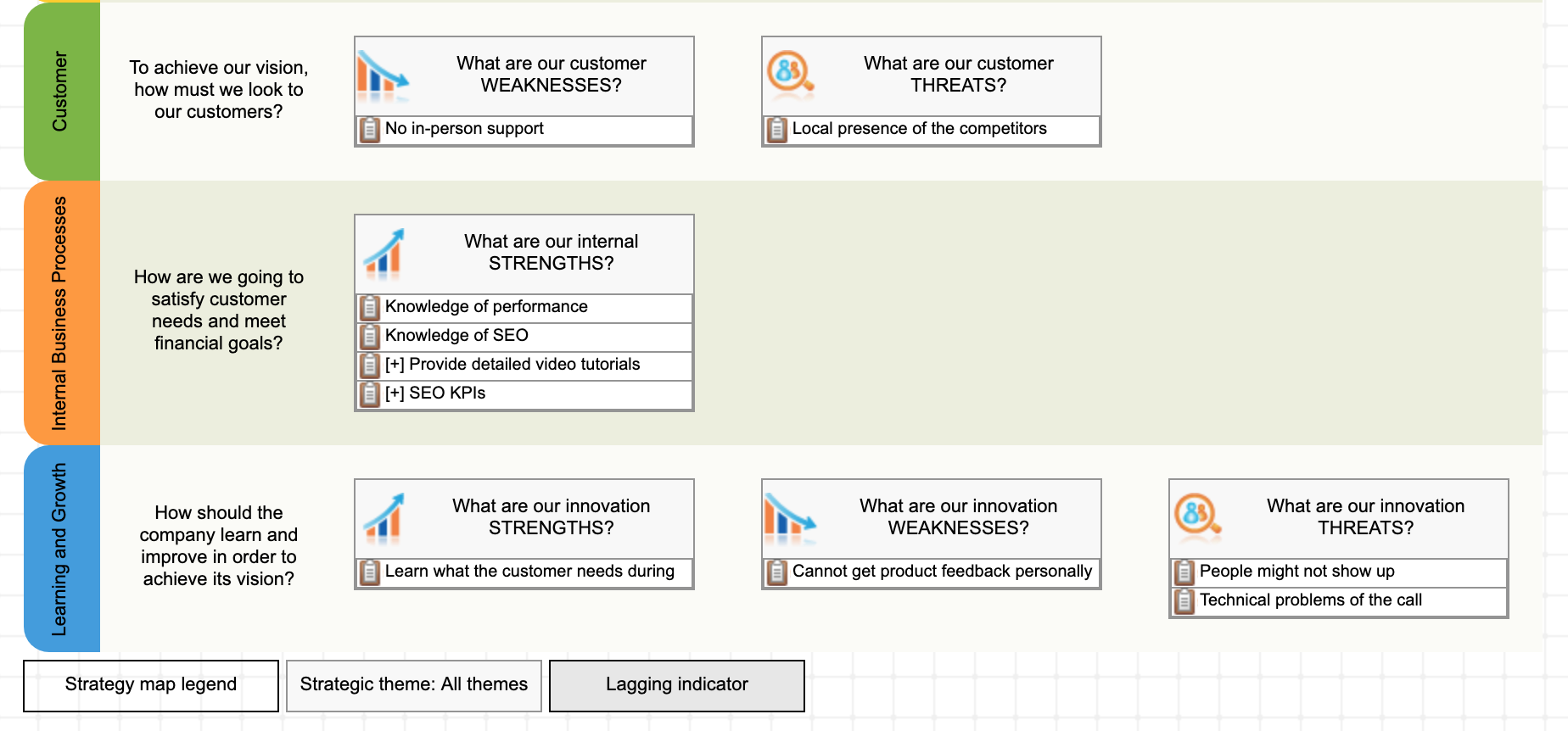
SWOT+S Template.- Our weakness is that we cannot get product feedback personally
- Our strength is that we do live demo calls where we can not only share our story but learn what the customer needs
- A typical threat for doing live calls are organizational issues – people might not show up, or there might be technical problems that prevent a smooth call experience.
Let’s discuss how we can address these factors.
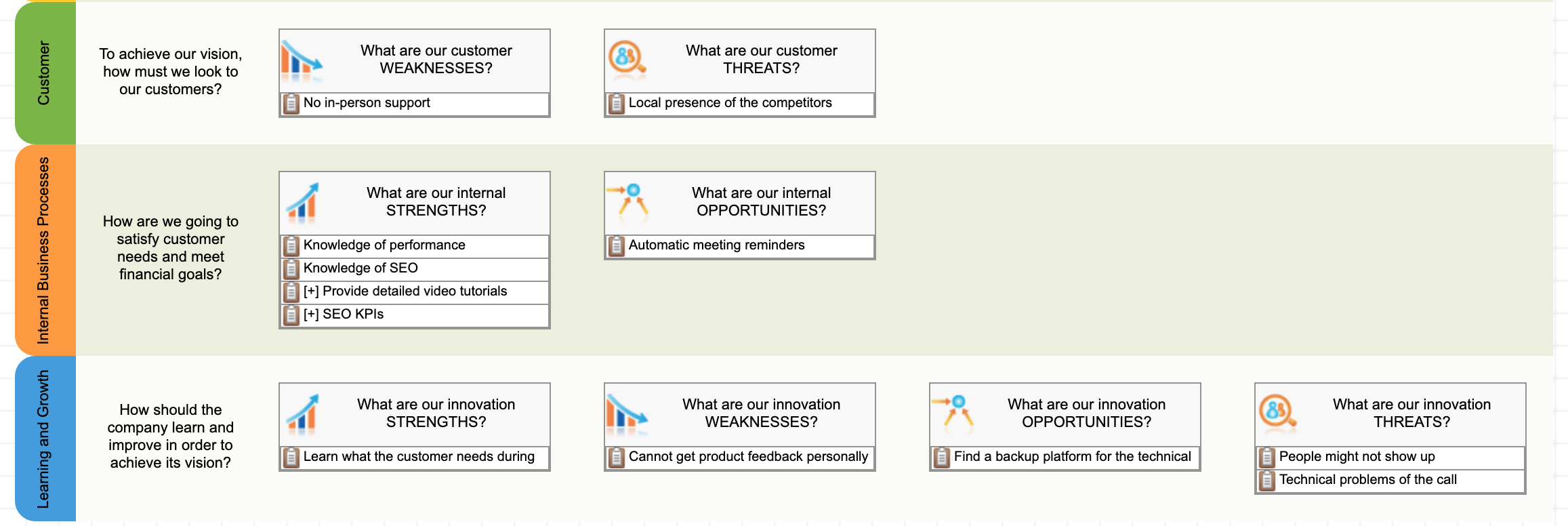
SWOT+S Template.For example:
- We can convert organization threat into opportunity by having automatic meeting reminders (we are using Google calendar) – this goes to the Internal perspective
- We can find a backup platform for the technical issues – this goes to the Learning
Save a Copy of a Scorecard
We are going to convert this SWOT+S template into a classical strategy map, so make sure you make a copy. In this way, you will be able to remember the whole analysis session and get back to the reasons for the goals when needed.
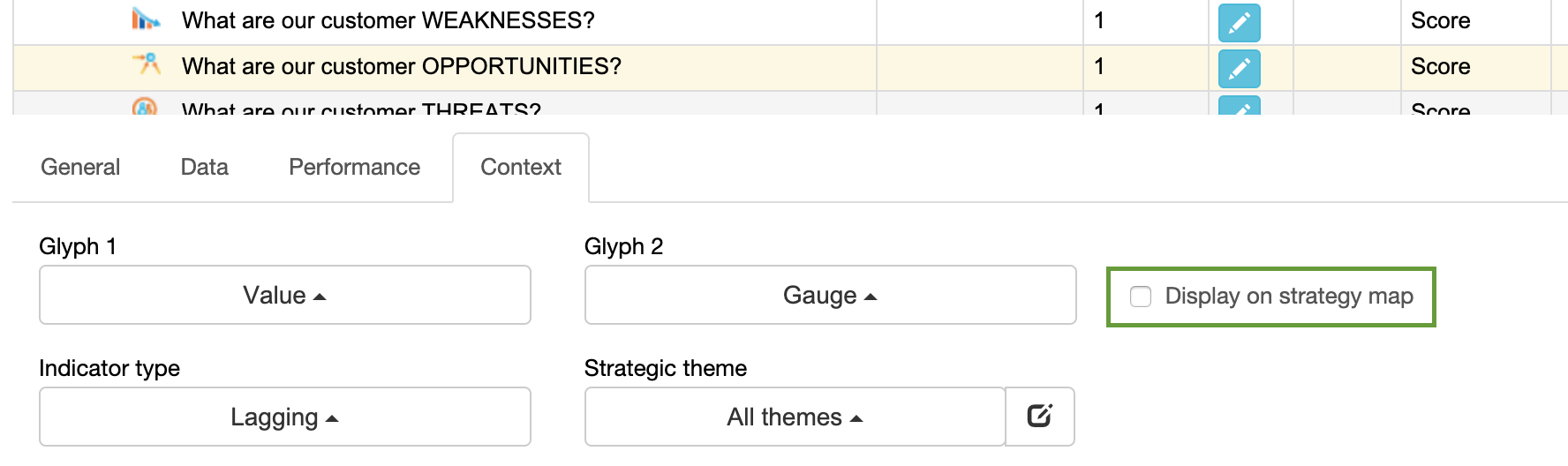
Another option is to use “Display on strategy map” checkbox to stop displaying certain rectangles on the map:
Convert SWOT+S into Strategy Map
We can now clean-up the template.
- Remove unused elements
- Remove some obvious ideas
- Remove some ideas that you cannot address now
- Better formulate some goals
In our example, the result might look something like this:
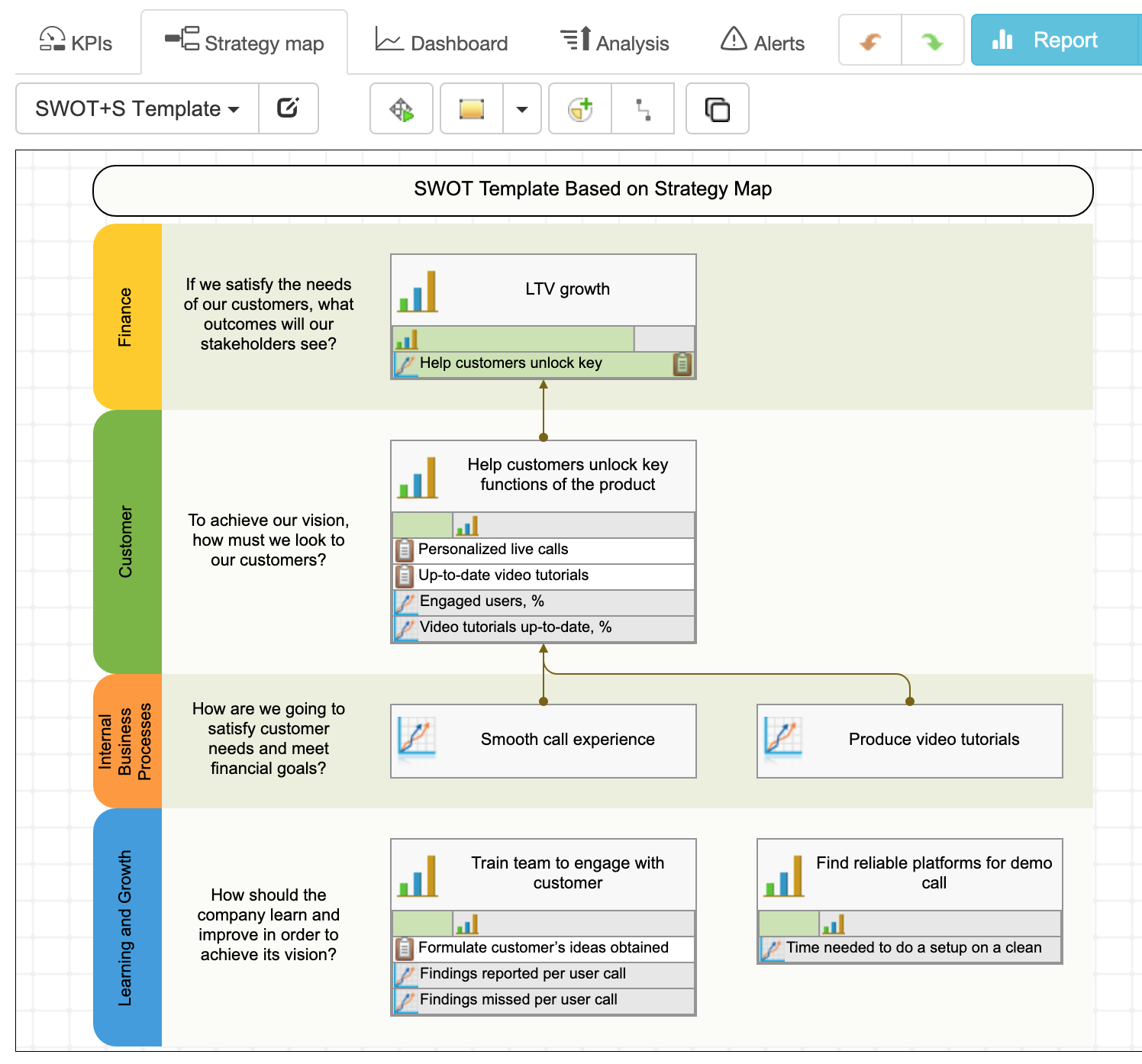
SWOT+S Template.Financial perspective
- LTV growth. By providing customers with better customer service, we expect more of them to use the product for a longer time.
Customer Perspective
- Help customers unlock key functions of the product goal
- Initiatives Personalized live calls and Up-to-date video tutorials
How can we quantify and measure this? At BSC Designer, we track:
- Engaged users, % – users who opened an account and did certain actions (create a new scorecard)
- Video tutorials up-to-date, % – we update the interface and the function of the software regularly, so this lagging metric tells us if most of our video tutorials are updated.
Internal Perspective
- Smooth call experience and Produce video tutorials goals
Learning and growth perspective:
- Train team to engage with customer goal with Formulate customer’s ideas obtained during the call as an initiative.
- Find reliable platforms for demo call
We can quantify the goals by:
- Findings reported per user call and Findings missed per user call – we can find the values of these metrics by doing random checks of the call recordings.
- Time needed to do a setup on a clean PC – in this sense, Skype is a good solution as it is typically installed on most PCs (if corporate policy allows it). We’ll evaluate an alternative solution according to this parameter.
What’s next?
We have done step 2 and step 3 of the strategic planning process. We can now go ahead with strategy cascading and execution.
Explanatory Video
SWOT PROs and CONs
In the end, I’d like to summarize some advantages and disadvantages of classical SWOT framework.
Advantages of SWOT
Here are some advantages of SWOT:
- Well-known among business professionals, so it’s easier to start talking in the same business language.
- Universal framework that can be used for any type of organization
- Provides a quick way to start the discussion about strategy
- Integrates perfectly with other business frameworks
- SWOT acronym is easy to remember
Additionally, we can add the advantages of the SWOT+S framework:
- Better integration with strategy map framework
- Involves stakeholders perspective
- Involves innovation perspective
Disadvantages of SWOT
What we call “disadvantages” are actually attempts to apply the framework out of its “designed for” area or a naive perception that the framework can generate some deep ideas even if used by someone unfamiliar with the business.
- Can be done formally on a basic level without in-depth analysis, a generic SWOT diagram creates a perception that some strategy planning job was done, when actually it wasn’t
- Doesn’t take into account time factor expressively
- Doesn’t take into account customer stakeholder expressively
- Doesn’t explain the correlation between the findings
- Doesn’t take into account the relative weight of findings
- Follow our
 Strategy Implementation System to align stakeholders, strategic ambitions, and business frameworks into a comprehensive strategy.
 - Automate strategic planning with BSC Designer by organizing goals, initiatives, risks, and KPIs into scorecards.
 Strategy Implementation System
More About Strategic Planning
Comparative Table of Strategic Planning Frameworks
- Strategy execution frameworks. Such as the Balanced Scorecard for the overall strategy and the more lightweight OKR framework for specific challenges.
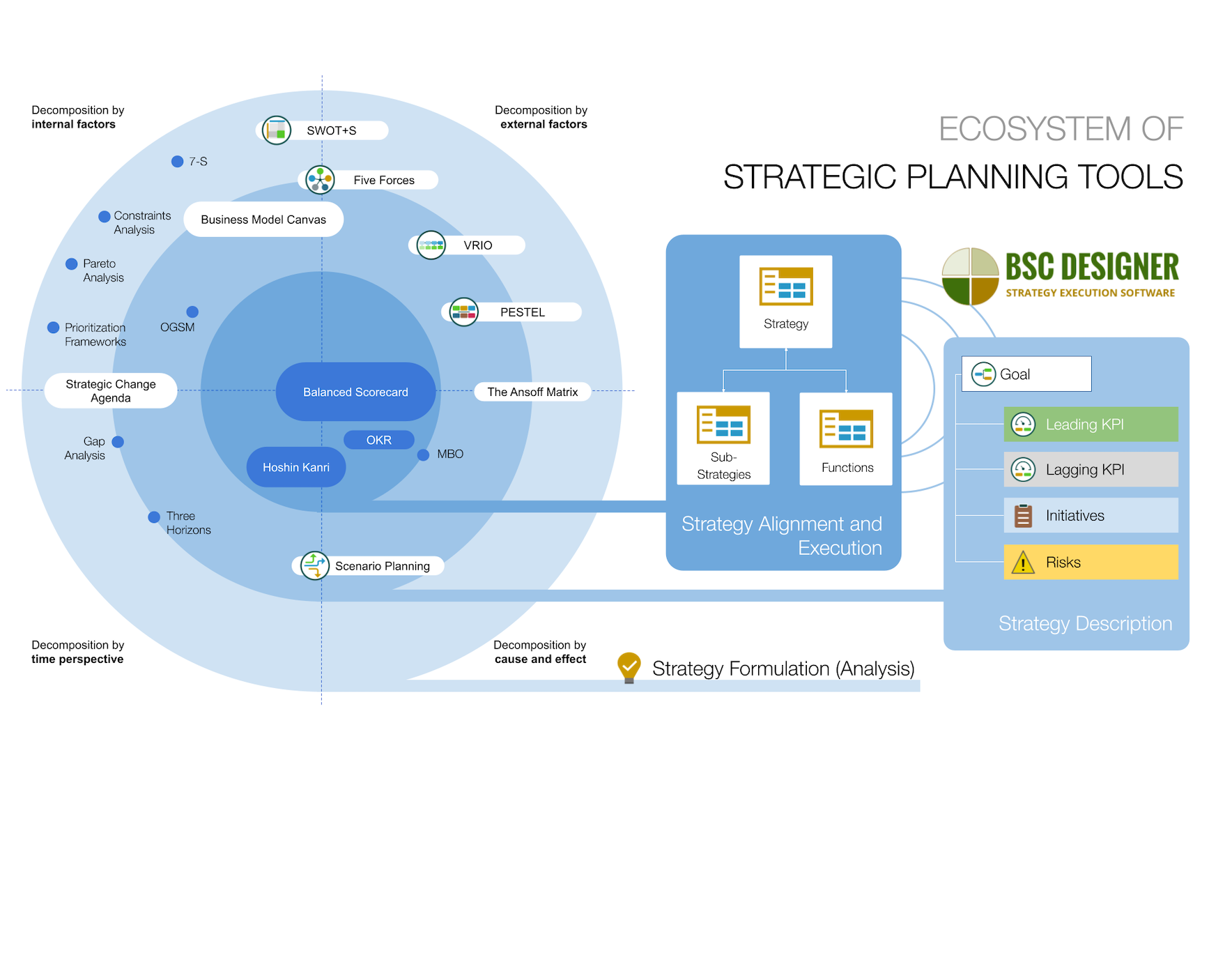
- Strategy formulation frameworks. SWOT, Three Horizons, Constraints Analysis, PESTEL, Gap Analysis, etc. that help organizations to generate new ideas.

 CEO | Author | Speaker
BSC Designer is strategy execution software that enhances strategy formulation and execution through tangible KPIs. Our proprietary strategy implementation system reflects our practical experience in the strategy domain.