Understanding the difference between leading and lagging indicators is important for successful performance measurement. This time the users of BSC Designer helped us to define the main theme for the article by asking excellent questions. Thank you for that!
Here are key topics:
- The difference between leading and lagging indicators
- What are good leading metrics and how to find them
- Critical success factors vs. leading metrics
- Many examples of leading and lagging indicators
- Measuring performance in soft niches like marketing and leadership
- How leading and lagging metrics contribute to the connected goals
Feel free to ask additional questions in the comment box below the article.
What is the Difference Between a Leading and a Lagging Indicator?
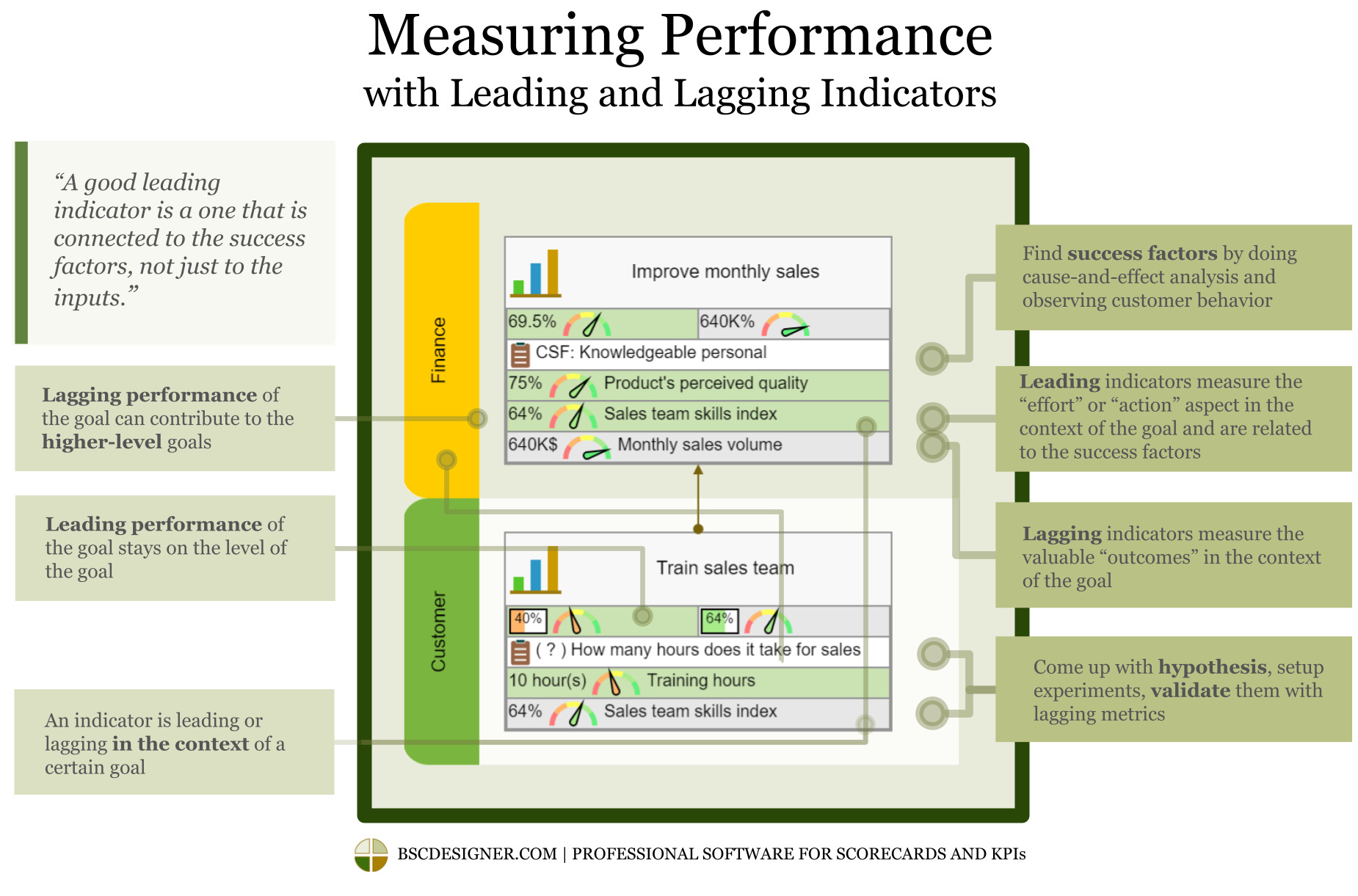
It makes sense talking about the indicator type only in a certain context (business goal):
- The indicators related to the success factors of the goal are called leading indicators;
- The indicators related to the valuable outcomes of the goal are called lagging
What does it mean that leading/lagging indicators are contextual?
The same indicator can play a role of leading or lagging metric depending on the context.
For example, in the context of a “Train sales team” goal, the “Sales team skills index” might be a lagging indicator showing how well the sales representatives were trained. The same indicator might be a leading one for the context of an “Improve monthly sales” goal.
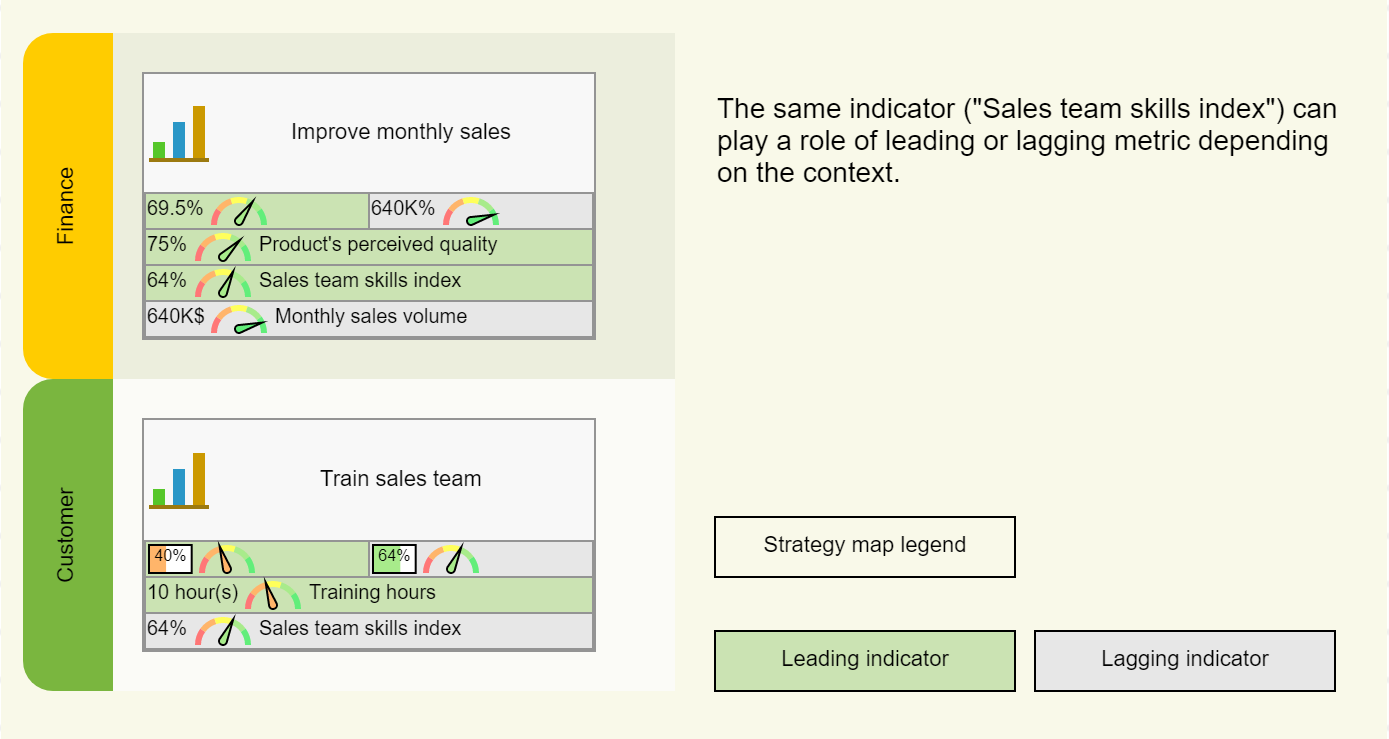
 An Example of Contextual Indicator.
Why do we need performance indicators?
To measure the performance, to understand better how things are working, to introduce corrective actions, to validate the results, to calculate bonuses, to improve accountability, etc.
- In some cases, the value is not in the indicators themselves (sometimes we simply cannot find good ones), but in the discussions/activities that happen when we were trying to find them.
What is an Easy Way to Find Leading and Lagging Indicators?
A starting point is a cause-and-effect analysis of the business context. We need to understand how things are interconnected. The result of such analysis is a list of:
- Stakeholders,
- Success factors (also called Critical Success Factors, CSFs) and
- Desired business outcomes.
Once we have success factors and expected outcomes, we can quantify and measure them.
The process to find leading and lagging indicators:
- Do a cause-and-effect analysis
- Understand success factors
- Understand desired outcomes
- Quantify
- Measure
To make things easier:
- Focus on specific business context
- Have a list of stakeholders for that context
- Think about the way value is perceived by stakeholders
What is the Difference Between Critical Success Factors and Leading Metrics?
- A leading metric is a quantitative representation of the qualitative success factor.
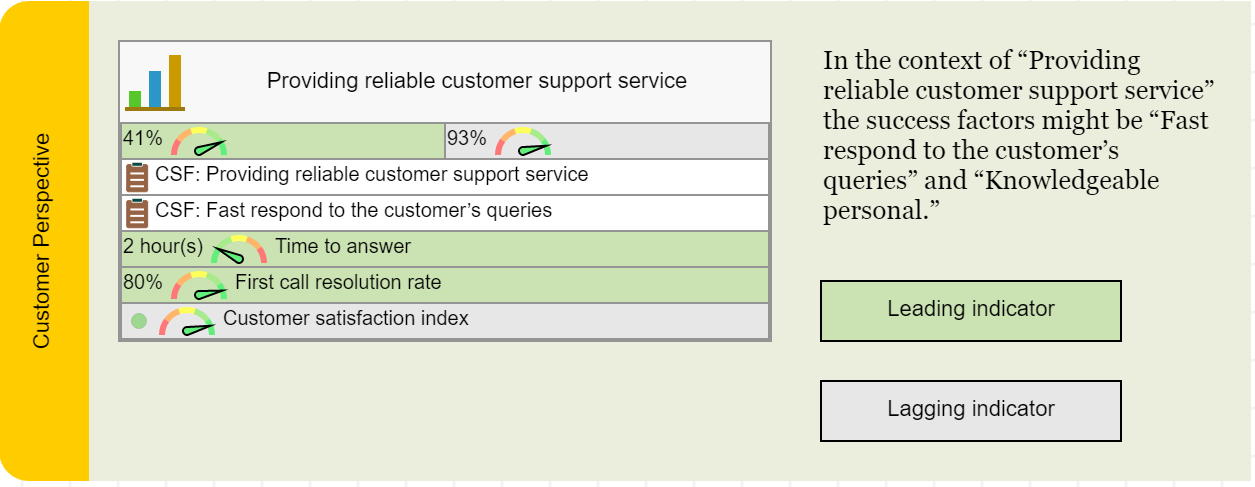
An Example of Critical Success Factors.For example, in the context of “Providing reliable customer support service” the success factors might be “Fast respond to the customer’s queries” and “Knowledgeable personal.” When we quantify on success factors we will have leading metrics:
- Time to answer, hours
- First call resolution rate, %
The quantification of the success factors allows us to associate numerical values with qualitative parameters, but obviously, it´s not a guaranty that those success factors are the right ones or the only ones.
We are always talking about a hypothesis that can be confirmed with lagging indicators. A lagging indicator in this case might be “customer satisfaction index, %” that will validate our hypothesis about the need to give fast and accurate answers.
What is a Good Example of Leading Indicators?
A good leading indicator is a one that is connected to the success factors, not just to the inputs.
A good leading indicator helps to focus future actions on what matters, it serves as an early warning signal.
In the 20th century, before a portable carbon monoxide detector was invented, coal mine workers brought canaries to the coal mine to have an early warning indicator of the dangerous carbon monoxide gas. In the context of “people have to leave coal mine” that was a leading indicator.
If you want a more poetical example, take vineyards in Europe. Next to a vineyard you will typically find planted roses. More susceptible to fungal disease, roses serve as an early warning signal to start an infection prevention plan for grapevine.
Is it Really a Good Leading indicator? Why Don’t They Just do a Chemical Analysis?
In the example above, vineyard manager must consider the value of measurement compared to the cost of measurement. The cost to plant roses is relative small, compared to the cost of continuous chemical monitoring.
How to Deal with Soft Niches Such as Marketing or Leadership?
Some typical problems in such niches are:
- Long waiting time before seeing actual results
- No way to differentiate the contribution of different experiments
- Some experiments will work only for big numbers (high traffic, a lot of daily sales, etc.)
The solution is to look at the cause-and-effect chain and find a chain link in the middle.
Let’s take marketing campaign for SaaS as an example. The cause-and-effect chain is not as simple as “marketing > sales.” Having a closer look, we’ll see that it is actually “marketing -> interest -> trial account created -> sales qualified lead -> decision making cycle -> sale -> loyal customer -> repeat sales.”
Instead of trying to answer the question “What marketing activities lead to increase in sales?” we should focus on something more tangible like “What marketing activities lead to getting sales qualified lead?”
Do We Measure Performance Using Leading Indicators or Lagging Indicators?
Let’s use this example: a sales person is making calls to the leads obtained via company’s website, his goal is to convert those leads into paying customers.
- How can we measure the performance of that sales person?
It depends on how we define the performance in this context:
- The performance in the sense of important business outcomes can be measured by the number of contracts closed;
- The performance in the sense of the efforts can be measured by the number of calls made, sales techniques used, leads quality, etc.
Is the performance measured by leading or by lagging indicators? Strictly speaking we are dealing with two types of performance – a leading and a lagging one.
Is “KPI” a Leading or a Lagging Indicator?
KPI stands for Key Performance Indicator. It is an indicator, and as any indicator, it makes sense only in a certain context. Depending on the context it might be leading or lagging indicator. For example, NPS score (the quantified answer to the question “How likely is it that you would recommend our product to a colleague?”) might be a lagging indicator for the “Improve customer service” and a leading indicator for “Increase sales.”
Measuring the Outcomes Sounds Like the Best Business Practice. Why do we Need to Care about the Leading Part?
Leading indicators are connected to the success factors, so they are useful when we ask “why?” questions. Why did sales drop? Why are customers not satisfied? Why is product quality decreasing?
Even if we don’t ask “why?” question right now, leading indicator will work as an early warning signal.
Sometimes it is Hard to Find Good Outcome Indicator. Can we Focus on Leading ones Instead?
In many cases the hard to find indicators based on outcomes are substituted with easier to find leading indicators (or vice versa). Let´s take sales training in the context of “increase monthly sales” goal. Instead of using hard to measure “impact of sales training on business performance,” HR manager can focus on easy to measure “training hours” metric.
This approach is possible, but we need to be clear about what is being measured (the efforts part) and what is not measured (the outcome part). We cannot say that the training was effective, because our team spent 10 hours on it. Training time is one of the success factors, but it doesn’t guaranty that the training takeaways will have an impact on business performance.
But they Say that Lagging Indicators are much Easier to Find than Leading ones…
Some authors stated that leading indicators are hard to find/measure, but easy to change, while lagging indicators are easy to find/measure, but hard to change. This is normally demonstrated by an example of person’s weight as a lagging indicator (easy to measure, but hard to change) and person’s diet as a leading indicator (hard to count calories, but easy to change).
As it was shown in the previous answer, an opposite situation is also possible, so using “easiness to measure” as a criterion of leading/lagging indicator type is probably not the best idea.
Isn’t “Training Hours” in the Previous Example a Lagging Indicator?
As it was discussed in the beginning, indicators are contextual. It might a good lagging indicator for the context of “Train sales team” (the focus here is on the training process itself), but it is not the best lagging indicator for the context “Increase monthly sales.” If we say that the recent sales training helped increase monthly sales, we cannot proof it by the “training hours” metric, we need to look for more tangible evidence.
What Would be a Better Lagging Indicator in that Case?
Instead of looking at the sales training, we need to look at the success factors of the sales process. Those might be:
- Short response time,
- Demo availability,
- Sales representative skills,
- Product’s perceived quality, etc.
Some of the leading indicators for the sales process will be a good lagging indicator of “effective sales training.” If there is no overlap, then we must question if this training is a good fit for the declared goal.
Are Teams Better Managed by Leading or by Lagging Indicators?
Focusing on lagging indicators only is dangerous in the long-term. The employees start caring more about getting their bonuses than about solving customers’ problem. A better approach is to discuss with your team the success factors that lead to the expected outcomes.
Are Leading Metrics Contributing to the Lagging Ones?
All hypothesis that we are testing are about answering this question. If we see that leading part is contributing to lagging one, then we are on the right track with our action plan.
Are Leading Metrics Contributing to the Connected Goals?
- Leading metrics are contributing to the leading performance of the goal they are aligned with. They are not contributing to the connected goals directly.
- Lagging indicators contribute to the lagging performance that can be used as a leading indicator for the connected goals.
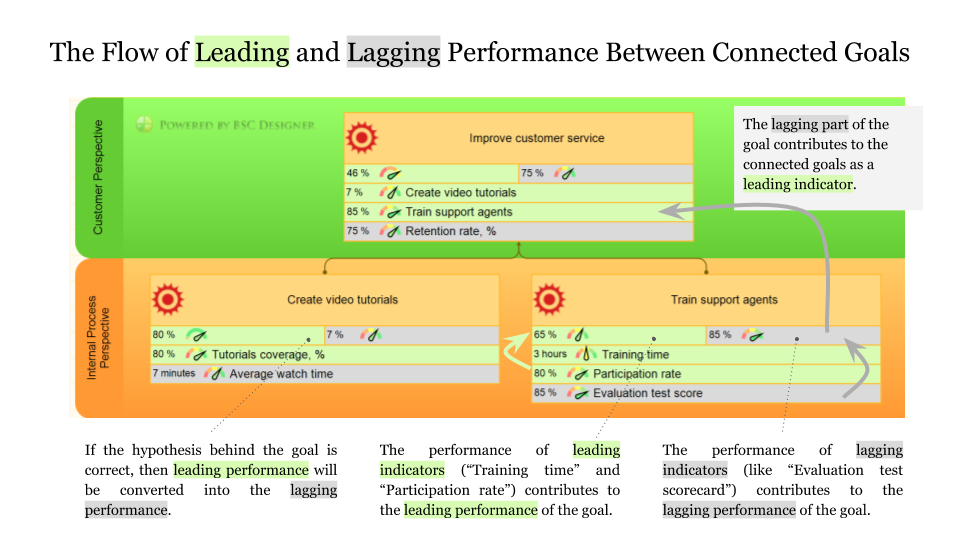
The math that stands behind the calculations was discussed here.
How do Leading/Lagging Indicators Fit into the Cause and Effect Logic of Strategy Map?
In a perfect case, lagging indicators of the goals from lower perspectives reflect the cause and effect logic by contributing to the above standing goals as leading indicators.
For example, a goal “make CRM work faster” from “Internal processes perspective” might be measured by lagging indicator “CRM response time.” The same lagging indicator “CRM response time” will work as a leading one for “Improve client service” goal from “Customer” perspective.
In practice, this is not always possible. There might be strategy maps without indicators at all (just with the goals) or the cause-and-effect logic might not be that easy to quantify.
How do Leading and Lagging Indicators Affect the Calculation of the Scorecard Performance?
We have discussed this question in detail in the Scorecard and KPIs 101 article. A short answer is that leading indicators contribute to the leading performance of the goal, respectively, lagging indicators contribute to the lagging performance of the goal. The leading performance of the goal doesn’t affect other goals on the scorecard; the lagging performance of the goal is translated to other goals on the scorecard in the form of a leading indicator.
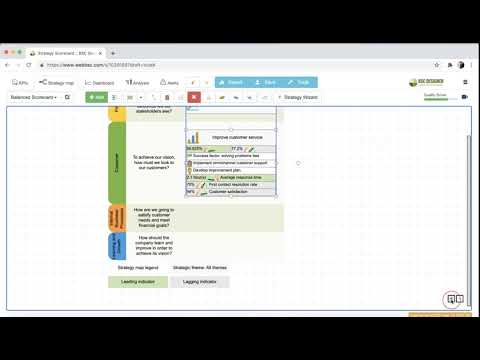
How can BSC Designer Software Help?
It helps you to:
- Track leading and lagging indicators,
- Calculate leading and lagging performance,
- Visualize both types of performance and indicators on the strategy map and on the dashboard.
Actually, the screenshots that you can see in this article were taken from BSC Designer Online.
Takeaways
Here are key takeaways from the Q&A.
Type of indicator:
- An indicator is leading or lagging in the context of a certain goal
- Leading indicators measure the “effort” or “action” aspect in the context of the goal and are related to the success factors
- Lagging indicators measure the valuable “outcomes” in the context of the goal
Finding metrics:
- Find success factors by doing cause-and-effect analysis and observing customer behavior
- Come up with hypothesis, setup experiments, validate them with lagging metrics
Leading and lagging performance:
- A business goal can have several leading and lagging indicators aligned with it
- Leading and lagging performance can be calculated for the goal
- The indicators must be normalized before the calculation
Leading and lagging metrics in scorecard:
- Leading performance of the goal stays on the level of the goal;
- Lagging performance of the goal can contribute to the higher-level goals;
The official Q&A is now closed, but you are welcome to ask more questions in the comments or using a contact form.

 CEO | Author | Speaker
BSC Designer is strategy execution software that enhances strategy formulation and execution through tangible KPIs. Our proprietary strategy implementation system reflects our practical experience in the strategy domain.