Learn how to measure leadership effectiveness with KPIs grouped into three perspectives – Strategy, Team, and Leader’s Growth.
 Leadership Effectiveness Scorecard.
Key topics of the article:
- Definition of leadership
- Is Leadership Measurable?
- Framework to assess leadership effectiveness
- Technical setup for KPIs
- Executive summary
Definitions of Leadership Won’t Help Much in Measurement
Many definitions of leadership were suggested over the last decades. For an overview of how leadership can be defined, I recommend checking out Leadership Effectiveness1 article. One of the definitions of leadership that the authors discussed is:
“The successful exercise of personal influence by one or more people that results in accomplishing shared objectives in a way that is personally satisfying to those involved.”
This definition, like many others, makes perfect sense. At the same time, in some discussions, it is hard to agree on whether a historical figure was an actual leader… Let’s see if the measurement framework suggested in this article could help to make leadership effectiveness more tangible.
Is Leadership Measurable?
Is it possible to quantify and measure leadership? The answer depends on the perception of the concept of leadership in your organization.
Here is a quick test:
Think about two leaders in your organization. Can you say that one person is a better leader than another?
If your answer to the question is something like “No, all leaders are unique, and they cannot be compared one with another,” then quantifying leadership doesn’t seem to be possible in your case.
If the answer is positive, then there are certain parameters that you used intuitively to evaluate those leaders. We can quantify these parameters and eventually come up with a framework to assess leadership effectiveness (at least as it is seen in the specific organization).
If leaders can be compared, then leadership is measurable.
For more ideas on the topic of how to measure leadership, check out the Can You Measure Leadership?2 article.
Framework to Assess Leadership Effectiveness
Below, I share a framework for measuring leadership effectiveness. It’s based on ideas that we shaped when helping our customers.
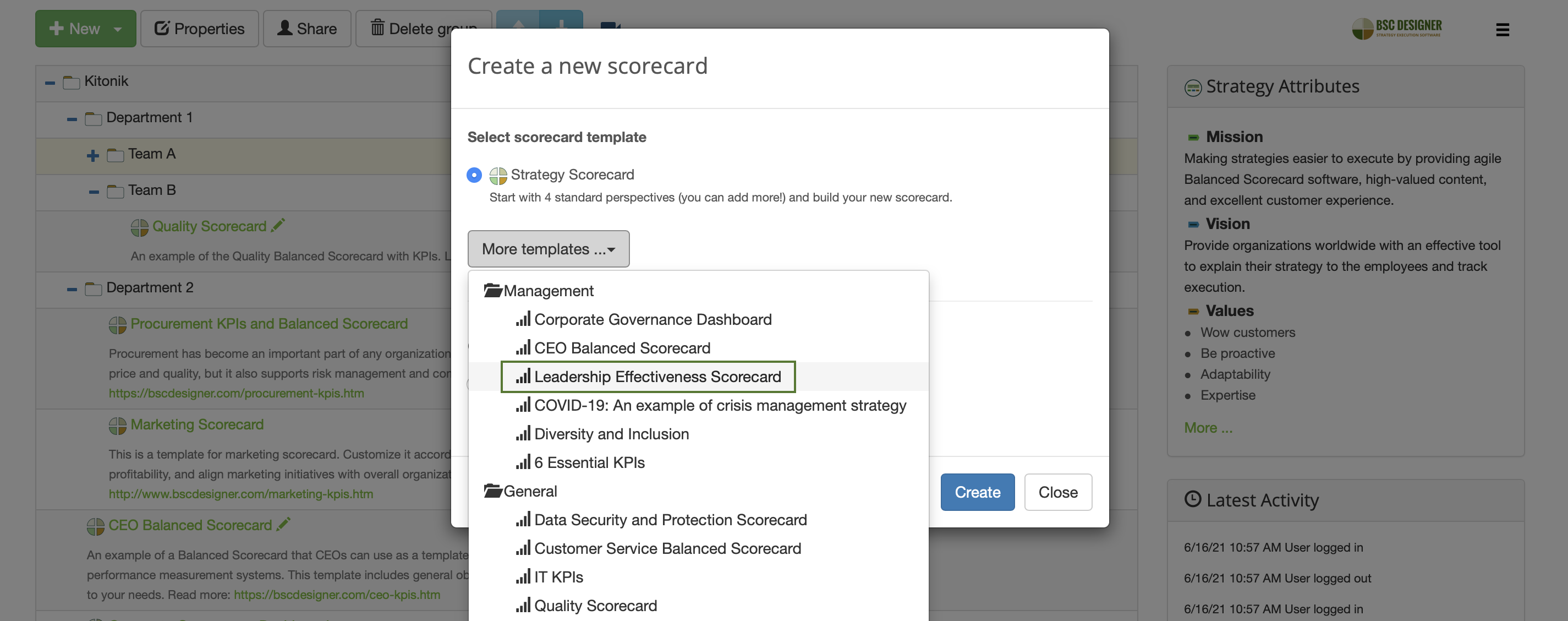
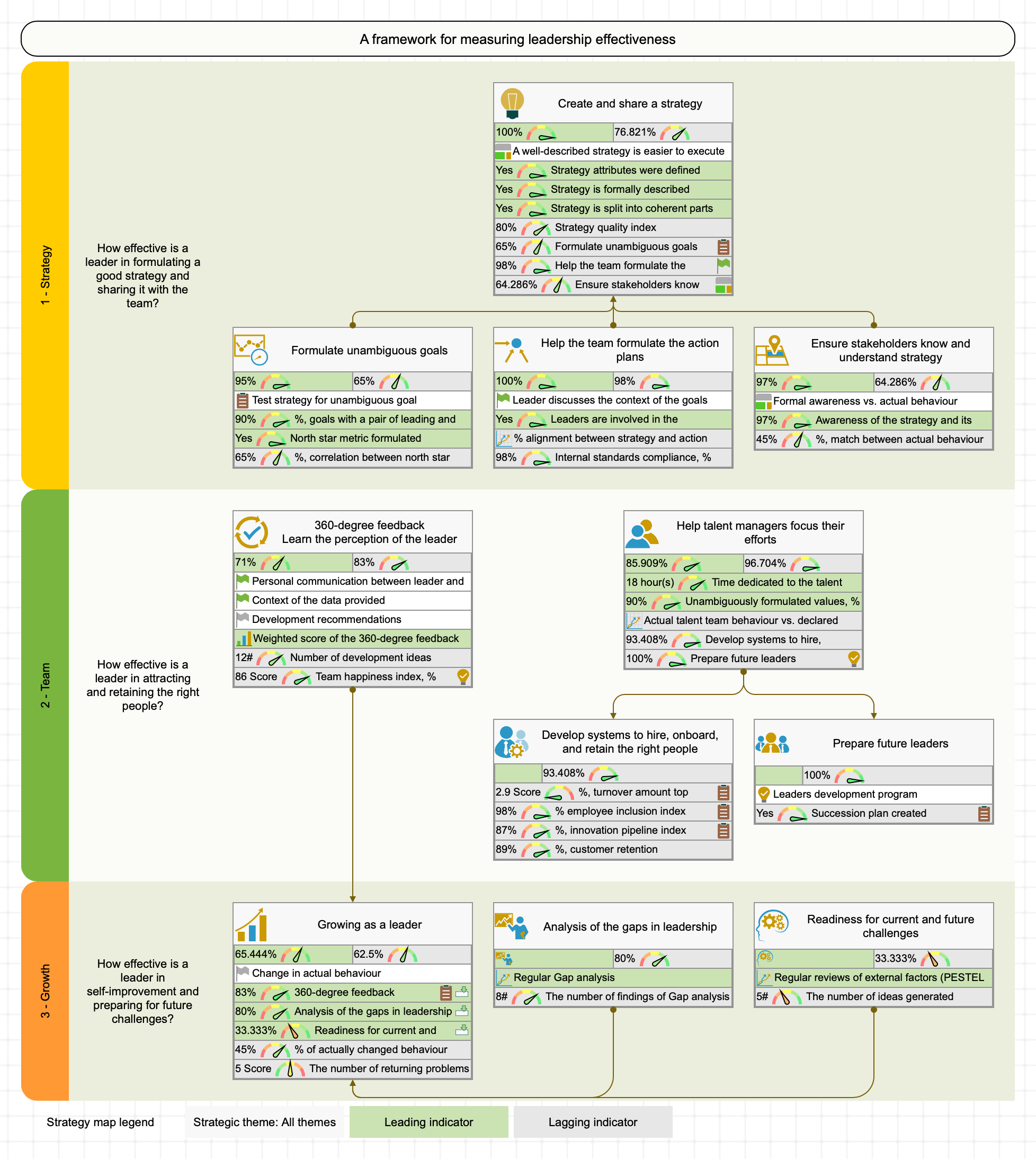
The template is available for the users of a free plan of BSC Designer software. You can use it as a starting point for assessing leadership in your organization.
Leadership Effectiveness Scorecard.Three Perspectives of the Framework
The first step of any measurement is to answer the “why?” question:
- Why do we want to measure leadership effectiveness?
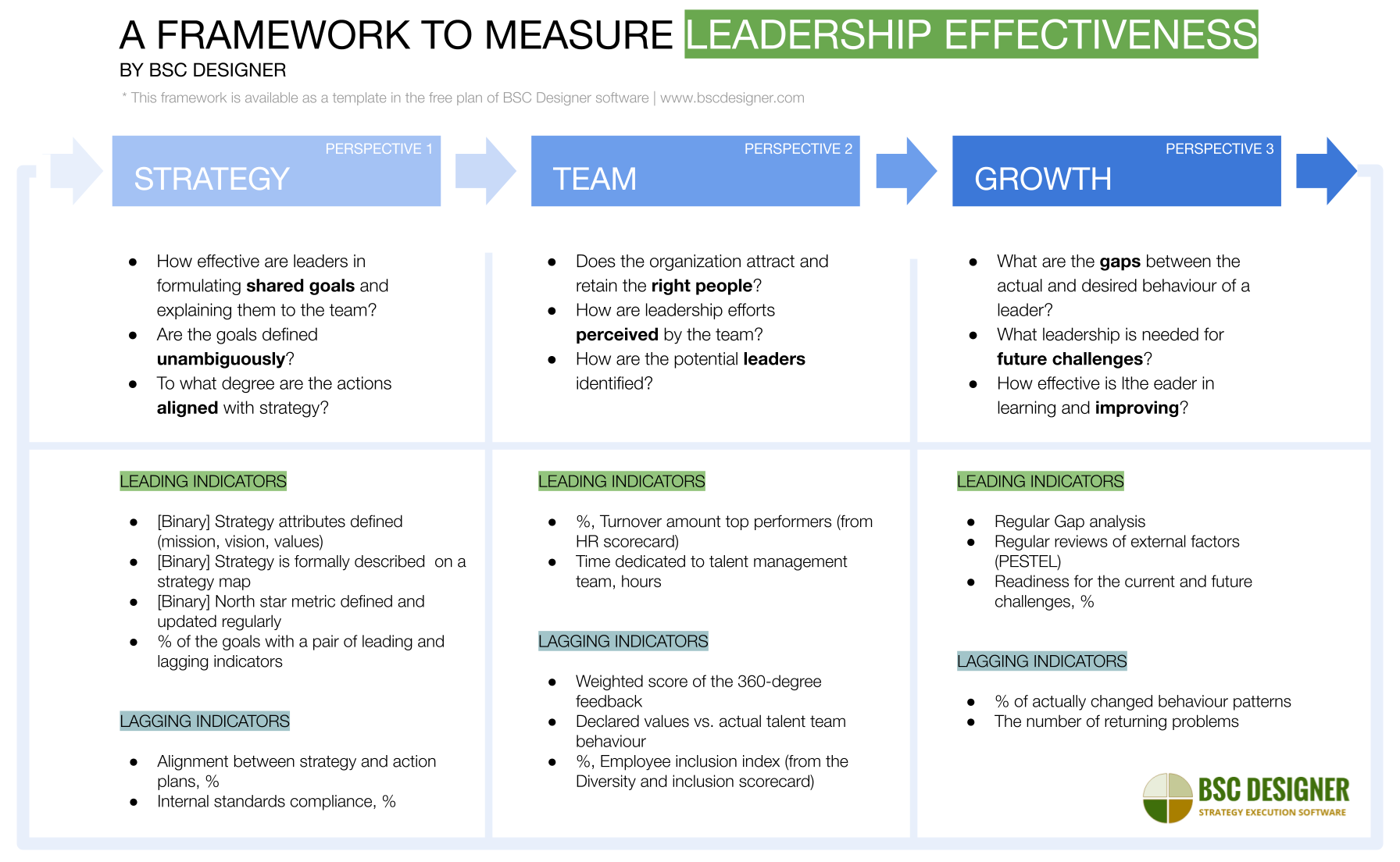
There are a number of challenges that an organization typically wants to solve in the context of leadership. We can formulate them within these three perspectives:
- Strategy. How effective are leaders in formulating shared goals and explaining them to the team?
- Team. Do the leaders attract and retain the right people? How are leadership efforts perceived by the team? How are the potential leaders identified?
- Growth. What are the gaps between actual leadership and the leadership needed to address current and future challenges? How can a leader improve?
Your organization might have different reasons for measuring leadership. Write down those reasons and use them as a filter when some new ideas related to leadership appear on the table.
Leadership Effectiveness Scorecard.Perspective 1 – Strategy. Strategy is a Leader’s Job.
Most of the definitions of leadership agree that it is about achieving shared objectives.
- What are the objectives of an organization?
- How to ensure understanding and acceptance of the objectives across the organization?
- How to make those objectives tangible and coherent?
Formulating a good strategy and sharing it with the team is a leader’s job!
There is certainly a technical dimension of the strategic planning process that includes building a strategy map, finding KPIs, cascading strategy, etc., that is often “outsourced” to strategists or other top managers, but on the conceptual level, strategy is the leader’s job.
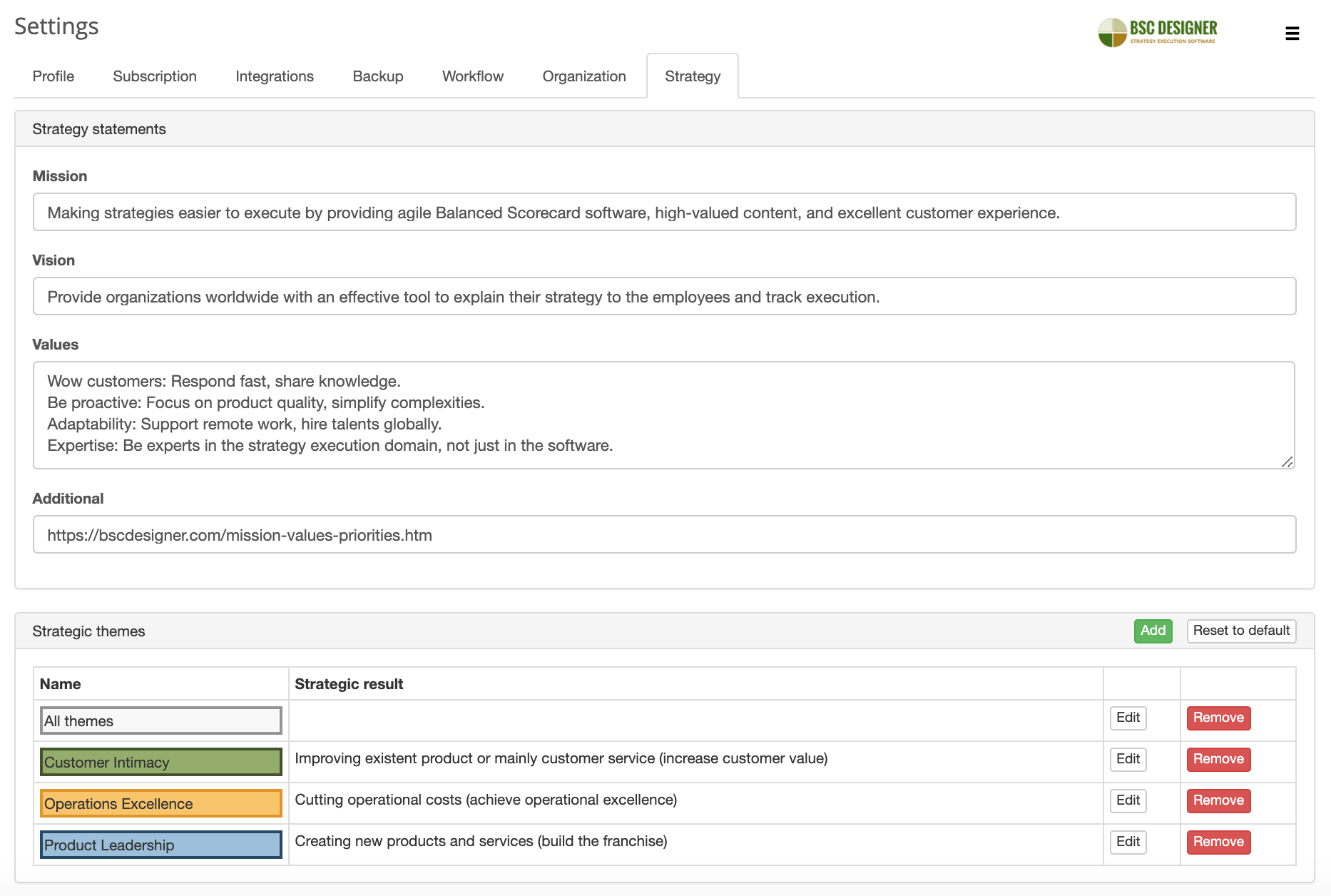
Formal Strategic Planning – Attributes of Strategy
How to quantify the role of a leader in strategic planning? We can start by looking at the formal existence of strategy and its attributes.
Leadership Effectiveness Scorecard.This can be quantified by binary indicators:
- [Binary] Strategy attributes are defined (mission, vision, values)
- [Binary] Strategy is formally described (for example, on a strategy map)
- [Binary] Strategy is split into coherent parts (for example, by cascading)
- % of unambiguously formulated strategic goals
Unambiguous Goals – Define Leading and Lagging Indicators
How can we say that some goal is vague and ambiguous and another is formulated well?
The proven way to formulate an unambiguous goal is to find two types of indicator for it:
- Leading indicators to quantify the success factors, and
- Lagging indicators to validate achieved results.
There are some challenging goals that are not so easy to quantify. Before, we shared a 12 step system that helps to quantify and measure even those tough goals.
Why should the indicators be in the leader’s focus?
For two reasons:
- Finding good indicators is not actually about indicators… The biggest value of the process is the discussions that happen along the way.
- In the end, the indicators themselves can be wrong, but with indicators, an organization will be moving along the improvement loop faster than without them.
How to quantify this:
- % of the goals with a pair of leading and lagging indicators
- Low complexity of the goals
Strategy Quality – Automated Quality Score
Users of BSC Designer have a built-in indicator of strategy quality. The software will analyze the existing elements on the strategy map and show the progress bar on the right to give you immediate feedback about the formal quality of the strategy.

Leadership Effectiveness Scorecard.You can also click on the progress bar to get some improvement suggestions.
North Star Metric – Indicator Owned by a Leader
Talking about indicators, probably the most important one on the leadership/top management level is a north star metric.
- The north star (or key stone) metric is a leading indicator that quantifies the core of the strategy and aligns it with the client’s value.
It’s easy to pick some promising indicator and say that it is a north star metric. The question is how to validate this indicator as the one that your team should be focusing on when making daily decisions? The trick is to look at the way the north star metric correlates with expected stakeholder results. If you see that improvement in one is strong evidence that another improves as well, then it was a good choice.
A good candidate for a north star metric is trust. It leads to a higher client and employee retention rate. Whatever action the leader plans, look at it from the perspective of trust. How will it be affected? Do leaders gain or lose trust, in this case? Check out the trust index from remote employees’ articles for some ideas about the quantification of trust.
Possible metrics:
- [Binary] North star metric defined and updated regularly (see the update interval for the metric)
- %, correlation between the north star metric and stakeholder outcomes
For possible candidates for a north star metric, check out the indicators for CEO.
Action Plan – Leadership Meets Management
Once a strategy is formulated, the leader’s job is to help the team formulate the action plans. In strategic planning, those action plans are called initiatives.
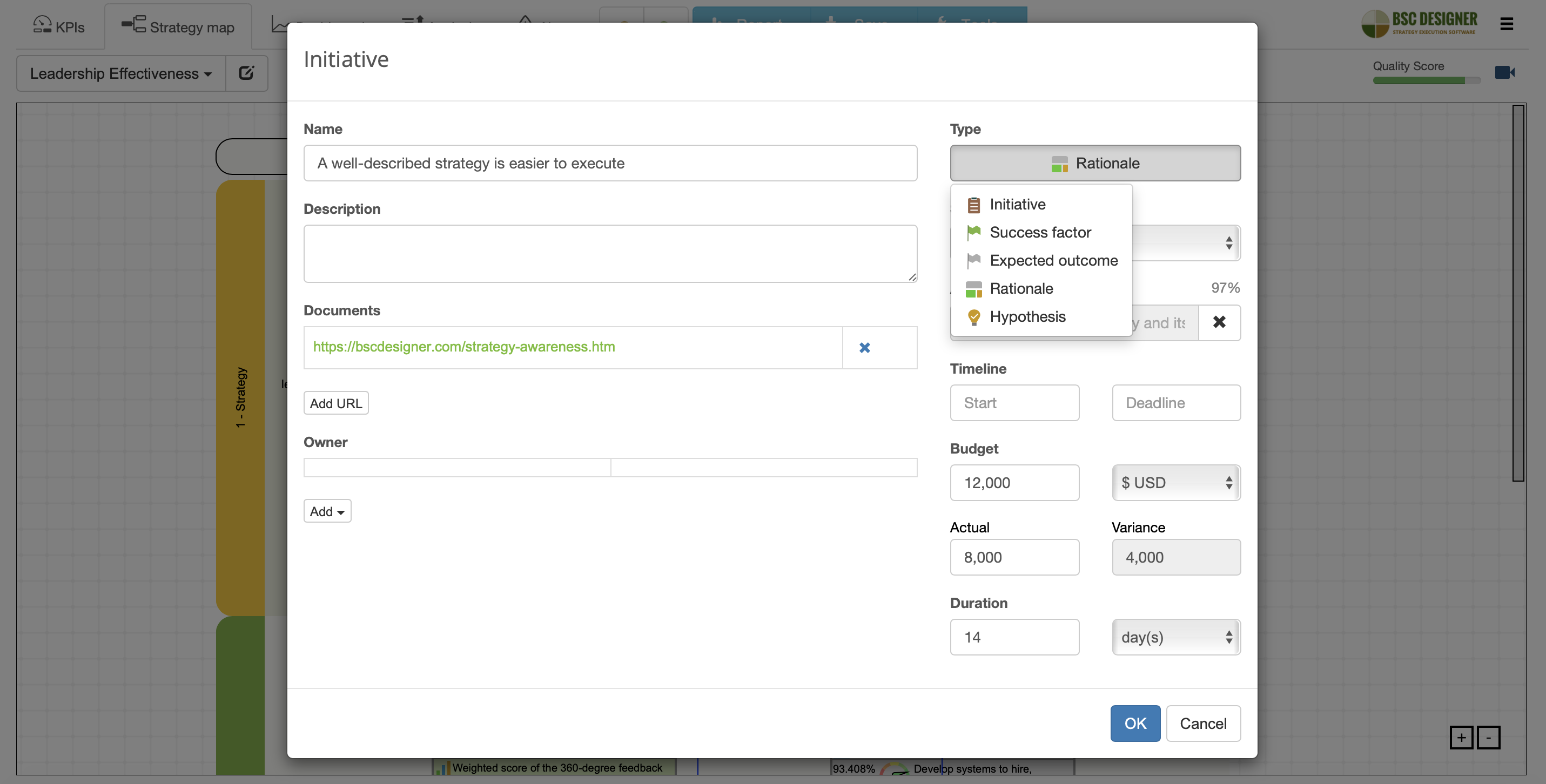
Leadership Effectiveness Scorecard.Besides a detailed description and classical attributes like budget, owner, and timeline, a good initiative includes:
- Rationale
- Success factors
- Expected outcomes
- Progress KPI
At that point, leadership becomes management. A basic metric to start with would be:
- [Binary] Leaders are involved in the discussion of action plans
Before, we discussed the most relevant KPIs for project management. It’s a good idea to pick a few high-level project management indicators and use them to quantify the outcome of leadership efforts.
- % alignment between strategy and action plans. A subjective estimation based on the analysis of recent actions versus strategy and its priorities.
- Internal standards compliance, %
Strategy Awareness
The best strategy will fail if the team doesn’t understand or doesn’t accept it.
Strategy awareness is tricky. It is easy to get a formal score of strategy awareness by doing a simple survey. In this way, you will find out the percentage of team members who know, understand, can repeat or can explain the strategy of the organization.
What is more interesting is to find out if people are actually acting with that strategy in mind.
How to estimate a “real” strategy awareness? Look at the latest crisis situation… To what degree did the actions of your team correspond to the proposed strategy and its values?
This gives us one of the lagging metrics for strategy awareness:
- %, match between actual behaviour and designed strategy
Perspective 2 – Team. Leaders Should Attract and Retain the Right People
What kind of team does your organization need today and will need in the future? How do the most valuable members of your team perceive leadership?
360-Degree Feedback – Find Behaviour Patterns to Be Changed
Start with 360-degree feedback to learn the perception of the leader from different stakeholders. If done correctly, the results of the feedback will become a change plan for a leader.
What are the right questions to ask in the 360-degree analysis? It depends on how leadership is perceived in your organization. You can review the academic studies for some ideas:
- The study Leadership, the Old, the New, and the Timeless: A Commentary3 suggests 14 factors of a good leader, like “Trains and coaches others,” “Provides recognition and support,” “Encourages goal achievement.”
- In the “Essential Behavioral Leadership Qualities” (EBLQ)4, 18 criteria were suggested to assess leadership effectiveness, like “good listening skills,” “knowledge of policies,” “Hardworking.”
A process metric, in this case, might be the number of improvement points found. Beyond basic process metrics, it would be interesting to look at actually implemented behaviours, and later on, the change in the keystone metrics like customer or employee retention.
How to quantify this:
- [Leading] Weighted score of the 360-degree feedback
- [Lagging] Number of improvement ideas
- [Lagging] % of actually changed behaviour patterns
- [Lagging] % customer retention
- [Lagging] % employee retention
Hiring, Onboarding, Promoting – Leaders Transfer Values to HR
Imagine a Venn diagram with two cycles:
- First cycle – current challenges of the organization
- Second cycle – best people to address these challenges
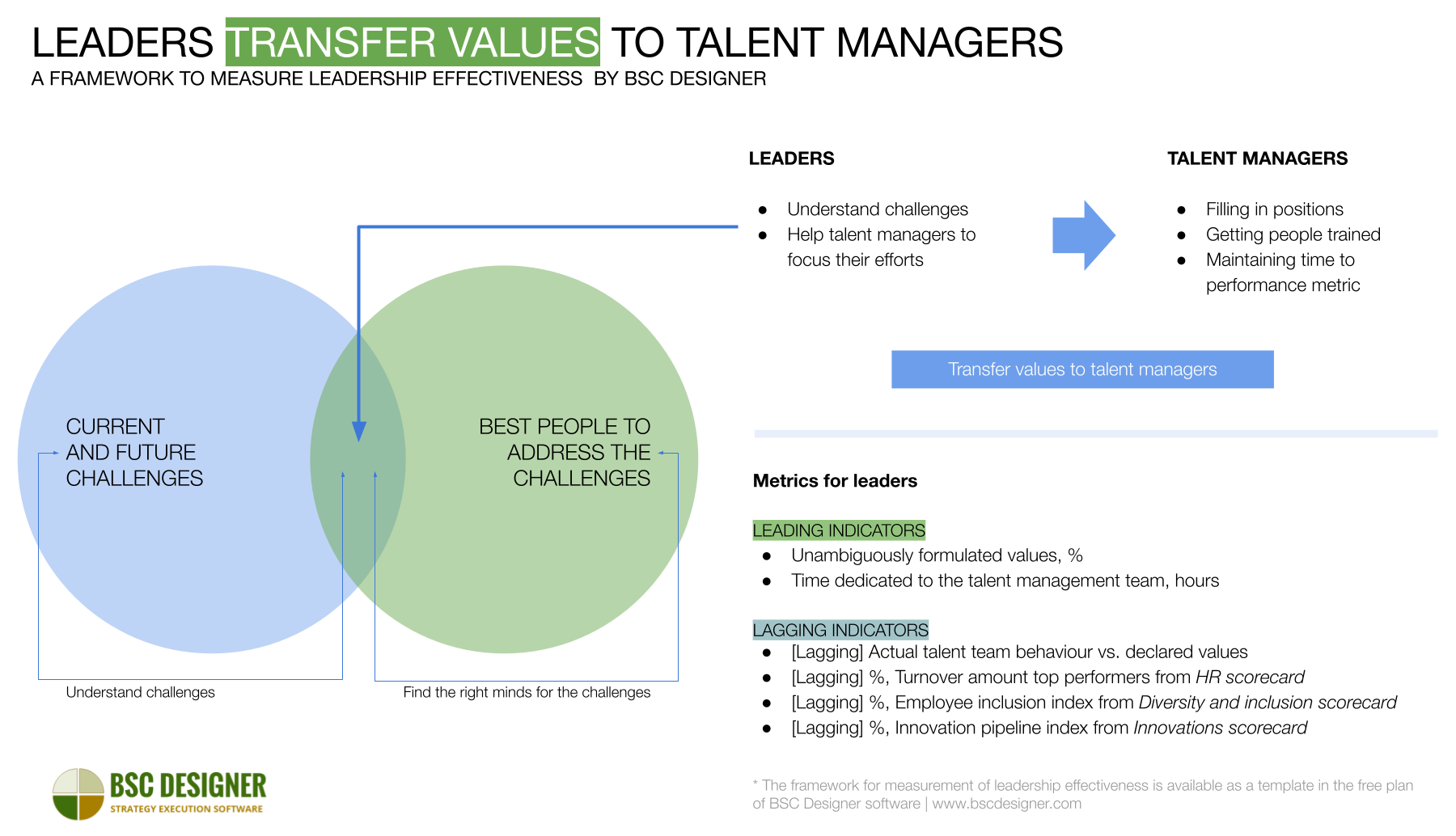
It’s the leader’s responsibility to find an overlap, e.g. understand those challenges and find the right minds to work on the challenges.
In this case, leaders help HR/CEO to:
- Build an effective hiring and onboarding process,
- Find the way to retain and promote the right people, and
- Create a succession plan.
How is the role of the leader different from the role of HR? The impact horizon is different, talent managers are typically responsible for short-term results, like filling in positions, getting people trained, maintaining time to performance metric.
Leaders should set a tone for talent managers and help them to focus their efforts on attracting the right people. The business filters of HR should be adjusted to make it easy for the right people to join the company.
What do those filters like these look like? They are something intangible; sometimes, they are called “values.”
To quantify this, we can use the following metrics:
- [Leading metric] Unambiguously formulated values, %
- [Leading metric] Time dedicated to talent management team, hours
- [Lagging metric] Actual talent team behaviour vs. declared values
How can we estimate that the values are formulated unambiguously? Just start a discussion with your team about the values and their practical application. You will see a lot of improvement points!
For additional lagging metrics, pick a few long-term metrics:
- %, Turnover amount top performers from HR scorecard
- %, Employee inclusion index from Diversity and inclusion scorecard
- %, Innovation pipeline index from Innovations scorecard
Perspective 3 – Growth. Development Plan for Leaders
We discussed the 360-degree feedback that helps leaders understand the perception of their leadership approach by other stakeholders and identify personal blind points. What are the other ways to find improvement points?
Start with an analysis of the existing patterns. How effective were the challenges addressed? Does the leader learn from mistakes?
Suggested metric:
- [Lagging] The number of returning problems
Use Gap analysis to compare the expectations versus reality. The difference is a sign that a picture of the world as seen by a leader is not accurate. What can be changed and improved in the future?
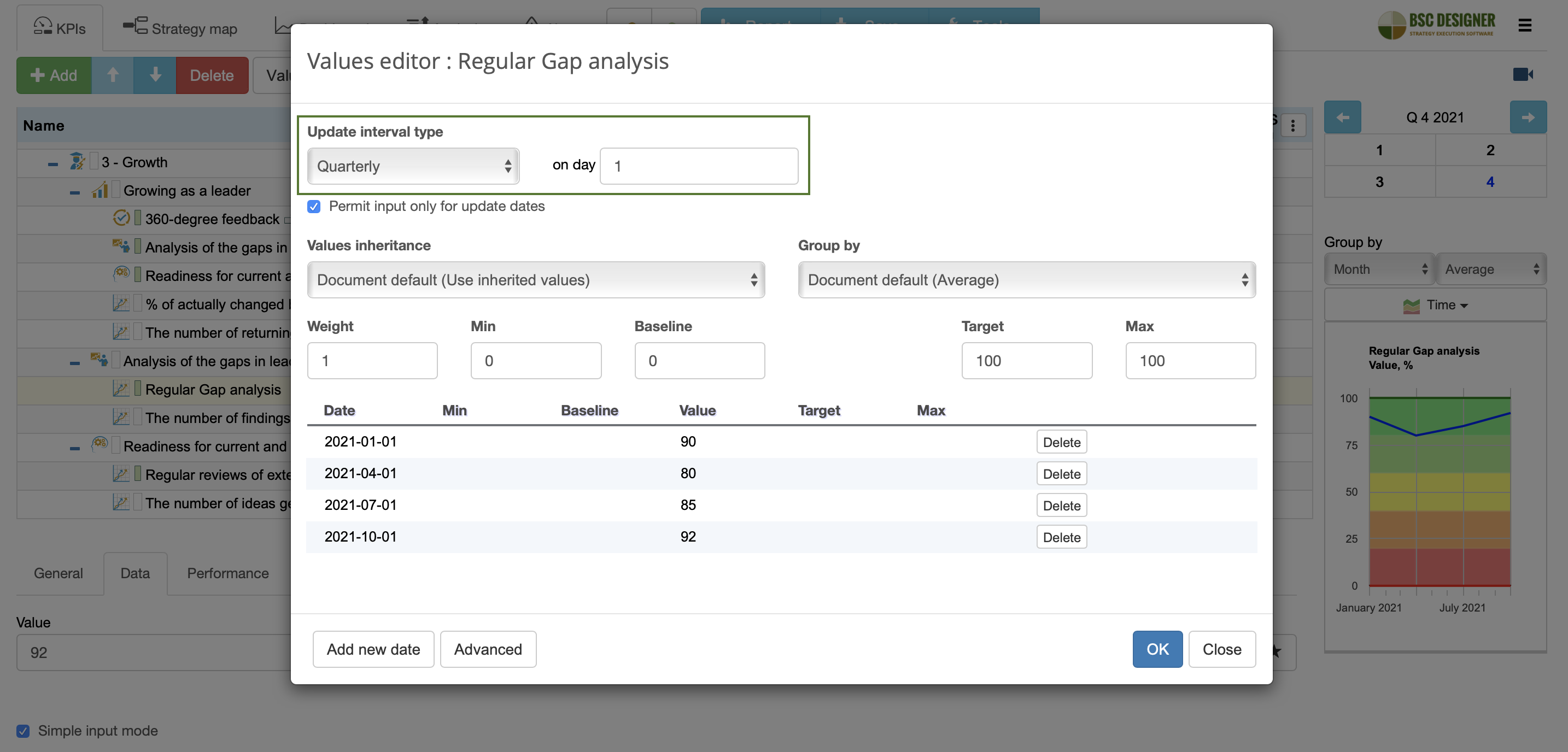
Leadership Effectiveness Scorecard.To quantify this, use these metrics:
- [Leading] Regular Gap analysis (as controlled via update interval of indicator)
- [Lagging] The number of findings of Gap analysis
The business environment is always changing. The readiness of leaders for the new challenges will be a success factor in achieving expected business outcomes. Leaders can use PESTEL analysis to look at the external environment, formulate new challenging tasks for their team, and develop a change plan for their leadership style.
Suggested metrics:
- [Leading] Regular reviews of external factors
- [Lagging] The number of ideas generated
Technical Setup for Leadership Indicators
Indicators for leaders are similar to classical KPIs, and most of the rules that we discussed in KPI guide can be applied.
Convert Binary Indicators into Quality or Performance Indicators
A number of indicators suggested for leaders were binary ones, e.g. indicators with two states:
- Yes/No
- Exists/Doesn’t exist
- Done/Was not done
From the viewpoint of strategic planning, such indicators have low value. To increase their practical usefulness, leaders should convert them into long-term initiatives.
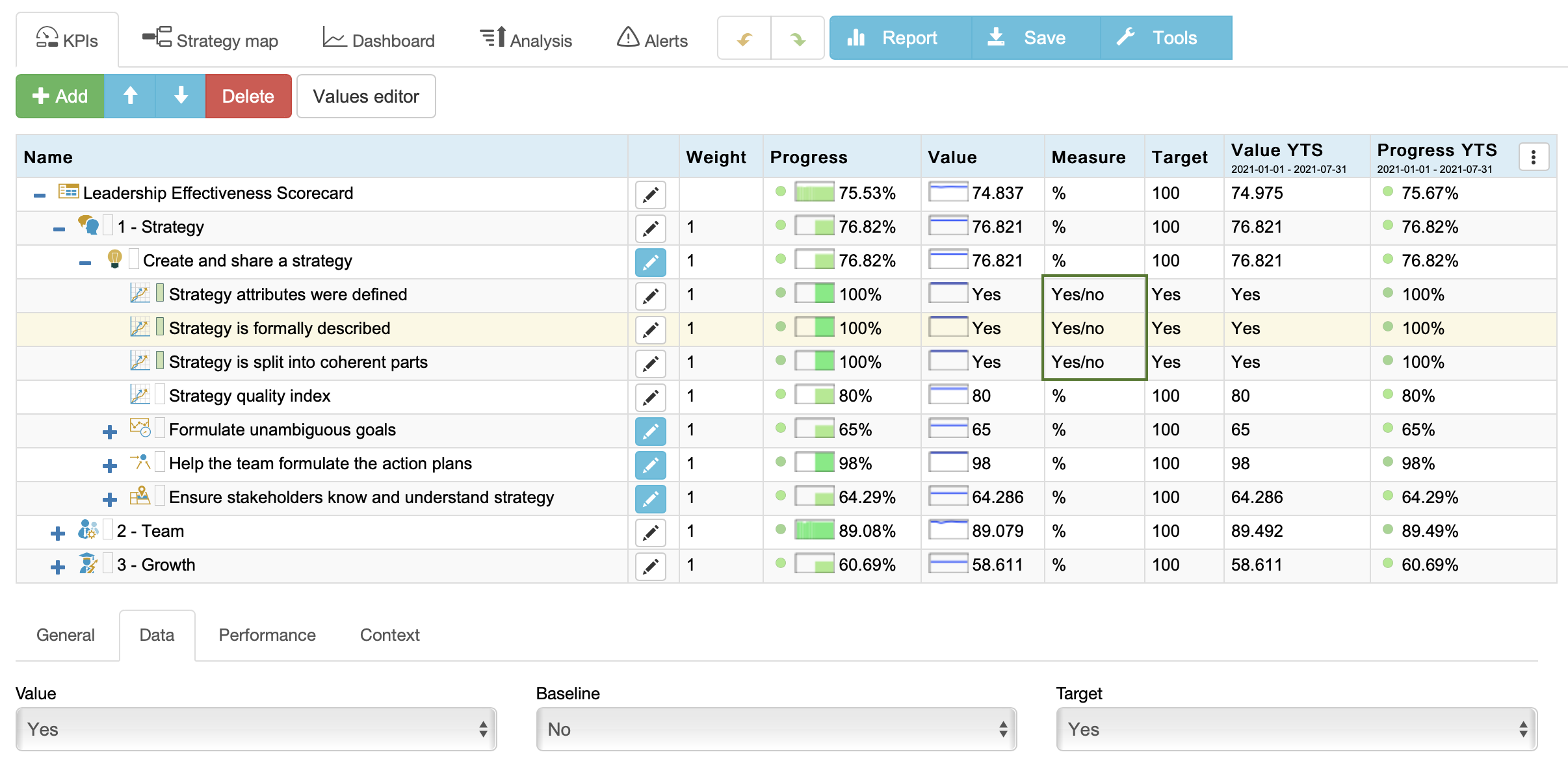
Leadership Effectiveness Scorecard.For example: the existence of a strategy map is a binary indicator.
- A bad practice is to simply mark this indicator as “done” (“yes, we have a strategy map”)
- A better practice is to look at what stands behind this indicator and suggest an improvement plan
In this example, good questions to ask are:
- What kind of strategy map do we have?
- Do the members of our organization need additional training on the topic?
- How can we estimate the quality of the map?
- Is it used regularly?
- What can we do to effectively use this tool?
With these questions in mind, it is easy to convert the binary indicator into a more sophisticated quality or performance indicator. In Perspective 1, you can find an example of how this can be done. If the focus of your performance measurement system is on quality, you will find some relevant ideas in this article.
Trends are More Important than Absolute Value
In this article, we discussed examples of how to quantify certain factors. You can find absolute values for the indicators, like, for example:
- 360 degree weighted score, or
- %, Readiness for a new risk factor
- %, Team happiness index
Those estimations will obviously be very subjective and won’t add much value in the context of understanding leadership better.
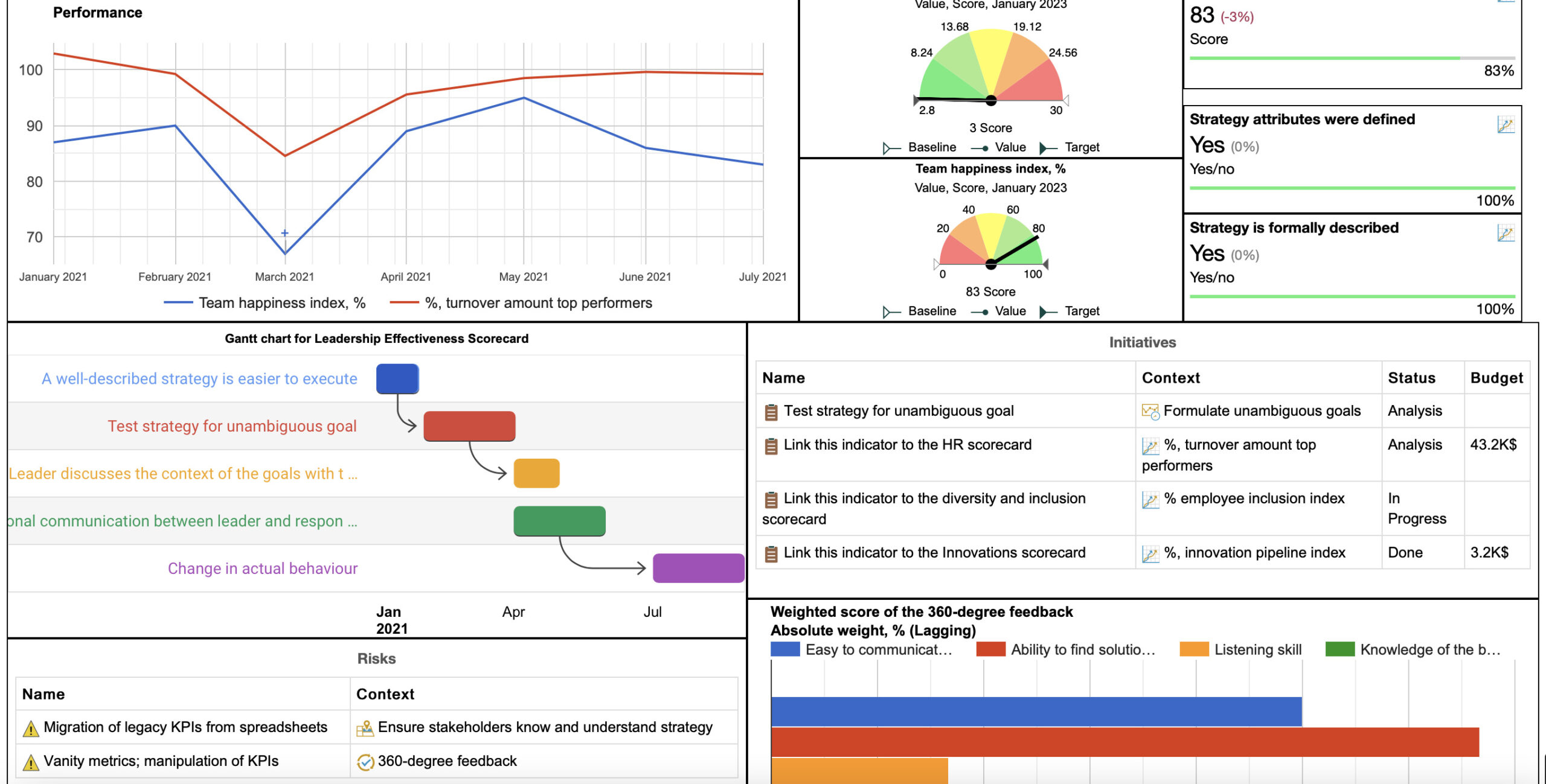
Leadership Effectiveness Scorecard.Instead of simply looking at absolute values, look at them in a dynamic! If the measurement method was consistent, the changes and trends that you will see would be the clues to actual improvement.
Additional information, such as initiatives aligned with specific dates, as on the screenshot above, will help to better understand the cause and effect connection between trends.
Consistent Measurement – Formulas and Update Intervals
In simple words, a measurement is consistent when the approach to measurement is not altered over the monitoring period.
How to achieve consistency in the measurement framework for leadership?
- Describe in detail how the values of the indicator are obtained
- Be specific about the way to normalize the indicator’s value, e.g. what measurement scale and performance formulas are used?
- Record all values to have a possibility to compare with historical data
The benefit of many indicators (like Number of findings of PESTEL analysis) is about a regular review of the indicators:
- Define the update interval for the indicator to make sure the indicator’s value is revised regularly
Learn to Build Weighted Indexes
How to quantify and measure taking into account several factors at once? A common approach is to evaluate those factors one by one and build a weighted index of the states of those factors.
This approach will often be used to measure leadership performance. In the template, you have an example – the Weighted score of the 360-degree feedback metric that is a weighted index indicator of several factors.
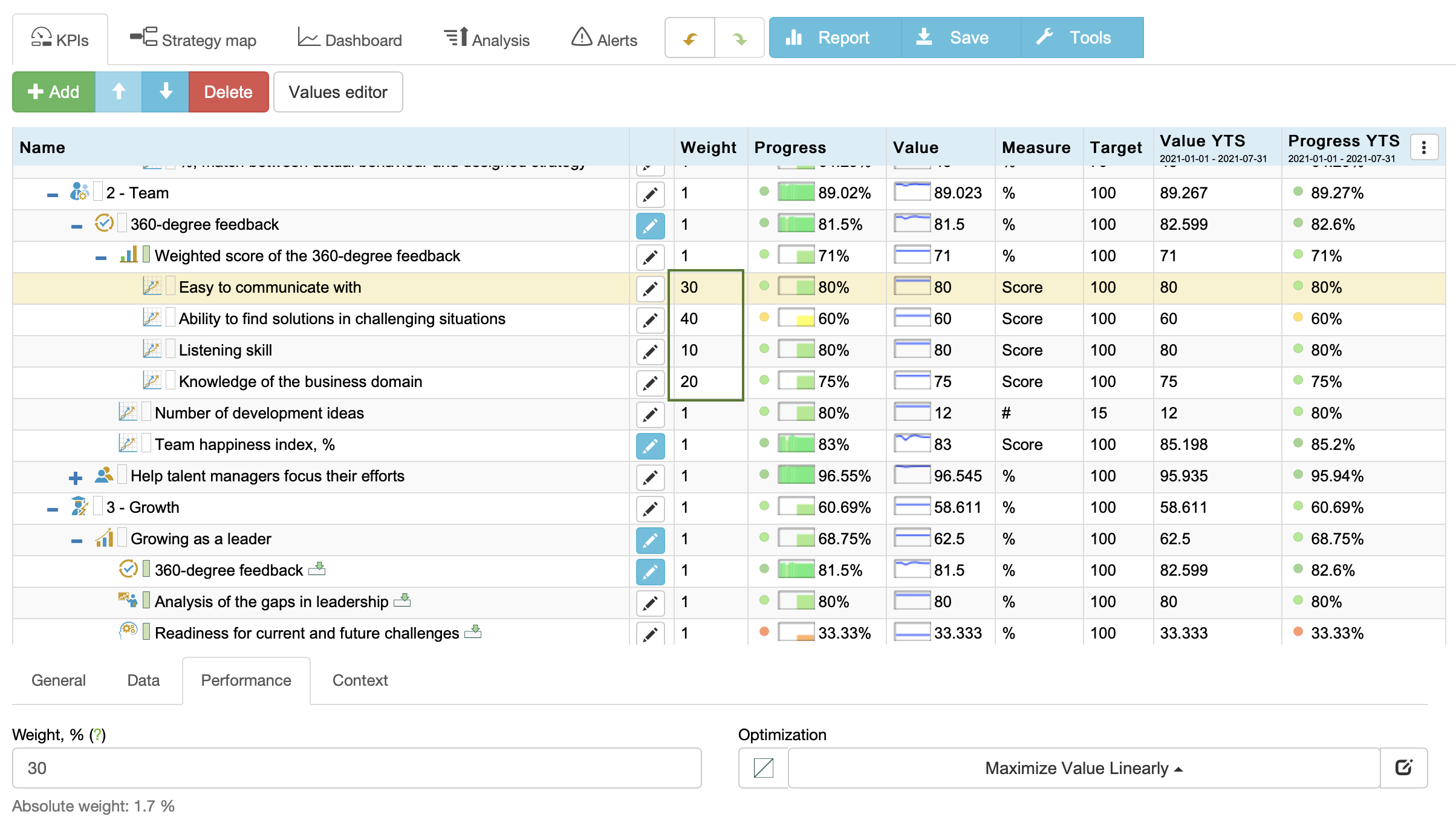
Leadership Effectiveness Scorecard.In that case, the software did all the calculations for us; we only had to assign weights to the factors. If you want to do the math yourself or learn more about calculating weight and building index indicators, check out this article.
Combine Different Scorecards Together
The scorecard for leadership that we discussed in this article should not be a separate measurement tool – it should fit the measurement ecosystem of your organization.
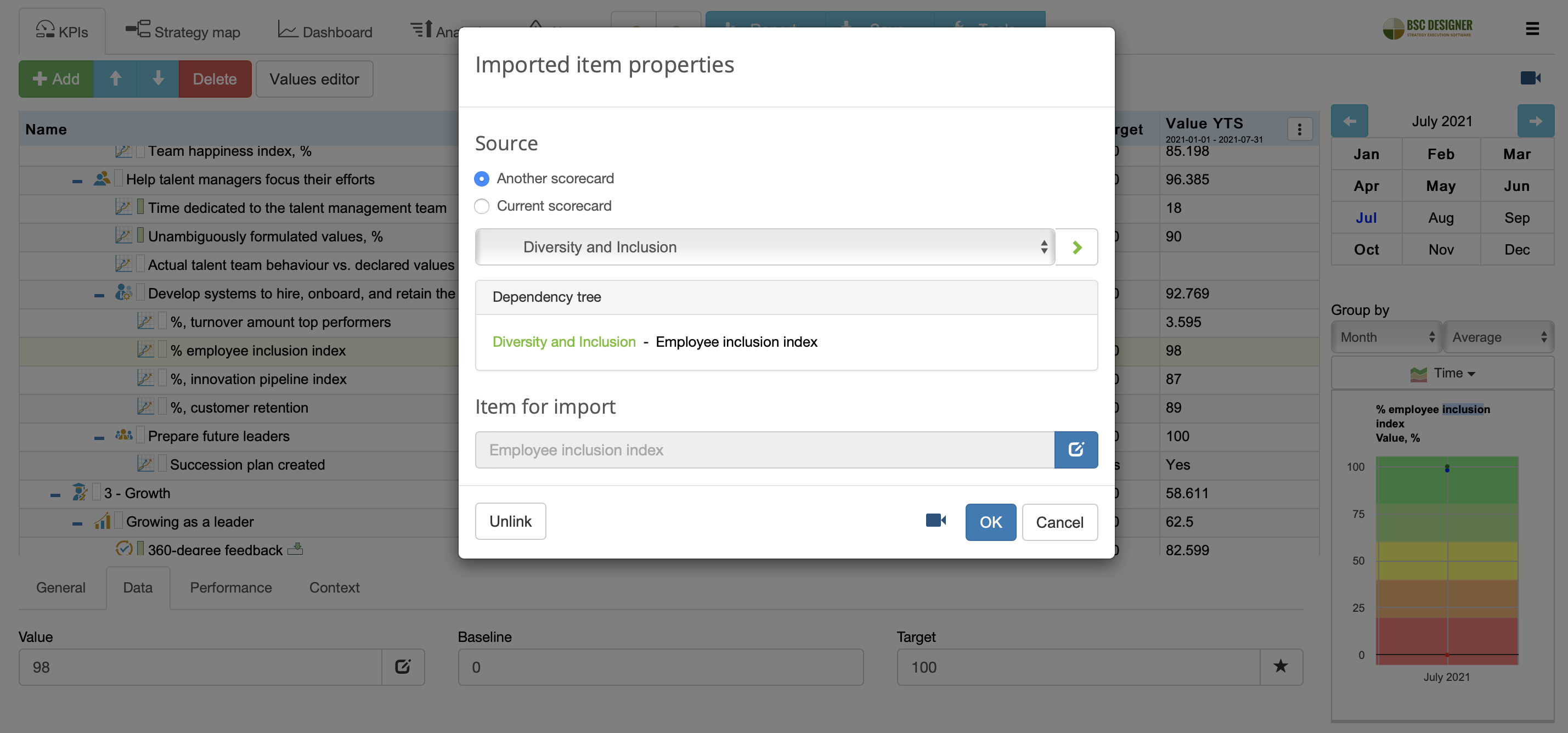
Leadership Effectiveness Scorecard.For example, the leadership scorecard can take data from:
And contribute data to:
Users of BSC Designer have the Data source button next to the KPI’s value that allows selecting indicators from other scorecards as source data.
Executive Summary
With some exceptions, leadership is quantifiable and measurable.
To get started with measurement:
- Invent a definition of leadership that works for your organization, and
- Write down your reasons to measure it.
Quantify leadership effectiveness on these three perspectives:
- Strategy. How effective are leaders in formulating and sharing the strategy (strategy attributes, unambiguous goals, leading/lagging indicators, rationale and action plans, strategy awareness).
- Team. The perception of leaders by different stakeholders (360-degree review). The way leaders focus talent management efforts (hiring, onboarding, promoting, and succession planning).
- Growth. The degree of readiness to the current (based on Gap analysis) and future (based on PESTEL analysis) challenges.
Measuring leadership effectiveness is possible when the measurement framework is comprehensive and consistent:
- Binary indicators are a good starting point, but try to replace them with quality or performance indicators
- Absolute values are nice to have, but the historical values and trends will tell a more complete story
- Update the values of indicators regularly
Do you have some experience in quantifying and measuring leadership? Feel free to share your thoughts in the comments for this article.
What's next?- Follow our
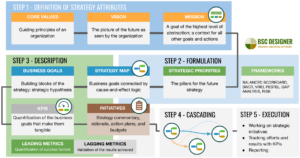
 Strategy Implementation System to align stakeholders, strategic ambitions, and business frameworks into a comprehensive strategy.
 - Automate strategic planning with BSC Designer by organizing goals, initiatives, risks, and KPIs into scorecards.
 Strategy Implementation System
More About Strategic Planning
- Cooper, Fenimore, Nirenberg. “Leadership Effectiveness.” Encyclopedia of Leadership. Ed. . Thousand Oaks, CA: SAGE, 2004. 845-54. SAGE Reference Online. Web. 30 Jan. 2012 ↩
- Can You Measure Leadership?, Robert Gandossy and Robin Guarnieri, MIT Sloan Management Review, 2008 ↩
- John Campbell, Leadership, the Old, the New, and the Timeless: A Commentary The Oxford Handbook of Leadership, 2012 ↩
- Oyinlade, A. Olu, A Method of Assessing Leadership Effectiveness: Introducing the Essential Behavioral Leadership Qualities Approach, Performance Improvement Quarterly, v19 n1 p25-40 Mar 2006 ↩

 CEO | Author | Speaker
BSC Designer is strategy execution software that enhances strategy formulation and execution through tangible KPIs. Our proprietary strategy implementation system reflects our practical experience in the strategy domain.